Greener bulk logistics for Baltic steelmaker
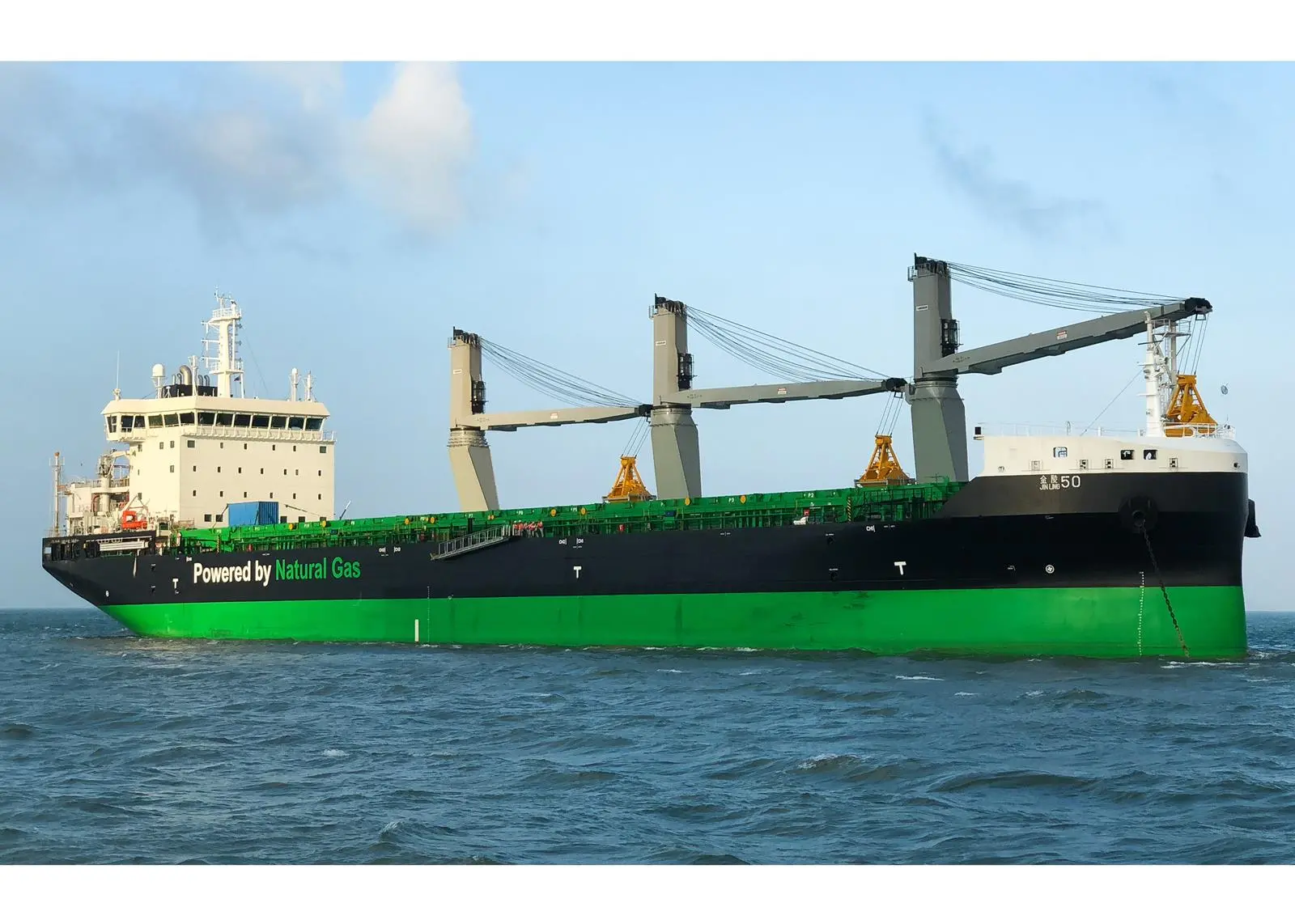
Distinguished as the first-ever bulkers in the handysize category to be LNG-fuelled, the EUR60m (US$70m) pair was ordered on the strength of a long-term frame agreement with Swedish-Finnish steelmaker SSAB covering cargo flows to plants around the Baltic coast.
European public funding has helped realise the newbuild scheme, as a pivotal element of the Bothnia Bulk joint industry project (JIP). The primary aim of the JIP, co-sponsored by the EU via its Connecting Europe Facility (CEF) transport programme, has been to establish a more energy conserving, low-emission, year-round movement of bulk material between Lulea (Sweden), Oxelosund (Sweden) and Raahe (Finland).
The pact between SSAB and ESL entails the shipment of some 6-7 million tonnes of bulk material per annum, to enable mutual, long-term gains to be achieved in efficiency and reduce logistic costs, while raising the environmental bar so as to ensure legislative compliance and meet corporate agendas.
Each of the newbuilds has dual-fuel machinery throughout, both for propulsion and auxiliary power, maximising the use of ‘clean-burning’ LNG at sea and in port. Furthermore, the capability to draw electricity from the shoreside grid when alongside will contribute to the ships’ reduced, overall carbon footprint compared to existing vessels.
The main engine is a five-cylinder model of MAN’s G45ME-C9.5-GI (gas-injected) two-stroke design, rated for a maximum output of 6,000kW.
By means of a permanent-magnet shaft generator operating in regular power take-off (PTO) mode, up to 700kW can be delivered to the ship’s electrical system while at sea without recourse to the gensets. The system will also function in power take-in (PTI) mode, energised by the auxiliary generators to serve as an electric motor acting directly on the shaftline to provide 1,250kW of boost power, and a total 7,250kW, for navigation in difficult ice conditions.
The arrangements meet criteria for Finnish-Swedish 1A ice class certification, while also resulting in optimised fuel consumption in open-water sailing.
The new generation is based on a Deltamarin-developed design, and the combination of gas fuel with energy saving technologies, meticulously-considered hull form and appendages, rudder and propeller arrangements, and operational practices, is intended to yield a 50% cut in CO2 emissions per tonne of cargo carried relative to current vessels.
Each ship is laid out with three holds, plumbed by three, port side mounted deck cranes to ensure complete cargo handling self-sufficiency.
For the positioning voyages, ESL laid plans for both ships to transit the Northern Sea Route (NSR) through the Russian Arctic. In each case, the vessels were fixed to load cargoes in Japan to be discharged in the Baltic region, proceeding via the Arctic seaway during the comparatively clement early autumn period.
ESL said that the NSR routing offered a saving of nearly three weeks’ passage time relative to voyaging by way of the Panama Canal, with attendant, substantial reductions in fuel usage and emissions. Haaga was expected to arrive in the Baltic by the second half of September, with Viikki to follow at the end of October.
PRINCIPAL PARTICULARS—HAAGA/VIIKKI
|
Length overall |
160.00m |
|
Length bp |
157.04m |
|
Breadth |
26.00m |
|
Depth, moulded |
15.01m |
|
Draught |
10.00m |
|
Gross tonnage |
19,955t |
|
Deadweight |
25,532t |
|
Hold capacity |
33,304m3 |
|
Deck cranes |
3 x 37.5t (hook)/30t (grab) |
|
Main engine power |
6,000kW |
|
PTI (boost) power |
1,250kW |
|
Thrusters |
1,000kW (bow) + 700kW (stern) |
|
Class |
DNV GL |
|
Ice Class |
1A |
|
Flag/Registry |
Portugal/Madeira |