



MHI new axial flow turbocharger series
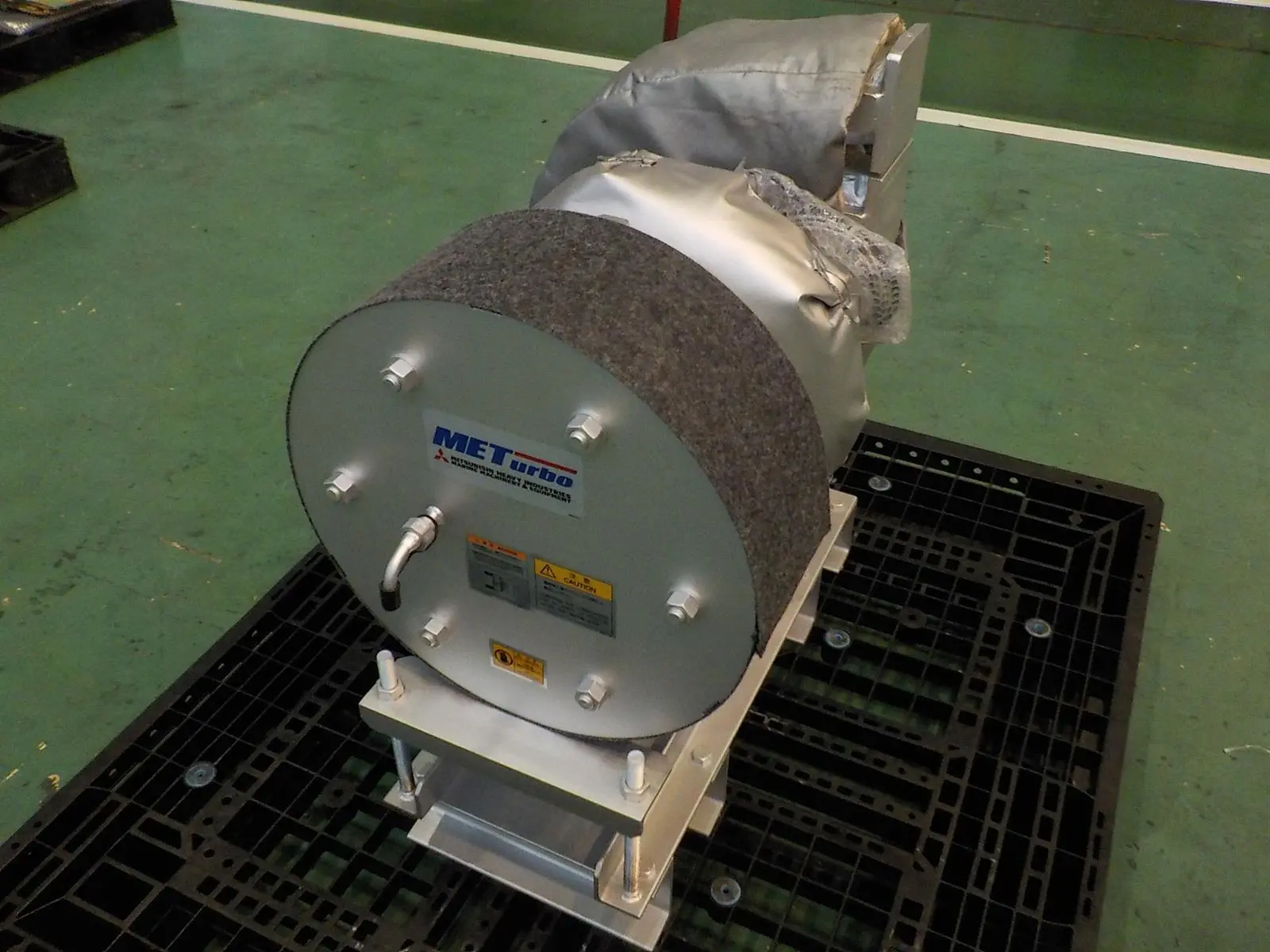
The turbocharger manufacturer continues to occupy a strong position in the global turbocharger market for two-stroke engines, with a market share of around 40%.
Mr. Yoshikazu Ito, team leader of the two-stroke design team, told The Motorship that the approvals from the engine designers “were under discussion with a positive attitude”, and that the new turbocharger series is expected to be launched commercially next year.
The MET-MBII series will consist of 10 models and that one turbocharger unit will be able to cover engine output from about 3,400 kW to 45,000 kW.
Design advances
The MET-MBII series features a new compressor impeller, with an optimised blade count and blade angle distribution. The number of blades was changed from the current combination of 11 whole and 11 splitter blades to 7+7 blades.
This has permitted a 16% increase in air flow rate, while maintaining the same body size, piping connection, footprints and turbocharger efficiency of the conventional model, MET-MB. MHI maintains the MET-MBII series offers turbocharger downsizing, weight reduction, cost reduction and space saving.
The compressor map has been widened thanks to several new innovations, while the maximum compressor pressure ratio is 5.0 for the MET-MBII series. The bearing diameter and the rotor shaft diameter were reduced compared with the MET-MB, permitting higher speed without an increase in bearing temperatures.
The MET turbocharger has redesigned the gas labyrinth on the turbine side, increasing the area where the seal air pushes on the turbine side, in order to reduce the increased pressure on the compressor side thrust bearing.
The previous MET-MB series’ turbine has also been replaced with a newer model featuring an optimised distribution of turbine blades.
The new design would reuse several components from the MET-MB turbocharger casing design, with the exception of the silencer, which would help ensure easy maintenance.
“This has been a trademark feature of MET turbochargers,” Ito noted, adding that the optimised design had also lowered the cost of production.
The new series offers particular advantages for conventional engines fitted with high pressure EGR systems, which could benefit from wide air flow range compressors. The new series was also suitable for the increasing number of dual-fuel engines entering service, which also had special requirements for air-flow at higher loads.
MET-ER series
Meanwhile, MHI also unveil a new generation of its radial turbocharger for four-stroke engines (MET-ER) in Vancouver.
The MET-ER series is to be launched into the market later in 2019 once tests with engine manufacturers are concluded. Preliminary results from engine tests indicate that the MET-ER series turbocharger will offer higher efficiency and consequently fuel and NOx emission savings compared with the MET-SRC series.
The MET-ER series can support a maximum compressor pressure ratio of 6.0, an increase on the previous MET-SCR generation of turbochargers, by implementing a new type compressor with optimized blade height and angle distribution.
The transient response was improved by about 25% compared with the existing MET-SRC series by developing a new-type turbine wheel that reduces the inertia of the turbine by making its diameter smaller while maintaining the flow rate and high efficiency.
Each frame size was optimised, with the space requirements for a turbocharger suitable for use with a 1,000 kW engine reduced by about 40% between the MET18SRC and the MET16ER.
The number of parts has also been reduced by around 30% between the two series, improving the turbocharger’s ease of maintainability.
“Customers will be able to opt for models that are between one and two frame sizes smaller than existing turbochargers,” Yushi Ono, Senior Deputy Manager of the Four-Stroke Team told The Motorship.
The series features seven types, and a single turbocharger can handle engine outputs from 500 kW up to 5,800 kW.
The series builds on the previous MET-SR, MET-SRII and MET-SRC series, of which around 15,000 units have been delivered. The MET-SRC series has gained a particularly strong position in the domestic Japanese market, but the company expects the new series ease of maintenance, optimised design and ease of overhaul to attract increased attention from engine manufacturers in China and Korea.
Related Articles
 2-STROKE & 4-STROKE
 TURBOCHARGER
 TURBOCHARGER