



Korean Register in joint scrubber research projects

The low-speed project is seeking to develop a commercially viable high efficiency combined NOx and SOx scrubber by the end of 2023. The same target has been set for a low back pressure electrostatic precipitation system for medium-speed engines, while the project includes a third project, targeting high-speed engines in marine applications.
June-Sung Park of Korean Register announced the research project during the Kormarine conference in Busan in October 2019, noting that the port of Busan was among the ten ports with the highest levels of particulate matter (PM).
He noted that while black carbon was not currently subject to regulation, such measures were being discussed at the IMO in the context of emissions in the Arctic Circle.
The Ministry of Oceans and Fisheries (MOF) had announced the project in late January. The low-speed simultaneous reduction project is to receive KRW8.9 billion (US$7.5 million) over the next five-year period, while the medium speed electrostatic precipitation will receive US$4.3 million in funding.
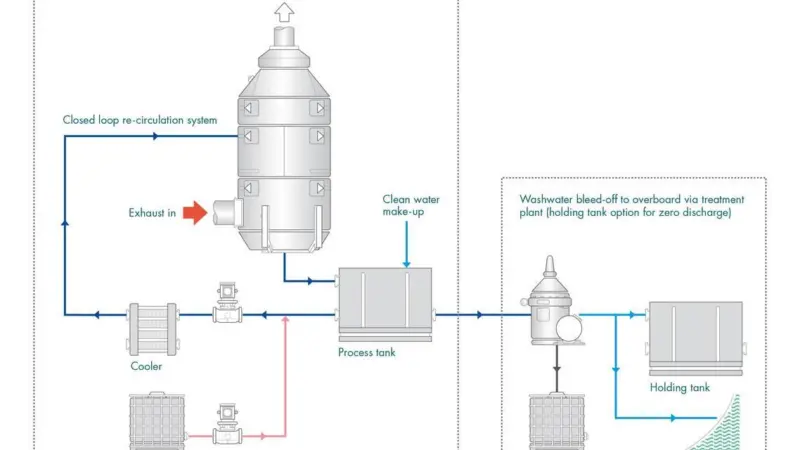
The simultaneous reduction process would add an additional “ion agglutination” step into an existing scrubber, employing an electrostatic process to encourage water droplets and PM molecules to combine. Park explained that the exhaust gases would then be oxidised using an unspecified chemical, targeting removal efficiencies of 80%+ for NOx and 95%+ for SOx. The resultant NOx is water-soluble and would be removed in the wash water.
The system was expected to be eligible for a Engine International Air Pollution Prevention (EIAPP) certificate, ensuring full compliance of the combined system under MARPOL Annex VI, meeting Tier III NOx emission limits. The SOx emissions would be certified by an International Air Pollution Prevention (IAPP) certificate.
KR has also joined forces with one of its partners, Gunsan University, to establish and build a test facility to meet increased demand.
The test facility is in the process of being built, and will be complete by end-2020. It will offer a total testing capacity for four test beds, of which one will feature a MAN 6S46MC engine, and another a MAN 6L27/38 medium-speed engine.
Related Articles
 EXHAUST GAS CLEANING SYSTEMS
 EXHAUST GAS CLEANING SYSTEMS
 EXHAUST GAS CLEANING SYSTEMS