



Maersk to trial first containerised battery system on boxship
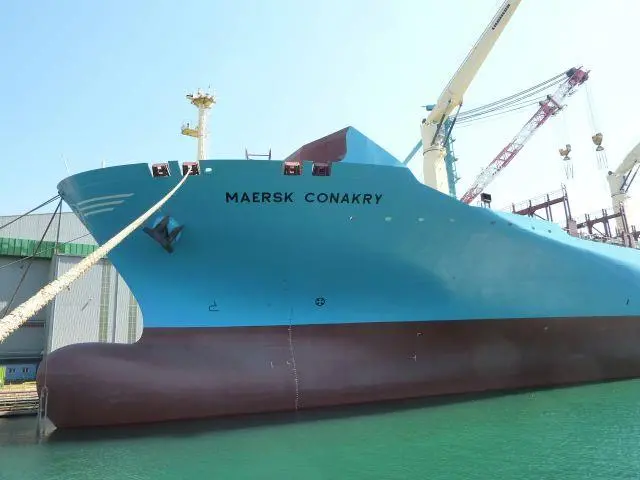
“This trial will provide a greater understanding of energy storage that will support Maersk in moving towards further electrification of its fleet and port terminals. Maersk will continue to facilitate, test, and develop low-carbon solutions on our journey to become carbon neutral by 2050,” explains Søren Toft, Maersk COO.
The battery system will be used to improve the efficiency of the vessel’s onboard electrical systems, reducing demand on the Maersk Cape Town’s generators. By maintaining the vessel’s auxiliary generators at a more optimal load, and avoiding running generators when not needed, overall fuel consumption can be reduced.
Additionally, it will support the generators with up to 1,800 kVA of power during rapid changes in electrical load such as thruster operation. This can reduce generator maintenance requirements. The battery system is also capable of providing redundant power, which can improve reliability at sea by ensuring continuous power supply.
The Maersk Cape Town, in common with a number of other Maersk containerships, includes a waste heat recovery system. The system allows the batteries to charge by capturing electrical energy from heat that would otherwise have been lost out of the exhaust gas system for the main propulsion.
“This exciting pilot – the first of its kind in the industry – will show the potential of battery technologies to keep improving the performance of our vessels while also reducing fuel consumption in our non-propulsion electrical systems,” reinforces Ole Graa, Maersk Head of Fleet Technology.
The Motorship notes that equipping reeferships with batteries represents a promising area where batteries could offer fuel efficiencies in the deepsea sector.
The containerized battery energy storage system has been manufactured in Odense, Denmark by the system integrator and turnkey supplier Trident Maritime Systems. The battery system will be shortly transported to Singapore and installed on board the Maersk Cape Town.
The first full voyage with the new system in place will take place next year and will be closely monitored to evaluate the performance of the system against the trial’s ambitions.
Battery modules will be operating within the container in conjunction with other electrical and control components. Maersk has also worked in close collaboration with the American Bureau of Shipping – the vessel’s classification society – to ensure safety and compliance.
The vessel is a one of a series of 22 container ships built to sail between West Africa and East Asia and was delivered in 2011.
Auxiliary engines comprise two 3,000kVA HHI model HFJ7 716-84K and one 2,200kVA HHI model HFJ7 638-84K. The vessel is equipped with a waste heat recovery system, saving up to 10% of main engine power.
Principal dimensions – Maersk Cape Town
Deadweight: 61,614dwt at 13.5m draught
Gross tonnage: 50,869tons
Length overall: 249.10m
Beam: 37.40m
Draught: 13.50m
Carrying capacity: 4,500TEU
Reefer capacity: 150 plugs
Main engine: 1 x 23MW HHI-built MAN B&W 6S80ME-C9 low- speed diesel engine
Auxiliary engines: 2 x 3,000kVA HHI model HFJ7 716-84K
1 x 2,200kVA HHI model HFJ7 638-84K
Related Articles
 ELECTRIFICATION AND BATTERY HYBRIDS
 ELECTRIFICATION AND BATTERY HYBRIDS
 ELECTRIFICATION AND BATTERY HYBRIDS