



Corvus ESS for hybrid crew transfer vessel
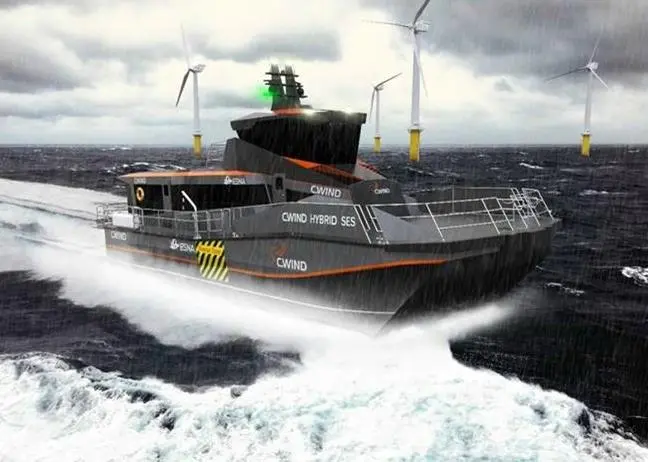
The development of the 22m hybrid SES is in response to an industrywide push to develop technologies that reduce CO2 emissions whilst cost-effectively servicing offshore wind farms. The vessel design has been developed in partnership with the operator CWind and ship design company, ESNA.
Trygve Halvorsen Espeland, naval architect at ESNA, explained the advantages. “We see that hybrid propulsion in vessels like offshore wind crew transfer vessels enables a greener footprint and multiple benefits for the vessel owners,” he said.
“The vessels have the benefit of range with the combustion engine, while the batteries provide both increased speed with power boost, peak shaving and reduced fuel consumption. The vessel design will accommodate further developments in hybrid propulsion and battery technology, ensuring it has the capability of being developed into a totally carbon-free solution in the future,” he added.
The vessel is designed with two catamaran hulls, a closed area between and an inflated rubber bag in the stern which supports up to 80% of the vessel weight when filled with air. The remaining 20% is supported by hull buoyancy. Less hull resistance enables higher vessel speed and less wave contact gives reduced motion for the crew.
The vessel will be built at Wight Shipyard in the UK and is expected to service the Borssele 1 and 2 offshore wind farms located 23 kilometres off the Dutch coast from mid-2020.
Related Articles
 ELECTRIFICATION AND BATTERY HYBRIDS
 ELECTRIFICATION AND BATTERY HYBRIDS
 ELECTRIFICATION AND BATTERY HYBRIDS