MAN ES targets 4-stroke DF methane slip reductions
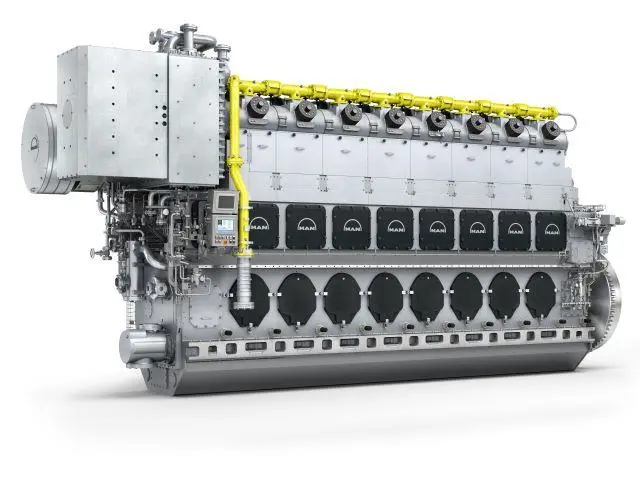
The paper also outlined the company’s commitment to bearing down on methane slip from its low-pressure dual-fuel four-stroke engines – including developments in oxidation catalysts and research into applying direct gas injection to its four-stroke portfolio.
Diesel Cycle combustion for 4-strokes
MAN Energy Solutions is investigating the possibility of adapting the direct gas injection technology employed in its ME-GI two-stroke engines to its Otto Cycle four-stroke Spark Ignition and Dual-fuel engines.
The solution would reduce the methane slip level from its four-stroke dual-fuel engines by up to 90%, the engine designer and manufacturer announced in a new white paper.
By injecting gaseous fuel with the diesel-fuel pilot into the compressed charge air at around top dead centre, the possibility for methane to escape during the four-stroke cylinder scavenging process is largely reduced.
The direct injection solution presents considerable engineering challenges and requires much higher gas inlet pressures. The gas compressor would need to be upgraded to accommodate the higher pressures compared with MAN’s existing four-stroke Otto gas engines, the additional cost would be offset by fuel consumption efficiencies (and lower greenhouse gas emissions). The solution would effectively convert the engines from Otto Cycle combustion engines to Diesel Cycle combustion engines.
The solution, which is being assessed by MAN’s engineers, will be ready for application “when the market demands it”, MAN ES said.
Oxidation catalysts
A second technological solution to reducing methane slip for MAN ES’s four-stroke SI and DF engines is also being developed.
The application of oxidation catalysts to the exhaust gases from a four-stroke engine could cut the methane slip level from MAN ES’ 4-stroke dual-fuel engines by 70%, the engine designer and manufacturer also discussed in the paper.
The solution is the subject of a Federally-funded German research project, IMOKAT, in which MAN ES is participating. The solution requires high exhaust gas temperatures to function effectively and needs to be applied after the wastegate and before the turbocharger.
Laboratory tests with synthetic exhaust gas have achieved 70 % methane conversion rates, the company noted. The next step will be tests on a full-size engine.
Combustion chamber, injection and valve timing
MAN ES noted that methane slip levels had already been reduced in the latest generation of engines. This involved all the major aspects of internal engine design, such as application engine operation; combustion processes and their control; and basic engine architecture refinements.
These solutions are being applied to new four-stroke DF engines as well as conversions to run on LNG.
MAN notes that one area of focus is on the timing of gas admission and valve overlap duration. The overlap is the time that inlet and exhaust valves are open at the same time. This is often used to allow partial cooling of engine components between the combustion cycles – to reduce NOx formation – but it also improves scavenging as the incoming charge air assists the removal of the remaining exhaust gas in the cylinder. So while this helps with cooling, it also exacerbates methane slip. Working on reducing overlap time, both through the engine control system and the valve train, will minimise methane slip.
The design of the combustion chambers has been altered to reduce the cooler spots in the combustion chamber, along with crevice volumes where unmixed methane can escape combustion.
For example, MAN has raised the position of the piston ring to reduce the height of the “top land” (or area above the top piston ring on the piston crown) to reduce the crevice volume, increasing the rate of combustion efficiency.