LNG-FUELLED TANKER DESIGNED FOR LOW COST CO2 CARRIAGE
The companies are targeting the growing number of carbon capture and storage (CCS) projects slated globally, and the design is based on technology proven in the LPG & LEG market, a cargo the tanks and tankers are also designed for with only minor modifications to the cargo handling system.
While transported CO2 is already used by the food and drink industry, David Gunaseelan, Vice President of Sales and Marketing at Høglund, anticipates that, in the near term, the bulk of the captured CO2 will be shipped will be sequestered underground, probably offshore as part of carbon, capture and storage chains. “With the global economy facing more pressure to reduce its carbon emissions, we must develop the technology for a viable CCS chain and new ways of solving the complex challenges that come with upscaling CO2 transportation,” he says.
Currently, the maximum capacity for transporting liquefied CO2 by ship is approximately 3,600cbm, or roughly 1,770 tonnes, in dedicated CO2 tankers predominantly operated by specialist shipping company Larvik Shipping. However, as CCS chains develop, maritime transportation capacity needs to increase significantly, requiring innovation in tank design and cargo handling systems, says Gunaseelan.
At this stage, Gunaseelan doesn’t believe the market is focussing on using the CO2 as feedstock for new industrial processes due to the potential impurities, including particulates, oxygen, nitrogen or other impurities, that could be in the gas captured from existing manufacturing plants. However, designing the tank and cargo handling system for both CO2 and LPG alleviates any concerns about impurities in the CO2, as LPG tankers are designed to carry a range of cargoes, including compressed natural gas, propylene and ammonia.
Doubling tank capacity
Norway-based Høglund is an automation, gas, hybrid and system integration specialist, and Germany-based HB Hunte Engineering offers marine design and engineering services. The companies have worked together on a range of projects in the past, and this time they are collaborating on the gas handling system, onboard cargo handling, integration and automation for an 8,000cbm CO2 storage tank.
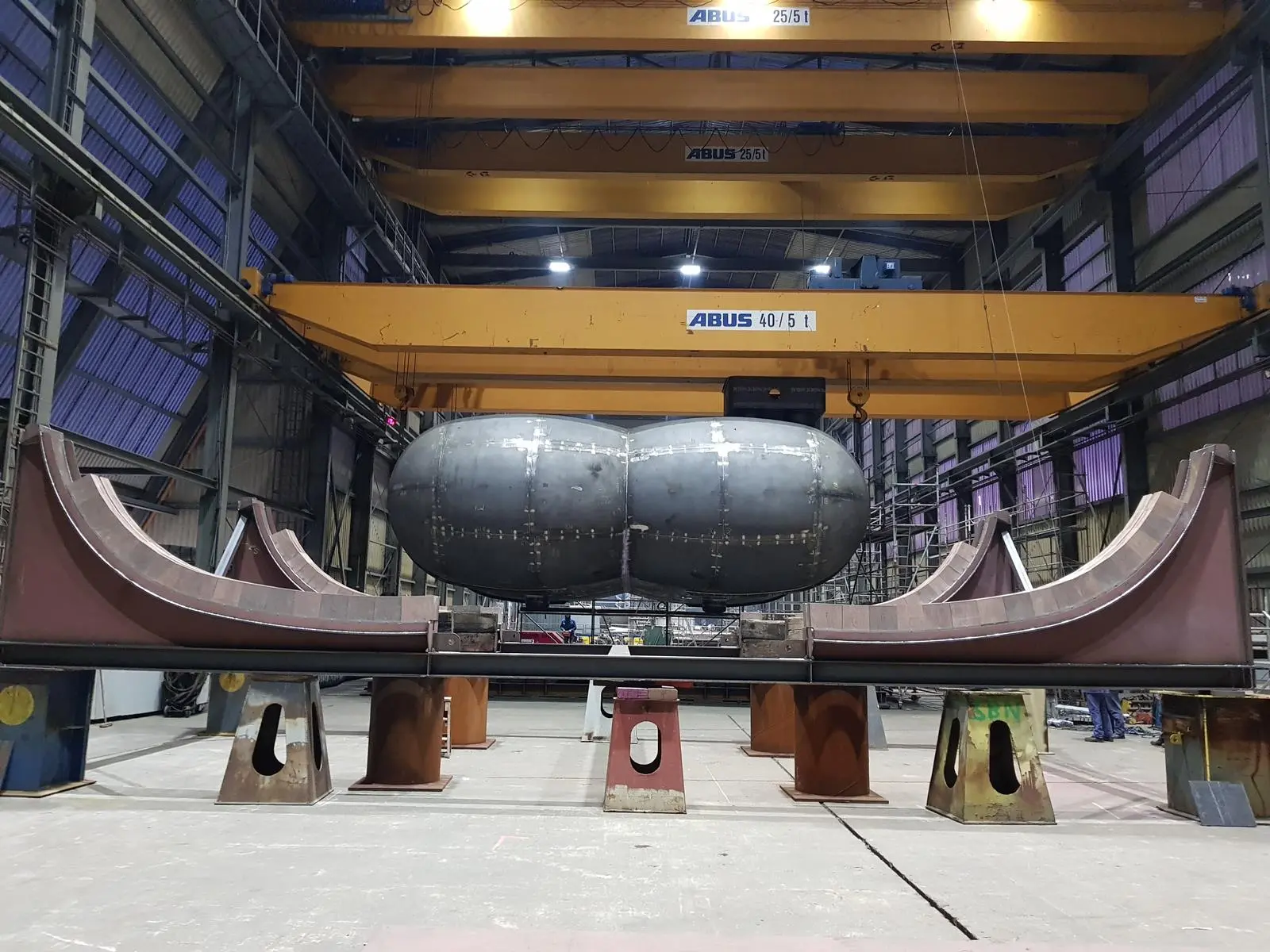
This new bi-lobe single-shell Type C cargo tank system more than doubles the current vessel capacity for transporting liquid CO2 without the size, weight and stability concerns that would have come from an equivalent capacity mono-lobe setup, says Gunaseelan. The tank shape has already been manufactured in Asia and Europe and used on sailing LPG, liquid ethylene gas (LEG) and LNG tankers. The project partners undertake the detailed design, then work with tank manufacturers to conduct inspections. IGC Code-compliant tanks can be made from steel alloys P690, VLF550 or A645 using existing fabrication processes. This allows the production of a solution which is substantially lower cost and risk than conventional very large diameter cylindrical tanks of the same capacity, he says.
Key to the 37-metre long, 2.4-metre diameter tanks designed for the new tanker is the pressure required to keep the CO2 in a liquid state. The CO2 needs to be kept at around -35C and 15 bar, and this can necessitate very thick tank walls in a mono-lobe design. The bi-lobe design avoids this and at the same time, the 663-ton tanks assists in vessel stability, reducing or eliminating the need for ballast water to keep the vessel stable.
The tank design requirements differ from those for LNG which can be kept in a liquid state at lower pressures, for example in a Type C tank at 3.5 bar. “If you’re transporting CO2 at around 15 bar, you need to have a safety margin. So, the tank is designed for 19 bar, and when you increase the pressure like that, the thickness of the tank increases,” says Gunaseelan.
Operational safety has been paramount in the design process. Pressure differences that could occur during cargo handling as the result of a leak or release could be great enough to cause CO2 gas to freeze (sublimate) and form dry ice that then blocks pressure relief valves. “In the worst-case scenario, a whole tank could turn into ice,” says Gunaseelan, referring to the catastrophic failure of a 30cbm, 6.5-meter long and 2.6-meter diameter CO2 tank at a citrus processing plant in Germany in 1988. Three people were killed and another 10 injured. Tank fragments weighing over 100kg were thrown over 500 metres from the explosion site. The failure was attributed to an over-pressure resulting from an internal heater failure, the failure of a relief valve as it was blocked by ice and the absence of an over-pressure alarm.
The cargo handling system developed by Høglund is designed to prevent ice formation and to enable cargo discharge even in the unlikely event that the tank’s two deep-well pumps were to fail. The tank is insulated with about 200mm of sprayed polyurethane, and the company has developed a smart pressure and temperature monitoring system and ensured full redundancy for all safety valves. Vessel owners can monitor the system remotely in real time. “It’s basically a digital twin,” says Gunaseelan.
The bi-lobe tank design is available for use in existing tanker designs and a new 130-metre long, 19-metre wide tanker vessel design developed by the project partners after discussions with experts from Larvik Shipping about their operational experiences transporting CO2 since 1988. Larvik’s CO2 vessels are currently trading in European, Baltic and Mediterranean waters and are all pressure vessels specially converted for transporting CO2 at food grade quality.
Indeed, the partners’ new tanker design, featuring two bi-lobe tanks, has been matched to the operating profiles of Larvik’s vessels, and the shipowner is anticipated to be involved in operating newbuilds with the new tanks in the future. No specific plans have yet been made public.
LNG-fuelled tanker design
The new tanker has been designed to burn LNG as fuel and has twin LNG tanks on deck. A heat exchange system enables the much cooler LNG to be used to maintain optimal temperature conditions for the CO2 tanks, with a smart management system that can be monitored remotely automatically controlling operations.
Additionally, Høglund offers its Ship Performance Monitor (SPM) software which is designed to help improve vessel and fleet efficiency by providing operators with accurate live data on fuel consumption, emissions and vessel performance. The system offers a web portal for presentation of fuel reports through the company’s partner Norway-based Yxney Maritime, and it offers automatic data export to DNV GL’s Veracity platform.
Low CAPEX and OPEX
Gunaseelan says the project partners are discussing a number of projects involving the tanks and/or tanker newbuildings, but details are yet to be made public. Through the projects, they are working with all the major class societies to obtain approval in principle for several different tank configurations.
“We have designed a ship that is CAPEX competitive as well as being a low OPEX design,” says Gunaseelan. “It’s completely modern, and at the same time a reliable vessel that is already in operation in the LPG market, so it’s proven technology.”
Bi-lobe design for LNG bunker tank
The partners have concurrently been conducting hydrostatic pressure testing for their novel bi-lobe LNG bunker fuel tank design “Bi-Nut” which will be available for newbuildings and retrofit on ships being converted to dual-fuel. The product name “Bi-Nut” is a combination of the expressions “Bi-Lobe” and “Peanut” deriving from the tank’s unique cross-sectional shape.
Høglund is providing the entire Fuel Gas Supply Systems (FGSS) including dedicated automation, and the Bi-Nut tank design has already been approved according to DNV GL rules as an IMO Type C tank.
Frerk Brand, Managing Director of HB Hunte Engineering, says a major challenge in retrofit projects has been to optimize the tank size for the various geometries of the available space on board different ship types. For a lot of ships, especially cruise and passenger ships with restricted deck heights, a conventional cylindrical or bi-lobe Type C tank would not achieve optimal space utilisation, he says. “We decided to come up with something new, creative and extraordinary. Our innovative Bi-Nut design uses the available space much more efficiently than normal circular geometries would do. According to our investigations, such a tank shape has never been designed or built before.” Depending on the severity of the shape, operational pressures of up to 10 bar are feasible with Bi-Nut.
Three tanks have been ordered through Bredo Dry Docks and are under construction at Stahlbau Nord GmbH&Co.KG. Both companies are located in Bremerhaven, Germany, and are members of the HEINRICH RÖNNER company group. After the hydrostatic pressure test of the first tank was completed, further outfitting and foam insulation was applied at Stahlbau Nord.
Christoph Flaig, Head of Calculations and Tank Design of HB Hunte Engineering, says: “Our Bi-Nut tank combines the high safety and performance of a Type C pressure vessel with a much higher utilization of available space, a combination Type A and B tanks cannot provide. We are now much more flexible in respect to different breadth-height ratios of the tank hold space, which is also a very interesting feature for further conversions and newbuilding projects we are looking into at the moment.”