



OPTIMISATION STRATEGY PRODUCES STRONG RESULTS FOR HYBRID DESIGNS
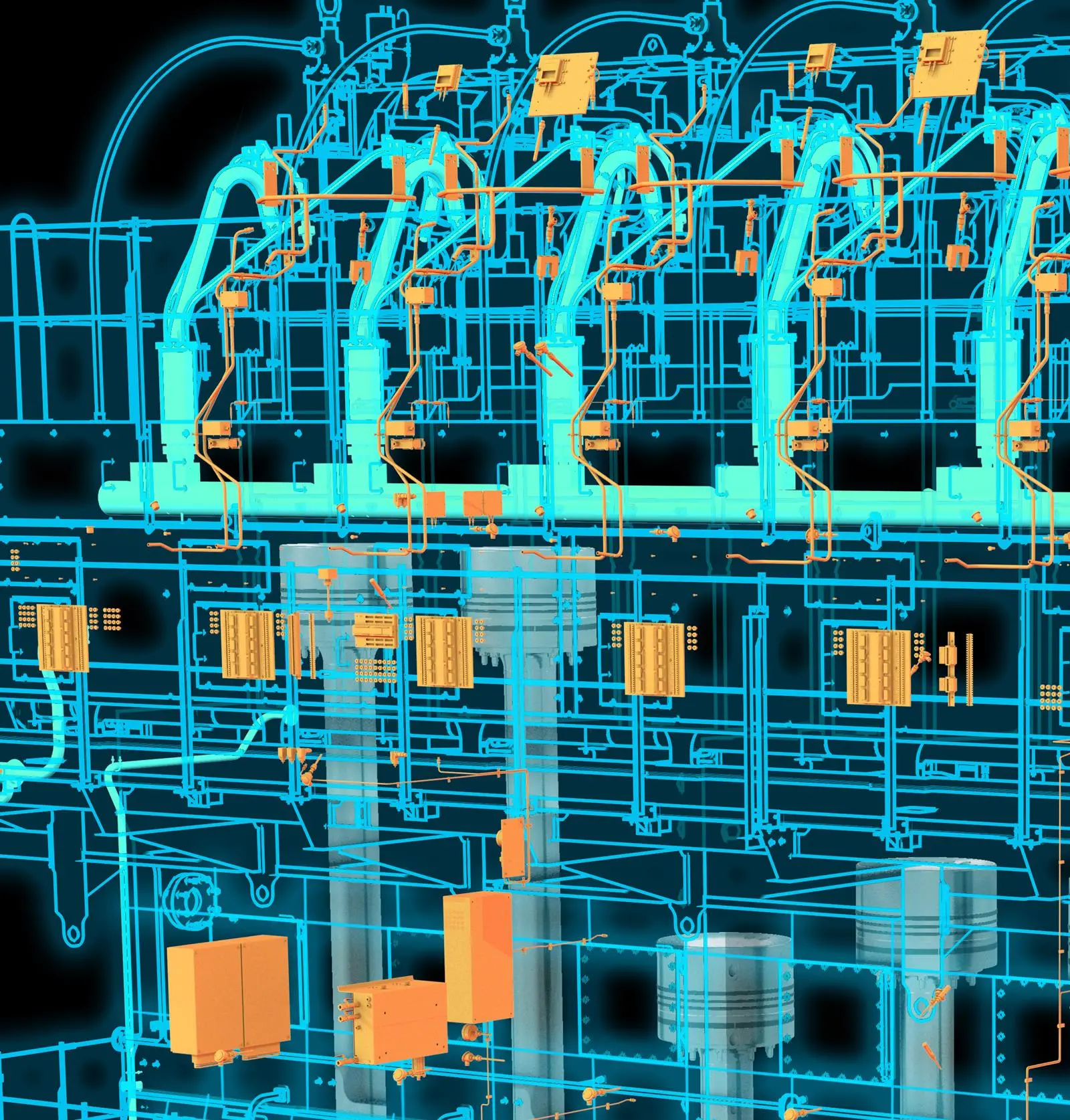
“The control configuration, fully integrating the main engines, is the key contributor to our value proposition,” says Stefan Goranov, Program Portfolio Manager – Digital & Hybrid at WinGD. “We consider the whole energy system onboard as one. The hybrid control system is monitoring the current states of all the active components and their constraints to find the system’s optimum operating point. Our value proposition is the holistic energy management, with the main engine as a central component.”
Following requests from their customers, WinGD has undertaken feasibility studies for a range of newbuildings, including a hybrid feeder container ship. In this case, the vessel has an X-DF low-pressure main engine and diesel auxiliary gen-sets. With a battery of 0.8MWh and a shaft generator of 1.3MW, CO2 emissions (calculated from the fuel burned, using a conversion factor) are estimated to be reduced by around 8% per annum, sailing and manoeuvring in various conditions.
WinGD’s hybrid controller aims to minimize the operating hours of the gen-sets while maximizing the energy production of the two-stroke engine running on LNG. The results suggest a reduction in diesel consumption of 68% balanced by an increase of 22% in gas consumption of the main engine. This would bring operational savings of about $250,000 per year.
Generally, the inclusion of an appropriately sized battery pack brings the opportunity to remove one of the gen-sets while improving the system transient capabilities, availability and redundancy, says Goranov.
The CO2-equivalent emissions are expected to be reduced by 8% on a PCTC design also fitted with a WinGD X-DF main engine and three dual-fuel gen-sets by adding a battery capacity of 750kWh and a 1.3MW shaft generator. The 8% related to sea-going and manoeuvring operations and was accompanied a methane slip reduction of up to 23% from the ship during her outwards voyage. With the power demand profiles under investigation, the main engine performed better in methane emissions than the four-stroke auxiliary engines.
“In this particular case, the diesel consumption savings of around 18% were not significant when looked at in tons, because it is pilot diesel oil only. In terms of megawatts however, we expect up to 54MWh reduction of the gen-set’s energy production. Considering prices of $450 per ton for diesel, $275 per cubic meter of LNG and gen-set maintenance $10 per megawatt hour, we can expect an annual expenditure reduction of around $200,000,” says Goranov. “What we can achieve in terms of LNG consumption reduction, on average for the whole year, is around 5%.”
In the case of a chemical tanker with a coastal sailing pattern, WinGD propose an 800kWh battery pack and a 1.3MW PTO as well. “Here, we included a clutch between the propeller and the shaft generator so that the main engine can be used as an electrical energy producer only. What our study shows is a reduction of around 13% of the CO2 emissions and 92% of the diesel consumption. The gen-sets are also diesel in this case, and again we achieve a reduction of around $200,000 in operational expenditure per year.”
WinGD is currently working on a study for a bigger container ship with diesel main engine and diesel auxiliary engines. Goranov says the numbers are significant. “We are aiming here, with our energy management system, to reduce fuel consumption by between 3% and 5%, but more details cannot be disclosed yet.”
The development of these solutions began in 2018, and their deployment involve three phases: feasibility and system architecture, detailed engineering and then in-service support for the vessel. During the feasibility studies, the power demand profiles are examined for sea-going, in and out of port manoeuvring and also berthing and cargo operations. Then generalisations are made based on the most common operational scenarios in order to find the best operational strategy for the vessel, considering certain constraints. The solutions are not limited to X-DF engines and are component agnostic.
Goranov explains the focus on full-system simulations. “During the first phase, feasibility and system architecture, we answer the questions of the customer: What is the best matching hybrid system topology and is hybrid a good investment in this particular case, because some ship types or some configurations are more favourable than others. We answer the question quantitatively, providing a very comprehensive picture of the operational expenditure and the savings that they can assume with such a system. We will also provide plausible numbers on the investments that they need to make; generally, we would enable them to make educated decision on their future ship or fleet of ships. Additionally, we consider the deterioration of the main engine margins imposed by hull and propeller fouling over time, typically for the period between dry docks.”
The second stage is the detailed engineering and design of the conceptualized system. “Here, we also run simulations but with detailed component models. The physics of each sub-system is modelled, and we can fine-tune the complete system and verify our initial choice. Normally, the choice of components is quite precise in the first step, but what the detailed component models contribute to is fine-tuning of the system control strategy by imposing more dynamic operational modes,” says Goranov.
“This gives us the opportunity to virtualize the system and reproduce the transient behaviour of a real engine in the virtual environment. Once the topology is verified and the control strategy is defined, we deploy the control software to the hardware and run a final validation on a hardware-in-the-loop to make it ready to be installed on the real ship. This is our hybrid control system which sets new standards in vessel energy optimization.”

WinGD has enhanced its engine simulation platform to be capable of virtualising the completely integrated hybrid system including all components and verify the efficiency of the integration. “This is really a crucial point, in our view, when we start discussing such a hybrid installation, because the component sizing and the control strategy selection matter a lot.”
As an example, it is important not to over-size the battery. At a certain point, the benefits of increased battery capacity become marginal. Alternatively, an under-sized battery could age prematurely or even cause safety issues, for example, due to a potential inability to provide the spinning reserve required for blackout prevention.
The same is true for the shaft generator. It is important not to overload the main engine or to leave an unutilized margin, but under-sized, it would not offer the full benefits of hybridisation.
The configuration is designed to minimize fuel consumption and optimize battery lifetime. “The battery is a crucial component in the system, and we don’t want it to degrade prematurely.”
WinGD could work with any battery supplier that fulfils the requirements of the installation and classification. Key constraints are obviously capacity, size, weight, charging and discharging rate, and cost but the cooling system can also be important, as some clients have clear preferences for either liquid or air-cooled batteries. Normally, the aim is a 10-year lifetime, but Goranov notes that the end-of-lifetime for a battery actually means that the battery has 80% of its capacity. This doesn’t mean the battery needs to be replaced, but it will not operate at its peak capacity and therefore the efficiency of the system will drop.
“We have developed our platform to be capable of virtualizing the whole system, maintaining parameters for each component so that we can actually run the system in a virtual environment. As an input of that system, we use the power demand of the propellers for propulsion and electrical power on board. This differs greatly from ship type to ship type; it is a key parameter. We are looking to find the 20% of the operational patterns assumed for the ship lifetime that will bring 80% of the benefits.” The power demand profiles can be either measured from a similar ship, the company has WiDE (its WinGD Integrated Digital Experts) deployed on many ships now, or it can be built specifically for the ship in question.
Currently, WinGD is only offering the solutions for newbuildings. A retrofit can be difficult if the vessel doesn’t have a shaft generator. “However, we have actually developed quite a flexible business model offering our solutions commercially, starting from advisory for system integration and energy efficiency analyses and scaling up to the end-to-end of delivery of a complete hybrid power pack. So, if we have a request to provide advice for a retrofit project, we are happy to do that.”

Goranov cautions on focusing too strongly on a ship’s Energy Efficiency Design Index (EEDI) when it comes to an integrated battery-hybrid ships. “It is rather a static index and probably not the most accurate indicator for quantifying the efficiency of a hybrid installation. The real advantages of a hybrid system occur during operation by setting up the control strategy that ensures the optimal utilization of the energy resources. In terms of EEDI, obviously if we remove one of the gen-sets and install a shaft generator we have a better figure; if we downsize the main engine, we have a better figure. But now the question is, and this is a discussion ongoing in the industry, is that the right indicator to judge the efficiency of a hybrid system? We don’t believe that it is.” WinGD is actively participating in CIMAC discussions on recommending a more appropriate indicator for the efficiency of such systems.
The company is also continuing to develop its digital capabilities including a set of optimizers to further boost efficiency that take into consideration various boundary conditions. These are, for example, the hull and propeller condition, actual cargo capacity utilization, weather and actual sailing area. These will be interfaced with the real time energy management controller. The optimizers will have predictive capabilities and will use artificial intelligence to evaluate the large datasets obtained from vessels in operation. “What we are aiming for is continuous optimization. We call it dynamic energy management. This is the next milestone.”
Related Articles
 ELECTRIFICATION AND BATTERY HYBRIDS
 ELECTRIFICATION AND BATTERY HYBRIDS
 ELECTRIFICATION AND BATTERY HYBRIDS