



CUMMINS FORESEES POTENTIAL FOR MARINE DECENTRALISED MICROGRID
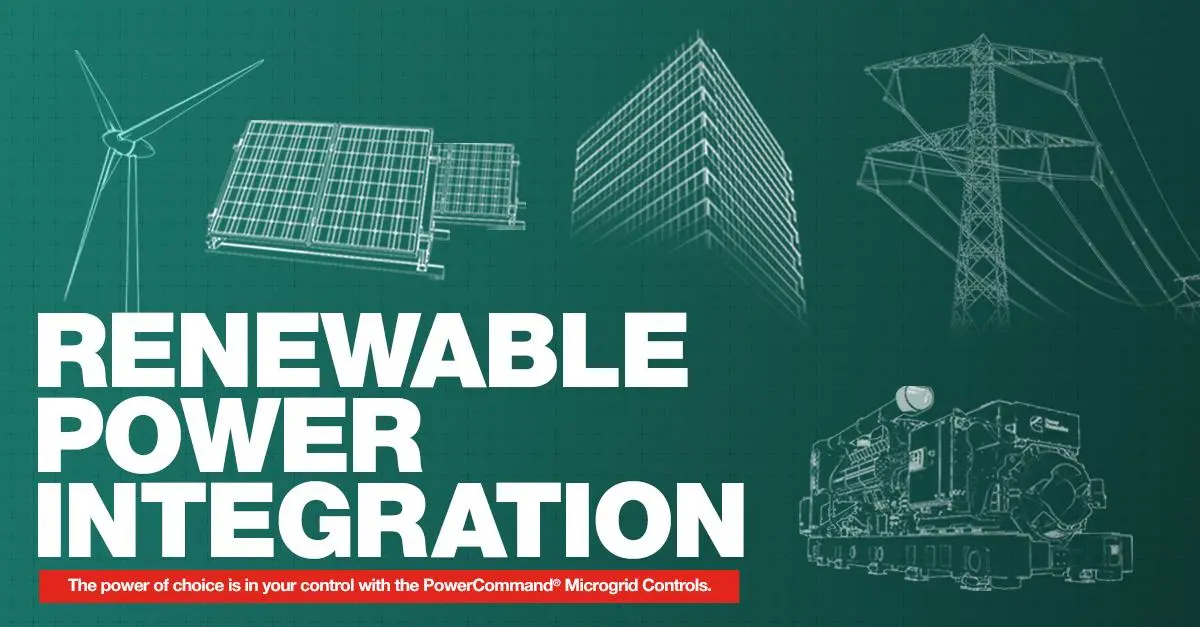
As local energy systems, microgrids are capable of producing, storing and distributing energy to the facilities within a network automatically. Crucially, they can disconnect from the traditional grid and operate autonomously to boost efficiency or to maintain supply when other parts of the grid need to be repaired.
PowerCommand® controls are currently available for electricity generation and distribution systems, industrial plants, data centres, hospitals and transport systems, among other applications, where it maximises reliability, efficiency and the use of renewables. Its functionality can include automatically starting and stopping generators based on load demand as well as the control of charging and discharging of energy storage system to achieve multiple goals including capturing excess renewable power, increasing system resiliency, preserving battery life and optimizing generator fuel efficiency. Additionally, the new system makes it easy to modify the load demand control sequences, which can be tailored at the operator interface.
Cummins Product Engineering Senior Technical Advisor for Marine, Frank Ruggiero, foresees that distributed power systems onboard vessels could evolve from having centralised power management to having a decentralized microgrid-type control system. The application of microgrid technology would improve the management of newer technologies such as fuel cells and variable speed hybrid gensets.
“Large offshore vessels will probably be the first to adopt it,” says Ruggiero. Harbour tugs, ferries and push boats, as candidates for hybridization or electrification, could follow. Vessels with standard routes and predictable power usage would be well suited to technologies such as fuel cells, and also for a microgrid solution where the aim is to burn less carbon-based fuels, he says.
“Traditionally, everything has to pass through a central controller and it decides how the power is managed. With microgrids, it’s distributed, so if any one unit goes down or has an issue, the other ones can pick it up automatically without having to contend with that central line. So, in terms of distribution of power and intelligence in the system, it’s not in that centralized space anymore, it’s actually spread throughout the entire power architecture.”
Ishan Jaithwa, Cummins Systems & Controls Business Development and Strategy Manager, says Cummins integrated solutions address the mix of resiliency, green ambitions and reduced total cost of operations expected by every customer based on the project needs and solution outcomes. The microgrid could, for example, make decisions on when the vessel should run on diesel power, when to idle on battery power and would automatically charge the battery using DERs or generator set.
Ruggiero agrees. The microgrid controllers are more adaptive than centralised control system currently being used. “Whereas a standard centralized diesel electric solution is a pre-prescribed program that says at this particular load level bring these units on and for how long and then change. It does that all day, every day. The microgrid with the shared intelligence is going to find if something changes, based on a particular usage profile, and it can decide when to bring something on and offline to maximize efficiency. So, it’s constantly trying to maximize efficiency rather than following your pre-prescribed program.
“In the future, when we look at things like batteries and fuel cells and engines, and I think we envision that engines will still be on vessels for quite some time, we’re going to need smarter controllers to be able to manage the different power sources. It becomes, I believe, fundamental to a multi-power source strategy,” he says. “The question is, how far can you scale it? It works well on big ships where they have the capital to buy the equipment, but when we get to the smaller units that will be switching over to these sources sometime in the future, it’s going to be a challenge. I think that’s where Cummins can provide the scale to bring that technology and scale it down to some of the smaller vessels.”
Cummins is currently evaluating which parts of the PowerCommand® solution are best suited to marine applications now and in the future in readiness for bringing the technology to the marine market.
Related Articles
 BATTERIES, SUPERCAPACITORS, FUEL CELLS AND OTHER ENERGY STORAGE TECHNOLOGY
 BATTERIES, SUPERCAPACITORS, FUEL CELLS AND OTHER ENERGY STORAGE TECHNOLOGY
 BATTERIES, SUPERCAPACITORS, FUEL CELLS AND OTHER ENERGY STORAGE TECHNOLOGY