Cinderella ‘shoe’ that turns a tug into an icebreaker
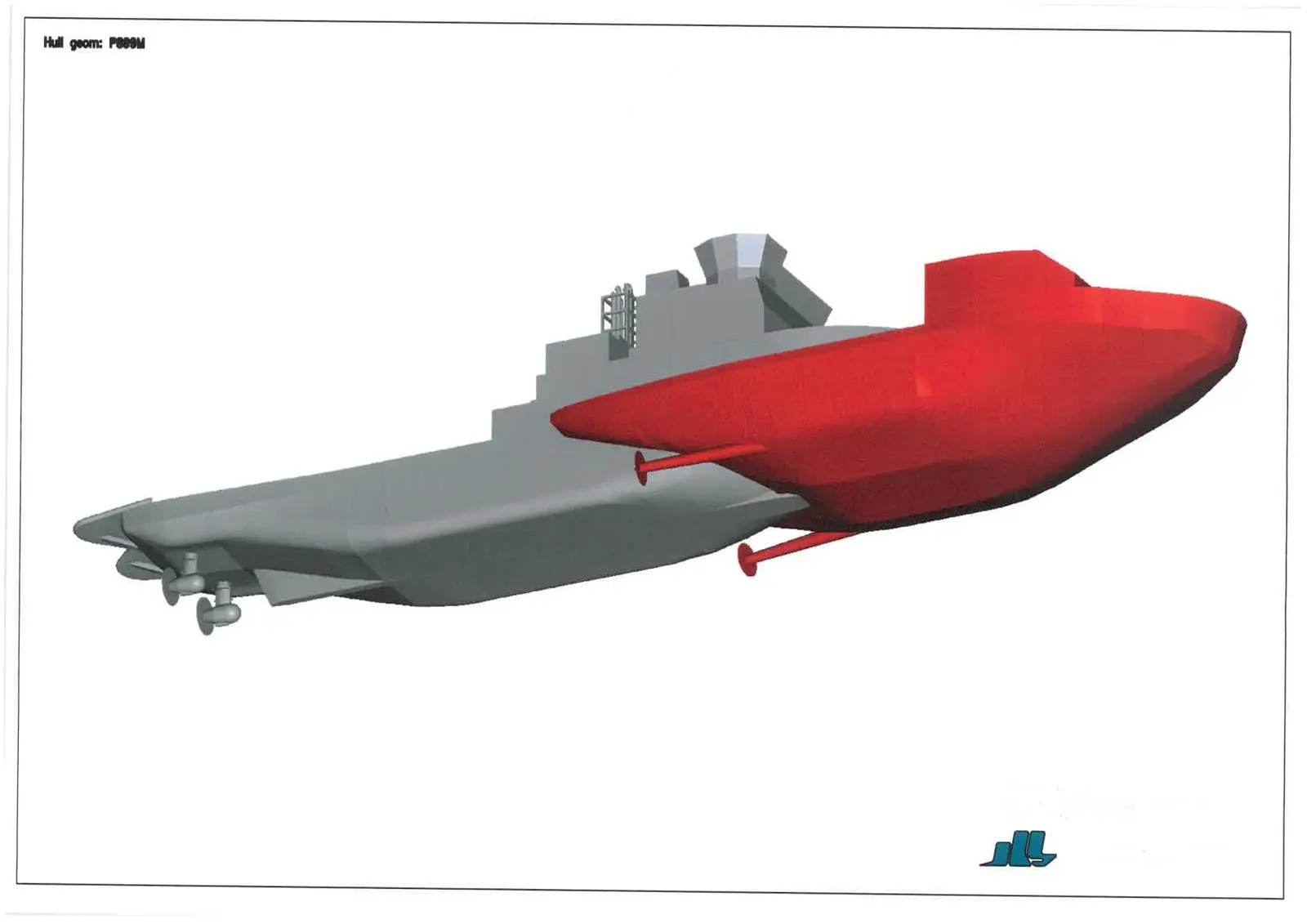
And now there is. It’s a rather surprising alternative from ILS: a removable bow which, when fitted to a suitably robust vessel such as an ice-class pusher tug, allows it to take on icebreaking duties. In summer the bow can simply be unpinned, leaving the tug to return to more typical operations.
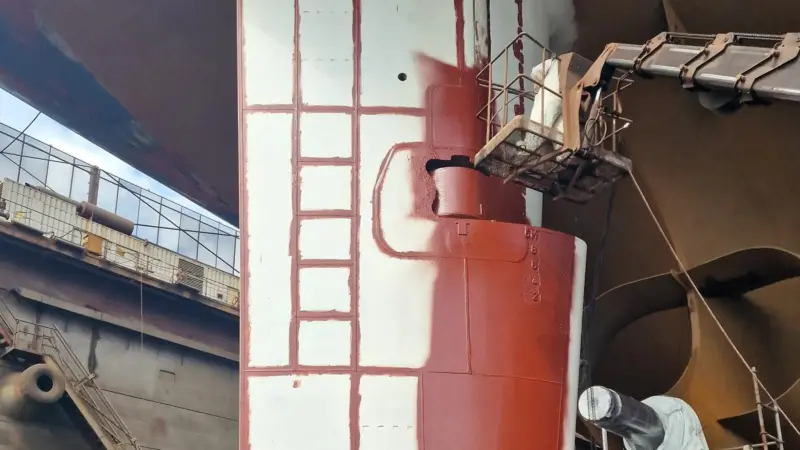
The design itself is reminiscent of a horseshoe (albeit with hefty bracing connecting the two sides) that fits quite snugly around the vessel’s form, conferring both strength and extra forward height.
However, it was clear the addition also needed to bring substantial power along with it. Thus, the self-propelled removable ice breaking bow (SRIB) was born: Lehtonen explains it’s almost a complete vessel in its own right, with engines, ballasting unit, and full automation.
Interestingly, the very first of them is already out there and working the waterways around Lake Saimaa. This is a somewhat smaller 25.3m version with a 12.5m beam and designed for inland operation: paired with its ‘other half’ – a tug called Calypso – the combined length comes to around 40m, with a total installed engine power of 2.6MW.
Hooking up was another challenge: it was necessary to create a single, rock-solid unit from the two halves and moreover, achieve it “inside a working day” says Lehtonen.
The solution, a three-point connection developed by partner ACM Trading, is a sophisticated ATB crossover with a central solid steel pin and sleeve amidships, plus hydraulically operated pins on the port and starboard wings. Interestingly, this allows the mating to be accomplished well within the timescale: if the trim and draft need attention in order to match up with the tug, the onboard ballasting system of the SRIB will compensate, possibly taking a couple of hours. If that isn’t necessary, he explains “the connection can be as fast as 10 minutes”.
FULL-SCALE
However, while the ‘pint-size’ version is operating successfully, the larger, Baltic-capable SRIB is a significant step up in scale. The first of these designs will likely have a waterline breadth of around 24m, and the length, when united, could easily double that of the pusher tug alone.
The idea is that taken together, the ice strengthened removable bow and the total power combination will yield capabilities “corresponding to those of present Baltic icebreakers,” he explains. Therefore, the duo should be able to achieve a 6kn progress in 0.8m level ice – a speed high enough for escort duties.
As a result, the combined pusher and SRIB will likely require a total installed power around the 11MW mark.
There are some givens. The candidate vessels will necessarily be of 1A Super ice class notation, and it’s most effective if “the bow and tug divide the power about fifty-fifty”, says Lehtonen: therefore the vessel will ideally already have 5MW or so of installed power – though there’s some flexibility. The balance may develop differently for the full-scale builds, depending on the pusher and local characteristics: “Each case will need a separate design,” he adds.
Like its smaller sister, the first of these larger SRIBs will likely incorporate diesel generators inside the hull – although battery power systems are under consideration for the future, it will require further development.
There are a number of elements governing the choices, says Erno Tenhunen of Danfoss Editron, the company supplying the power and distribution for the inland SRIB. For example, a DC bus gets rid of the need for AC/DC converters and so on, and it also allows the gensets to run at variable speeds.
The permanent magnet motors on each shaft line are also very compact, as are the DC/DC inverters which, usefully, don’t require locating in an isolated area: as a result they can be positioned directly inside the machinery space. Further, while it’s plausible that the 6MW or so of power for the full-size SRIB could still be supplied by two generators, efficiency might best be served by divvying up demand between four of them.
But most importantly, icebreaking operations have a very high, rapid power demand. In order to avoid over-sizing the generators an energy storage unit will peak shave these spikes, as well as enabling open water transits on just one genset. Significantly, it’s not a battery: it’s a supercapacitor.
Although batteries can hold a charge for much longer, supercapacitors are far superior when it comes to sheer power output as they store energy in a static electric field rather than electrochemically. As a result they are able to both absorb and release large amounts of power pretty much instantly, without degradation.
However, the 10.4F/650V DC/DC converter-controlled supercapacitor onboard the inland SRIB, developed by Danfoss itself, has a sizeable (for a supercap) 3.1MJ/ 0.86kWh energy density in order to cover blackout and spinning reserve. But the choice of ESS answers another concern: the cold.
Unlike batteries which usually start failing below 20degC – and which can be impaired by low-temperature recharging – supercapacitors will continue working happily even when deep into sub-zero conditions. It also helps that they can be designed to meet very high shock and vibration requirements: icebreaking can be a jarring business.
Lastly, Tenhunen points out the SRIB necessarily relies on “a highly automated power system”, with the control interface located inside the pusher tug’s wheelhouse.
VARIATIONS
It’s worth noting the design embraces a number of alternatives. To start with, the straightforward scaled-up version of the inland SRIB has two, aft-facing, 3MW fixed pitch reaming propellers in skegs on both sides of the horseshoe.
But double-acting icebreakers have a hull optimised for running ahead in open waters and thin ice, turning around and proceeding astern to take on thicker chunks: this allows the propellers to bite into the ice and flush it aft very effectively.
Therefore other solutions on ILS’ drawing board lean further toward this kind of operation. One of the designs positions a 6MW, fully azimuthing ‘pulling’ pod at the bow: another places a pair of smaller, similarly oriented 3MW units on each side, and there is a fourth version which extends the two, straight shaft lines and propellers forward. Further, Lehtonen explains these are just the base designs: it’s possible to incorporate more pods or propellers to adapt to different challenges.
Moreover, some of these options – such as the single pod – can reduce the beam, tailoring the SRIB to narrower approaches: therefore the signature horseshoe shape could be swapped for something closer to a slipper.
Finally, how does the bottom line add up?
The main costs accrue from the installed power level, says Lehtonen. But, he points out, it’s much cheaper than building an entire vessel: there’s no bridge or associated kit, and likewise, no accommodation or crew facilities, “so the bow doesn’t come to more than 30% of the cost of buying a complete icebreaker”.
It’s already gaining interest, and there appear to be contracts waiting in the wings. Certainly the SRIB looks like becoming a cost-effective choice for regularly ice-bound, industrial locations, making them navigable year-round.
It might not be that long before more pusher tugs find an alternative winter identity by slipping their bow into an icebreaking ‘shoe’.
By Stevie Knight