HYDROGEN AND METHANOL INJECTION SYSTEM EYES 2-STROKE MARKET
The FS MARINE + system has been field and lab proven for 4-strokes, and a current working process is defined for MAN and MaK engines. Work is underway with other engine manufacturers. FuelSave has approval projects underway with DNV and Bureau Veritas and is about to start work with Lloyd’s Register and ABS.
The technology has also attracted interest from the 2-stroke market, and FuelSave has received a Letter of Intent from one of the world’s largest, independent container ship operators for a system to be installed on a 70MW slow speed 2-stroke main engine.
The FS MARINE + is the world’s first onboard hydrogen generator and methanol injection solution with gas and liquid injection processes. The hydrogen used by the system is generated by an onboard electrolyser on demand as needed to avoid the need for a storage tank. The intelligent injection system injects a mixture of gaseous and liquid media, equivalent to up to around 20 percent of the fuel mix, comprising hydrogen and oxygen, to increase combustion efficiency, as well as a methanol/water mixture, to reduce combustion temperatures to control NOx emissions. The introduction of hydrogen results in earlier ignition and gives a more complete burn, boosting energy efficiency, reducing fuel consumption and reducing emissions.
The hydrogen, oxygen and methanol mix are each injected at separate, precisely calibrated positions along the air intake, with the exact positions determined on a case-by-case basis. Intelligent control is maintained using feedback on engine load and charge air pressure via different interfaces. With the system’s inherent flexibility in injection timing, it has the potential to adapt and optimize combustion in combination with the use of new fuels with different characteristics, says CEO, Marc Sima.
For 4-strokes, the solution is suitable for ferries, cruise ships, heavy lift, heavy transport, dredging, pipe layers, PSVs, OSVs, wind farm installation platforms, accommodation vessels and offshore drilling units. There are no limitations on the type or age of 4-stroke engines upon which the system can be installed, nor any requirement for a common rail injection system. The system won’t interrupt engine operation even if it experiences a failure, as it does not alter any part of the engine and does not touch the electronic control unit or fuel system.
The engine room layout is not an issue either, as modules are fitted in available space. Up to six engines or boilers can be supported in parallel with one system. A plug-and-play containerised version is also available. “We can deploy the system within three weeks if we can manufacturer the modules before delivery, and it can even be installed while a ship is underway,” says Sima. Some additional pipework is required to connect the FS MARINE+ Container to the engine and the ship.
As hydrogen is not stored onboard, bunkering and some regulatory restrictions are avoided. Although, for safety reasons, the hydrogen and oxygen are separated and injected independently. The methanol, in contrast, is bunkered, but the space requirements are modest.
The company already claims an average return on investment within three years for 4-strokes on larger deep sea vessels and around two years for cruise ships. Savings on fuel consumption can be 10-15% for 3-4% methanol consumption, NOx emissions can be reduced by 30-80% and particulate matter can be reduced by up to 40%. Sima says the system also reduces engine maintenance and repair costs, reduces lube oil consumption and enables IMO Tier I & II compliance for older ships, while IMO tier III compliance without a SCR is something the FuelSave team is keen to validate in a pilot. Looking forward, Sima is looking to bring down the cost of the electrolyser and further increase efficiency.
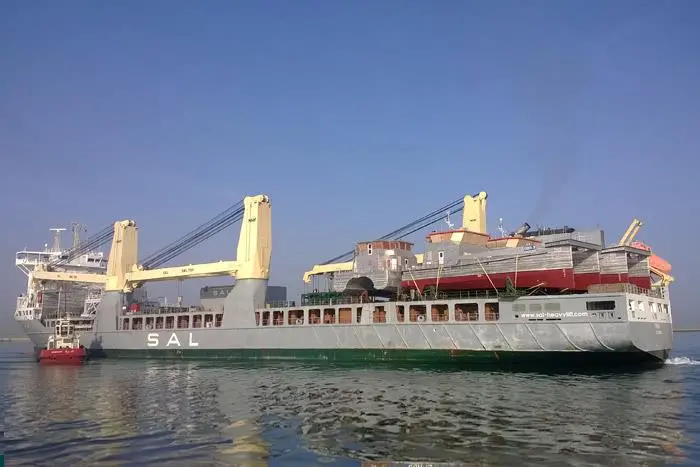
The system was initially proven on trucks and stationary power generators. It has since operated for over two years on the heavy-lift ship MV Annette and resulted in a 25% primary fuel reduction. SAL Heavy Lift is installing the system on another six vessels where it will be applied to both the main medium-speed 4-stroke MAN 12.5MW 58/64CD engine and three 1MW auxiliaries.
FuelSave has signed the contract with Van Oord for the DP3 vessel Bravenes which will also feature the world’s first dedicated retrofit methanol storage tank containers. Ferry operator DFDS has announced that it is evaluating the system, and the technology is also positioned for Seadrill’s upgrade of its West Saturn drillship.
Correction: The article was amended on 10 June to clarify that hydrogen forms one of the FuelSave injection system’s inputs, which cumulatively amount to up to 20 percent of the fuel mix. Hydrogen itself does not account for up to 20 percent of the inputs, as we originally reported.