WOODWARD L’ORANGE EXPANDS INJECTOR RANGE FOR NEW FUELS
In most regions of the world, the cost of renewable power is now cost-competitive with fossil fuels, even without subsidies. Using green hydrogen, it will be possible to create cost-competitive synthetic fuels with zero carbon footprint, and hydrogen and Power-to-X (PtX) technologies are also expected to follow a strong cost decline as they are scaled up to meet demand created by globally ambitious GHG targets.
It is still not clear which fuels and engine technologies offer the most future-proof investment, but the shipping industry has great potential for using hydrogen, and there are various PtX fuels currently being investigated. Looking to the future, Woodward L’Orange predicts that for short-range and especially highly utilised applications, direct electrification or a fuel cell might be the best solution for a vessel’s propulsion, but for many long-range applications, a retrofitted or new internal combustion engine is more feasible.
To fill the gap between its existing high-pressure dual-fuel and port fuel injection technology, the company is currently working on a flexible medium-pressure direct injector platform. This injector can be designed to either inject the fuel at pressures of around 20 bar or up to several hundred bar, making it suitable for a range of new fuels, including ammonia. In general, direct injection with spark plug ignition (possibly with a prechamber) is conceivable for all engine sizes, in applications where dual fuel concepts with a second pilot fuel is not needed or desired. The company anticipates that the technology will be primarily used for high-speed propulsion engines (about 200 kW/cyl) and is working with MTU on methanol engines as part of the MethQuest research project.
DNV has forecast that ammonia will have about a 30% share of the maritime fuel market by 2050, and Woodward L’Orange is also a project partner in MAN Energy Solutions’ AmmoniaMot project which aims to define the steps necessary to produce a dual-fuel, medium-speed engine capable of running on diesel and ammonia. Woodward L’Orange will produce the injection system, and together with MAN, the technology will be scaled up to large, 4-stroke engines as part of the project.
New HP DF injector family
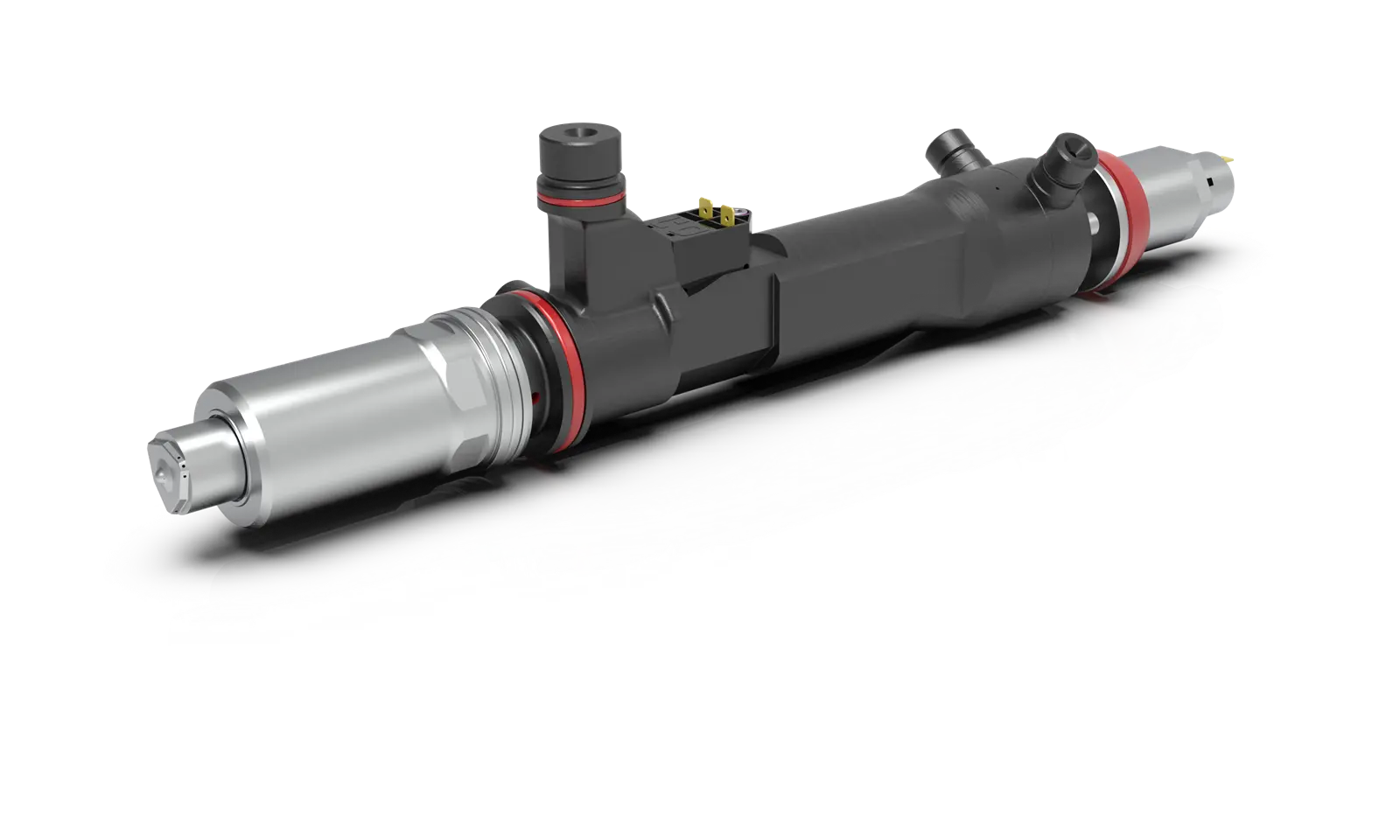
For high-pressure dual fuel applications, Woodward L’Orange introduced its new high-pressure dual-fuel injector family last year. This technology enables the injection of both diesel fuel at up to 2,200 bar and a second/PtX fuel at 600 bar directly into the cylinder. This allows for diesel-like engine performance at highest efficiencies and power densities. The engine can be operated with both fuels at 100% load. Pilot-ignited, high pressure direct injection suits combustion of low caloric value fuels even though they require greater injection quantities, and because those quantities are fairly similar, even external components, such as the fuel tank or high pressure pump are similar for some of the fuels.
Where Woodward L’Orange’s existing GD-series injectors are designed for engine bores of over 320mm, the new injectors are targeted at bores of 170mm. They have a nozzle tip diameter of 25mm and use diesel as a sealing oil rather than engine oil. They are compact and can be fitted to most engine configurations. The standard configuration has three gas needles around one single diesel nozzle – a configuration with one diesel and only one gas needle is also possible. For liquid fuels such as methanol, a separate accumulator is integrated into the design.
For many years, the company’s solenoid operated gas admission valve (SOGAV) port fuel injector has been used for applications where gaseous fuels need to be injected at low pressure upstream of the cylinder intake valves. It offers a direct actuation and is therefore an easy to use and robust injection solution. With a virtual sensor included, it is possible to monitor in real time the position of the valve. This makes it a good solution for pure gas or dual-fuel engines. As ignition source, these low-pressure dual-fuel engines use Woodward L’Orange’s diesel injectors that can inject the smallest quantities of fuel with extreme precision while being able to run at full power in diesel-mode.
Different pathways for fuel “bridging” are possible, and Woodward L’Orange says its injectors are designed to allow a fuel switch with minor changes. Choosing a flexible engine technology today gives shipowners the opportunity to change to other fuels during the long lifetime of an engine, and the company’s expanding range of injectors is designed to support those changes.