Benefits Of Running On LNG Stack Up For Large Crude Carriers
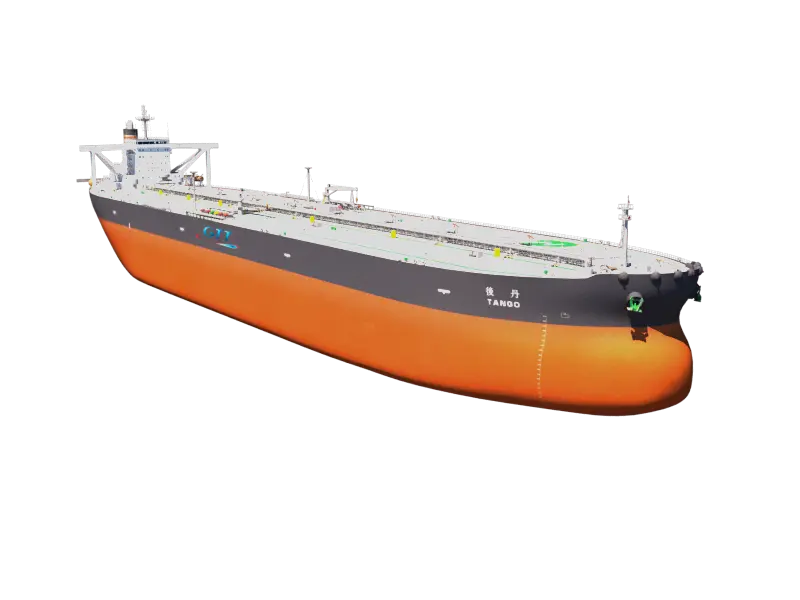
Speaking at Gastech in September, Alexandre Tocatlian, Head of Business Development EMEA at GTT’s LNG as Fuel Division, cited forecasts that oil demand is expected to reach 80-100 million barrels a day by 2050, leading to an average of 38 VLCC newbuildings a year. He also noted the rapid development of LNG bunkering facilities over the past five years, minimising spot market volatility.
Using GTT’s membrane tank technology can overcome the limitations of Type C tanks, he says, by holding a relatively larger volume of LNG in the available space on a ship. A 12,000 cubic metre capacity membrane tank allows a VLCC to work 94% of the global trade, making the vessel flexible and therefore more valuable on resale. Such a long-range dual-fuel VLCC would be able to bunker at cheaper locations (saving US$612,500), have less off-hire time (saving US$150,000) and reduced terminal fees (saving US$635,000) – combined savings that could reach around US$1.4 million annually.
The customised tanks fit between the main bulkheads of tanks 3 and 4 and are the most competitive solution for capacities larger than 8,000 cubic metres, says Tocatlian. The location and covered tank design reduces sloshing with minimum foam density usage and maximises protection from weather and from green water, something particularly significant for low freeboard tankers. The tanks have a low boil-off rate, are designed for all filling levels of LNG and are suitable for future fuels bioLNG and e-LNG, and also, with prior upgrade, for ammonia.
He sees a positive future for LNG in the decarbonisation transition. “In the short-term, including bioLNG will allow significant CO2 reduction,” he says. “In the mid-term, e-LNG will have similar or better well to wake performance than other e-fuels and similar challenges regarding the wide availability of clean hydrogen.”
Helping to comply with EEXI
Bureau Veritas (BV) is not advocating for any future fuel in particular, but Jonathan Hudson, Market Leader – Tanker Owners & Adjacent Stakeholders at BV, notes: “While LNG may not be the final solution to decarbonise shipping in the long term, it is one of the main alternatives that is available here and now to enable shipowners to comply with the new EEXI and CII regulations and be ready for Phase 3 EEDI requirements.
“For very large tankers in particular, LNG might be an interesting option due to these vessels’ large and flat decks, which leave plenty of room to install LNG tanks. This also gives ships the flexibility to be able to run on different power sources. Moreover, these very large vessels can go on long sea voyages without needing to refuel, making them less dependent on the availability of LNG bunkering facilities. There are also operational benefits: the owners currently operating dual-fuelled engines have reported lower maintenance costs due to the ‘cleaner’ nature of LNG, which results in less particles or rust inside the engines.”

BV is providing classification services for one dual-fuel VLCC under construction at Samsung Heavy Industries in South Korea for AET Tankers and is also classing several other LNG-powered vessels. In one of the most significant and best-known LNG projects, BV was chosen to class CMA CGM’s 23,000 TEU container ship series, the first of which was the CMA CGM Jacques Saadé, the largest LNG-powered container ships ever built. These vessels have very large tanks (18,600 cubic metres in a single tank).
WinGD engine for first operational LNG-fuelled VLCC
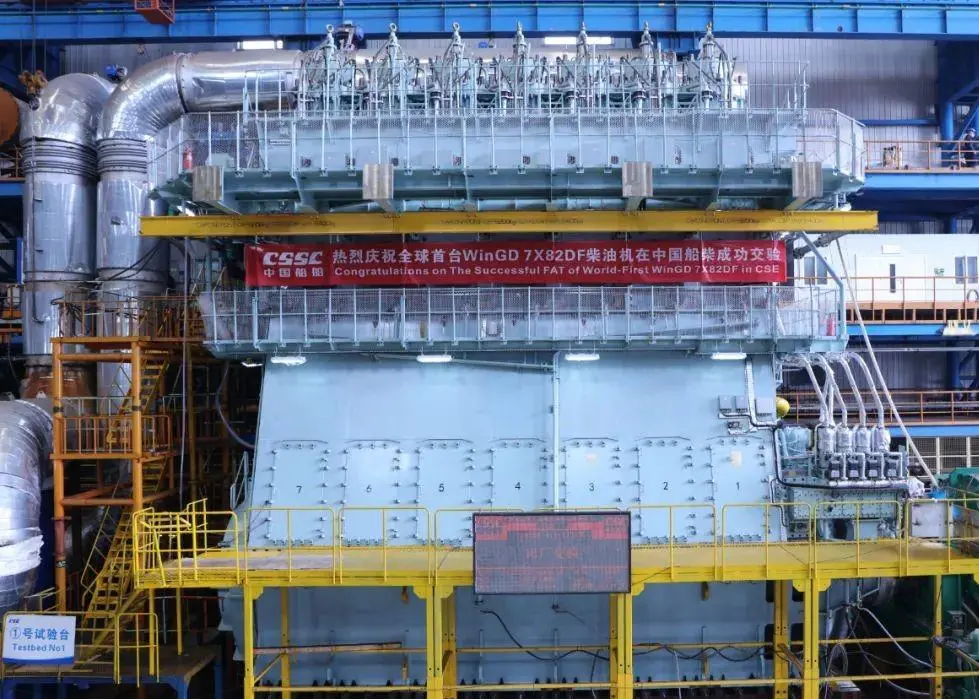
Current orders for WinGD’s X82DF engine include a 7X82DF-1.0 engine from China Shipbuilding Industry Corporation Diesel Engine (CSE) for a VLCC for COSCO Energy being built at Dalian Shipbuilding Industry Co (DSIC) and two 7X82DF-1.0 engines from Doosan Engine Company (HSD Engine) for VLCCs for AET being built at Samsung Heavy Industries. AET and Total agreed a time charter for the two LNG dual-fuel VLCCs in April 2020.
The COSCO Energy VLCC, the world’s first LNG-fuelled VLCC, commenced sea trials in September in Chinese waters. The 318,000dwt vessel’s main engine and generator have low-pressure selective catalytic reduction reactors to help the vessel meet Energy Efficiency Design Index (EEDI) phase III requirements and NOx Tier III requirements. The LNG is stored in Type C tanks with bunkering stations either side of the ship. The vessel can travel 12,000 nautical miles in gas mode, while the combined endurance of fuel oil and gas is 24,000 nautical miles.
WinGD completed Type Approval testing for their 7-cylinder, low-pressure X82DF-1.0 engine in April. The test took place in April at engine builder CSE-QMD in Qingdao, China, with China Classification Society, BV and DNV participating. The new engine rounds out WinGD’s portfolio of low-pressure, dual fuel engines which cover the full engine bore range of 40-92cm. It includes the designer’s new control system WiCE (WinGD Integrated Control Electronics) and its iGPR (integrated Gas Pressure Regulator). Targeted at the VLCC, VLOC and Panamax container vessel segments, the X82DF-1.0 is available in 6-cylinder to 9- cylinder configurations and covers a power range from 16,560 to 49,500kW at 58 to 84rpm.
WinGD notes the benefits of LNG are a reduction of 21-23% of GHG emissions, reduction of 98% of SOx and a reduction of 62% in particulate matter compared to traditional diesel engines. The designer claims its X-DF range has the lowest CAPEX and lowest total emission footprint. “Low-pressure two-stroke engines already offer benefits compared to both four-stroke engines, which have higher methane slip and GHG emissions, and high-pressure Diesel cycle engines, which demand a more costly installation and cannot meet IMO Tier III NOx emissions in gas mode without aftertreatment.”
Equipment for using recovered volatile organic compounds (VOC) for fuel has been installed on some dual-fuel shuttle tankers, but it is most beneficial for vessels that undertake frequent cargo loading/offloading operations, where a lot of VOC can be recovered. On VLCCs the potential is expected to be somewhat smaller, says WinGD. However, the capability of the X-DF to burn a mix of LNG and VOC does minimize the environmental footprint of operation of all tankers, including VLCCs.
Shell orders 10 LNG-fuelled VLCCs
In March, Royal Dutch Shell announced that it has signed charter agreements for 10 new VLCCs powered by dual-fuel LNG engines to be built by DSME in South Korea. The company will charter four of the VLCCs from Advantage Tankers, and three each from AET and International Seaways. The vessels will be on charter for seven years, and the first is expected to be operational from 2023.
According to Shell, the main engines and vessel design will enable the vessels to have the lowest possible methane slip and the highest fuel efficiency. They will use an average of 20% less fuel than eco VLCCs currently on the water.
“A study by Thinkstep found that when compared with heavy fuel oil, from extraction to combustion, LNG can reduce greenhouse gas emissions by up to 21% for 2-stroke slow speed engines and up to 15% for 4-stroke medium speed engines,” said Tugrul Tokgoz, CEO of Advantage Tankers. “We know that the design guarantees for these vessels deliver a minimum emission saving of 16% when compared to an eco-ship, and our operations modelling suggests considerable improvement on that figure.”
The vessels will see Shell hit a new milestone for its fleet decarbonisation with an average of 50% of its crude tankers on time charter powered by dual-fuel LNG engines once in service. Shell is rapidly making LNG available on global trading routes at major ports in Europe, Asia and North America as demand from tankers and the bulk and liner segments continues to grow. It plans to double its existing LNG bunkering infrastructure on key international trade routes by the mid-2020s. By 2023, marine LNG demand is expected to reach around 3.6 million tonnes with 45 bunker vessels expected to be in service.
MAN conducts comparative analysis
MAN Energy Solutions won the order to supply 10 × MAN B&W 7G80ME-GI Mk9.5 dual-fuel engines to the series. MAN says the Diesel principle provides the ME-GI engine with high operational stability and efficiency and ensures 100% stable and reliable operation during load changes on gas with just normal additions of pilot oil amounts. Furthermore, there is a seamless change-over between gas operation and diesel operation. Methane slip is guaranteed to be 0.20-0.28 g/kWh dependent on the load.
MAN has conducted a detailed comparative analysis of its 7G80ME-C10.5GI (gas optimised), 6G80ME-C10.5GI (gas optimised) and 7G80ME-C10.5GI engines with a competitor LNG two-stroke Otto cycle engine. The OEM says that says that for a 319,000dwt VLCC, specified maximum continuous rating (SMCR) can be covered by a 6-cylinder engine rather than a 7-cylinder because of higher power density of ME-GI. Having one cylinder less reduces both CAPEX and OPEX.
MAN also estimates annual OPEX savings of US$136,915 per year for the gas optimised 7-cylinder engine and US$113,722 per year for the 6-cylinder engine (including main and auxiliary engines, lube oil, sludge and urea). Based on 40-days endurance, bunker tank size could be reduced by 550 cubic metres for the 7-cylinder optimised engine and by 470 cubic metres for the 6-cylinder engine. Even higher OPEX savings would be achieved when the engines were only operated on LNG 70% of the time. Despite the higher CAPEX given that the same tank-size is applied, MAN says its ME-GI propulsion solutions have a short return of investment and GHG emissions are actually lowered.