LNG CARRIER DESIGN FOR EVOLVING CII RATINGS EXPECTED EARLY 2022
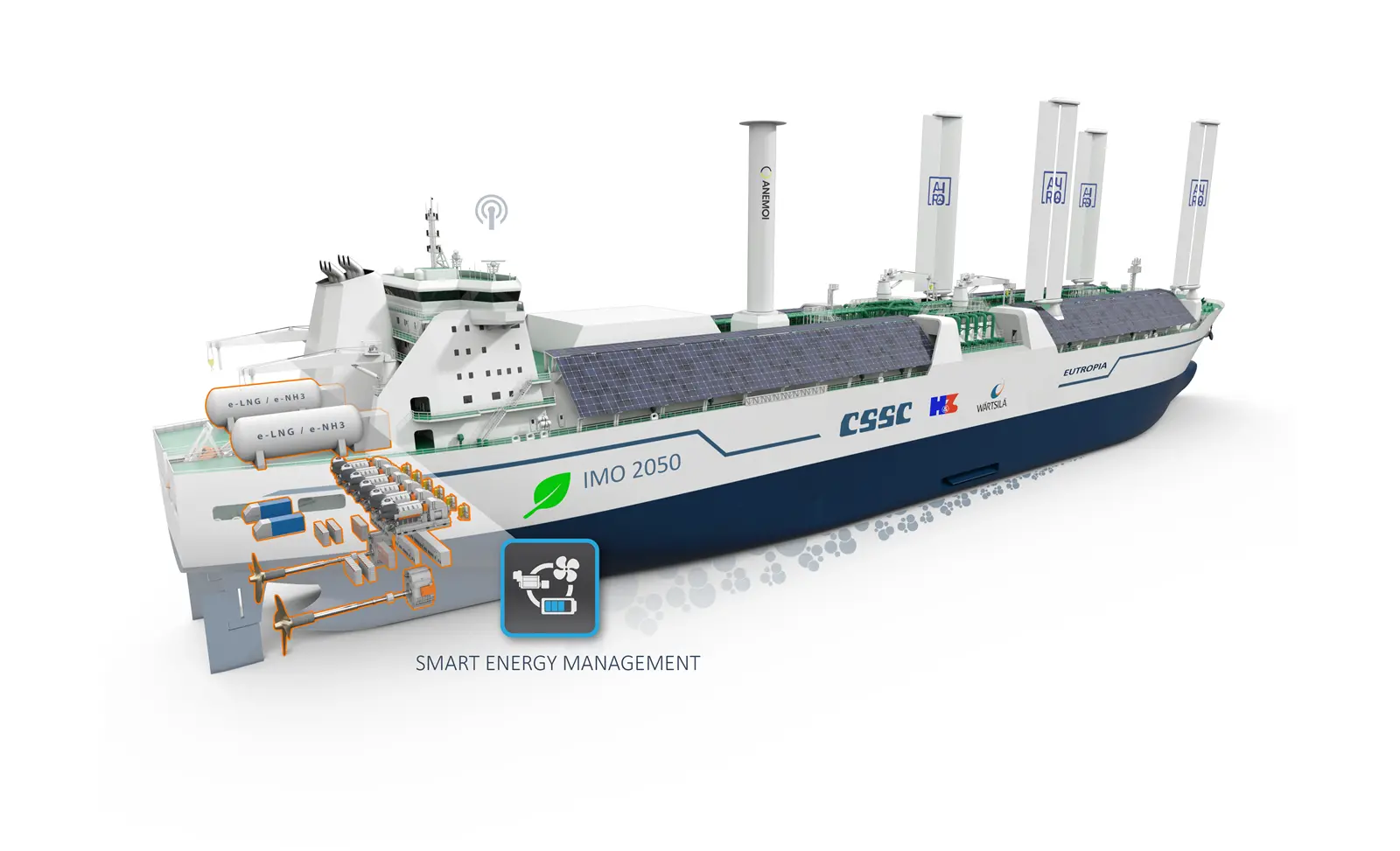
Wärtsilä, ABS and Hudong-Zhonghua Shipbuilding are collaborating on the design concept that is intended to deliver immediate CO2 savings as well as being ready for the adoption of future decarbonisation technologies to meet IMO’s CII trajectory of -70% by 2050.
The propulsion and auxiliary power plant will be built up around multiple latest generation 4-stroke multi-fuel engines operating initially on LNG, combined with a battery and smart energy management system. The base design will include heat recovery technologies and additional optimisations to the propulsion system made possible by the latest electric permanent magnet drive technologies that feature low speed and high torque. Energy saving devices including a Hull Air Lubrication System will also be included in the initial design.
Fuel flexibility is achieved as 4-stroke multi-fuel gensets running at nominal speed are able to easily burn alternative fuels via LNG blending or in high concentrations, says Grant Gassner, Director, Integrated Systems & Solutions, Power Supply at Wärtsilä Marine Power. The most likely scenario is that these fuels will be initially blended with fossil LNG from the cargo tanks. “For LNG carriers, the most likely alternative fuels introduced would be bio-methane, synthetic methane, ammonia or hydrogen which all could be used in Otto cycle.
One or more gensets could be replaced with alternative new low carbon power sources such as fuel cells, solar panels or heat to power energy recovery systems in the future. “Simply remove, or turn off, one genset from the common electrical distribution system and replace it with the new power source that can be either AC or DC,” says Gassner. “The modular, multi-engine nature of the plant, combined with energy storage, ensures that individual units are always running at high load with very high efficiency regardless of the load demand from propulsion and auxiliary systems.
“This also provides a suitable system foundation to accommodate new propulsion energy savings devices such as wing sails or Flettner rotors which can significantly reduce and create variability in the power demand from the propulsion plant. Additionally, methane slip is extremely low regardless of the vessel speed and power requirement thanks to latest engine technology and high load factors and the engine-battery hybrid.”
Novel electric propulsion enhancement is made possible with the design including potentially a gate rudder and large diameter low speed fixed pitch propellers. The flexibility of electric propulsion enables a far wider choice and room for optimization of the propeller designs now, and in the future for example application of contra-rotating propellers or pods are possible to implement, he says.
The inclusion of a shore power connection system for charging and zero emission port operation could be incorporated in the Day 1 design. Onboard carbon capture will be evaluated, but it is not yet clear if this will be included.
Expected emissions and costs savings will depend slightly on what technologies the customer wishes to take into newbuild directly and which technologies are taken up later, says Dr Gu Hai, Vice President, ABS, Head of Global Simulation Singapore. “In general, if one considers that the targets of IMO are to reach 40% reduction in CO2 intensity by 2030 and 70% reduction by 2050 (compared to 2008), the newbuild design might include technologies that satisfy IMO CII A-Rating up to about 2035-2040 and then the remaining technologies could be added at an appropriate point in time to secure IMO CII A-Rating up to 2050 without a significant compromise in vessel speed. If the owner did decide on speed reduction as a compliance lever, then the system efficiency also remains very high at low vessel speed. However, the overall objective of the project is to show a clear pathway while maintaining competitive speed through evaluation of alternative decarbonization technologies using advanced simulation methods.”
“Thanks to the compact and lightweight attributes of Wartsila’s 4-stroke multi-fuel engines, customers can realize an additional 4,000m3 of LNG cargo space versus a traditional 174,000m3 LNG carrier. The higher cargo delivered could be good for the CII and benefit the shipowner,” said Mr. Song Wei, R&D Director of Hudong-Zhonghua Shipbuilding. “The new design will make a double reduction for shipowners on low carbon footprint, low OPEX cost but higher income.”
The more detailed conceptual design will be carried out during Q4 2021, and it is anticipated that the vessel design will be enter commercial offering in Q1 2022. There are interested customers already inquiring” says Mr. Song Wei.
The design partners are expected to present further information at Marintec Shanghai in December 2021. Preliminary calculations show very good system performance and flexibility.