



Diesel-Electric Mode For Dutch Coasters
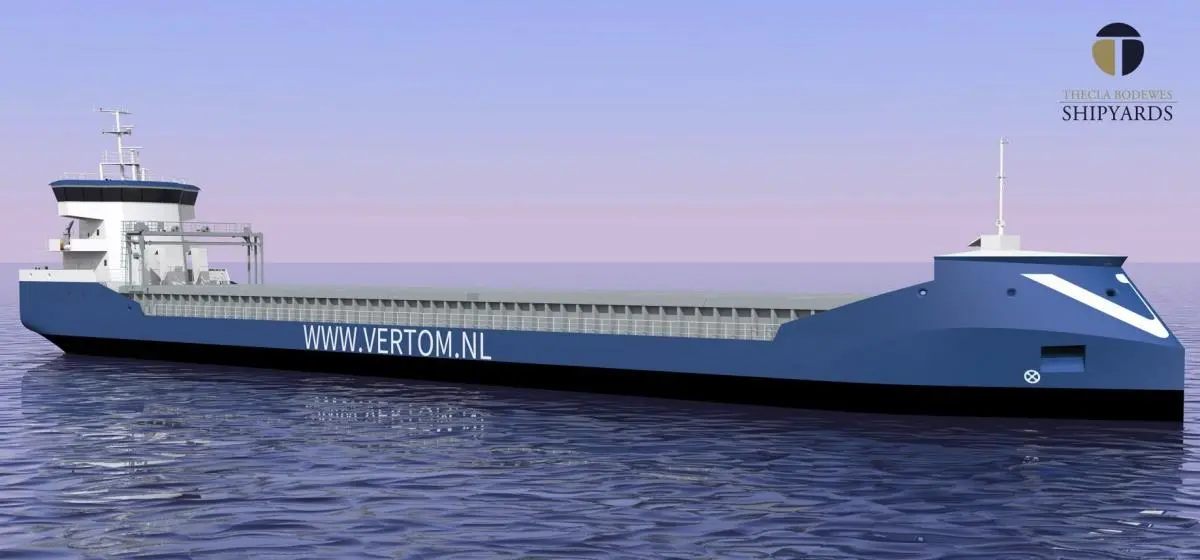
Four 7,000dwt multipurpose cargo vessels contracted with Thecla Bodewes (TB) Shipyards will be of the Labrax-type developed in conjunction with Groot Ship Design, originator of the energy-saving Cross Bow concept.
Construction has been allocated to the TB Group’s Kampen yard, on the Ijssel, the former Peters Shipyards. As a prompt delivery schedule has been stipulated, spanning slots through 2022 and 2023, keel-laying for the first vessel has already taken place.
Computational fluid dynamics (CFD) optimisation of the hull form has been undertaken so as to achieve a fuel-efficient speed/power relationship using what is described as a modular electric propulsion system.
Embodying a box-like hold configuration, to provide ease of handling and maximum stowage for the gamut of short-sea cargoes, the Labrax class has main dimensions of 118.6m length by 14.3m breadth.
Founded in 1974, Vertom has grown to become a diversified organisation, deploying a fleet of more than 70 owned and commercially-managed vessels, predominantly in the 3,000-7,000dwt range, albeit with a number of larger ships, complemented by chartering, agency, liner service and technical management activities across a European network.
TB Shipyards, which encompasses construction yards at Harlingen and Stroobos as well as Kampen, is following a strategy which reflects the market’s push for low- and ultimately zero-emission vessels.
An expression of this policy was the cooperation agreement signed earlier in the year with the Norwegian company TECO 2030 to develop a hydrogen-based fuel cell propulsion solution, aimed at low-profile sea/river coasters, inland waterway vessels, tugs and dredgers. A key objective is to commercialise the TECO 2030 marine fuel cell for inland waterway transport.
Related Articles
 ELECTRIFICATION AND BATTERY HYBRIDS
 ELECTRIFICATION AND BATTERY HYBRIDS
 ELECTRIFICATION AND BATTERY HYBRIDS