



DRIVE TO GREEN SHIPPING SHIFTS UP A GEAR
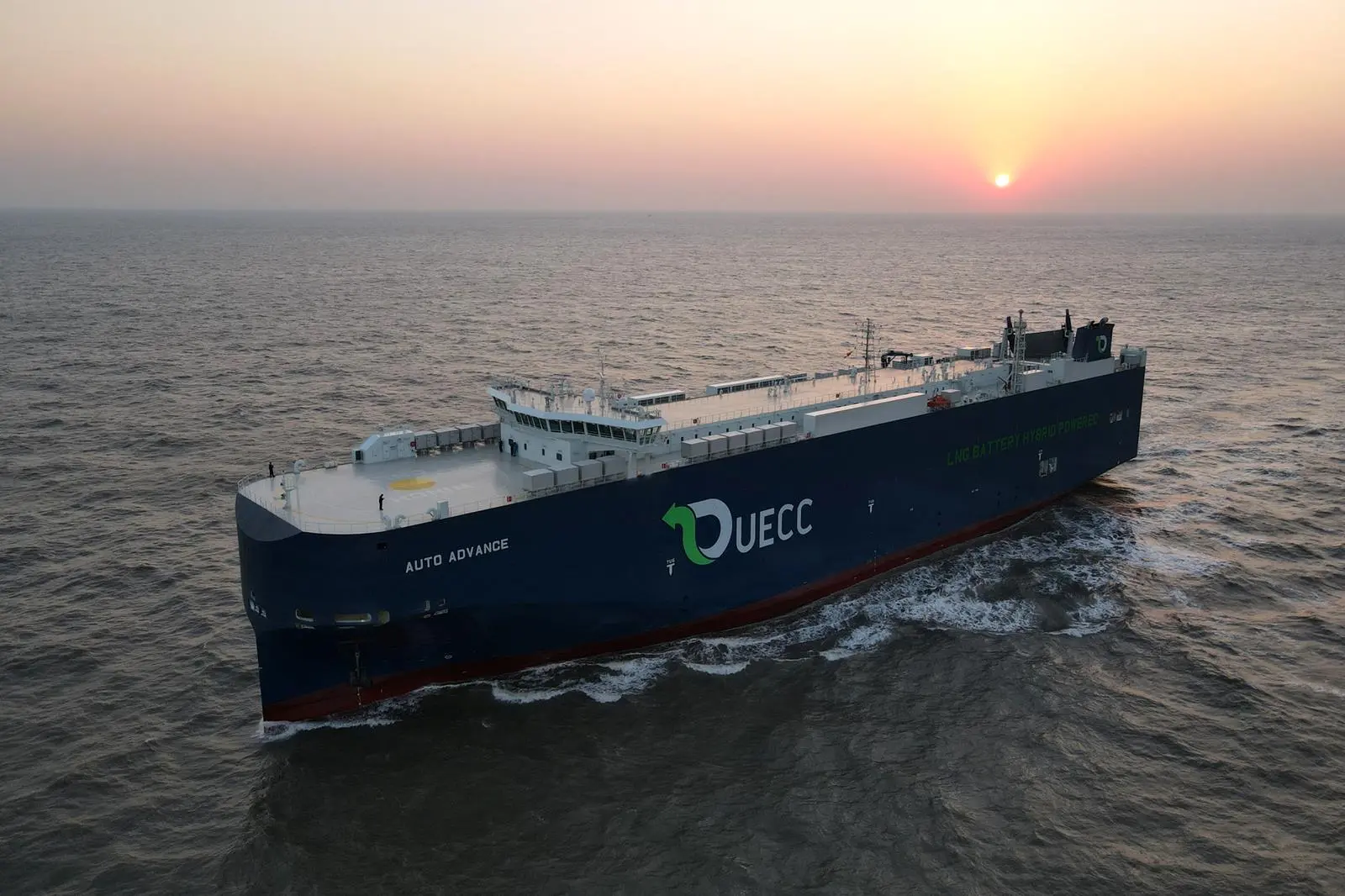
In company with the unerring drive to reduce cost per transported unit, new investments in dedicated vehicle carriers are increasingly shaped by the wider agendas of the powerful producer groups, as well as by the regulatory evolution as concerns ship emissions.
Exemplifying the response to these various forces is the latest generation of intra-regional traders ordered by United European Car Carriers (UECC), the first of which was handed over in China on 25 November. Leading a trio of 3,600 car-capacity newbuilds ordered from Jiangnan Shipyard, the 35,700gt Auto Advance subsequently sailed to load cargo in Nagoya, Japan, for her positioning voyage to northern Europe.
Hybrid LNG dual-fuel/battery powering, in conjunction with improved underwater hull lines, will enable the vessels to exceed the IMO requirement to cut carbon intensity by 40% in 2030, relative to the levels pertaining in 2008. The dual-fuel firing capability is embraced not only by the two-stroke propulsion machinery, but also by the four-stroke auxiliary gensets and main boiler.
UECC’s adoption of a hybrid solution builds on its earlier pioneering move in the sector, whereby the world’s first LNG dual-fuel pure car/truck carriers(PCTCs), Auto Eco and Auto Energy, were introduced to the north European traffic five years ago.
For the Auto Advance series, dual-fuel engine technology has been combined with an energy storage system (ESS) supplied by the Finnish company WE Tech. This incorporates a battery package from Corvus Energy, charged by a directly driven, permanent magnet(PM) shaft generator or the dual-fuel gensets. The ESS, which provides power to the main switchboard with a direct current (DC) link for energy distribution, enables peak shaving for the main engine and auxiliaries and affords an energy reserve for blackout prevention.
For charging at sea, the most efficient practice is to use the shaft alternator. This ensures that the batteries are in a fully-charged condition on entering port, so that the bow thruster can be solely and safely driven by the batteries, and which can also meet shipboard electricity needs while docked.
Whereas such a vessel would normally require a third genset, as on the Auto Eco class, the Auto Advance generation has only two auxiliary gensets, since the ESS and shaft generator confer a spinning reserve. Sized according to the new vessels’ anticipated operating pattern, the ESS is expected to achieve a payback time of five years.
In common with the slightly larger, preceding vessels, two-stroke dual-fuel power with direct drive to a controllable pitch propeller has been adopted, and a 500mm-bore cylinder size retained. However, a change of marque is involved. Whereas the previous vessels employ an MAN eight-cylinder S50ME-C, high-pressure gas-injected (GI) engine rated for 11,000kW at 113rpm, the Auto Advance type has been specified with a six-cylinder RT-flex50DF installation, from Winterthur Gas & Diesel (WinGD). The design’s nominal maximum continuous rating is 8,640kW at 124rpm.
MAN machinery figures in each of the newbuild series by way of a pair of 6L28/32DF dual-fuel auxiliaries, whereas the Auto Eco and Auto Energy are equipped with Wartsila 20DF, low-pressure dual-fuel gensets.
While LNG offers a 25% reduction in CO₂ emissions compared with other fossil fuels, the company is not locked into LNG as the dual-fuel engines employed offer scope for alternative, low-emission options such as biofuel, bio-LNG and synthetic LNG once these become commercially and logistically viable. UECC has already undertaken certain practical investigations, having trialled sustainably-sourced biofuel over a 12-month period in the 21 year-old, 2,080 car-capacity Autosky during the course of regular service between the north west Continent and northern Spain.
Besides resulting in a smaller carbon footprint, running the new ships in gas mode will cut SOx and PM emissions by 90%, and the accompanying 85% abatement in NOx also ensures compliance with IMO Tier III controls for the North Sea and Baltic.
The hybrid power plant as a whole is steered by a Kongsberg Maritime-supplied intelligent management system, acting as a control for overall energy production and consumption.
The payload is accommodated on 10 decks within a hull envelope of 169m x 28m x 13m. The vessels adhere to the principle of load flexibility, such that the deck configuration and structural parameters incorporated allow for a wide range of ‘high and heavy’ freight plus breakbulk cargoes, in addition to cars and trucks.
The latest breed has been developed by the Oslo-headquartered operator in conjunction with DNV and Shanghai Merchant Ship Design & Research Institute (SDARI), which provides design input to Jiangnan. While UECC has carved its own niche and built its own name in the European short-sea market, the project also reflects the business culture of the company’s joint owners NYK Line and Wallenius, both of whom have been to the fore in implementing ‘green’ initiatives in the deep-sea ro-ro/PCTC business.
Production of the second and third newbuilds, Auto Achieve and Auto Aspire, is well in hand at Jiangnan, with deliveries set for 2022.
The 2016-built Auto Eco and Auto Energy are slightly larger, 1A Super ice class vessels, of 181m length and 30m beam, accommodating 3,985 cars (by the RT43 measurement standard) on 10 decks. The layout includes provision for 6,000m2 of ‘high and heavy’ cargo.
That earlier fleet project had testified to China’s rising star in the PCTC stakes, having been fulfilled by Nantong COSCO KHI Ship Engineering (NACKS), and benefiting from Kawasaki’s long-crafted expertise in the sector. UECC’s decision to return to China for the latest generation, ordered and organised in terms of main equipment supply in 2019, before the onset of the pandemic, speaks as to its experience with the earlier project.
With an eventual five ‘eco-friendly’ PCTCs in its 17-ship fleet, the company is looking to gain a commercial edge in the European market through the focus on a greener shipping future.
Every facet of the build and supply chain is now coming under scrutiny by European automotive manufacturers from an environmental standpoint. Moreover, EU plans to include shipping in the Emissions Trading System (ETS) will clearly give less pollutant shipping an advantage.
TECHNICAL PARTICULARS
Auto Advance
| Length overall | 169.11m |
|---|---|
|
Length bp |
164.46m |
|
Breadth |
28.00m |
|
Depth |
13.08m |
|
Draught |
8.80m |
|
Gross tonnage |
35,667t |
|
Deadweight |
12,457t |
|
Capacity, car equivalent units |
3,600 |
|
Main engine |
WinGD 6RT-flex50DF |
|
Class |
DNV |
|
Class notations |
1A Car carrier, BIS, Battery(Safety), BWM(E<f>,T), DG(P), E0, Gas-fuelled, LCS, MCDK, Naut(Nav), Recyclable, TMON(oil-lubricated( |
|
Flag/registry |
Portugal/Madeira |
Related Articles
 ELECTRIFICATION AND BATTERY HYBRIDS
 ELECTRIFICATION AND BATTERY HYBRIDS
 ELECTRIFICATION AND BATTERY HYBRIDS