



New Chapter Opens In Short-Sea Trade
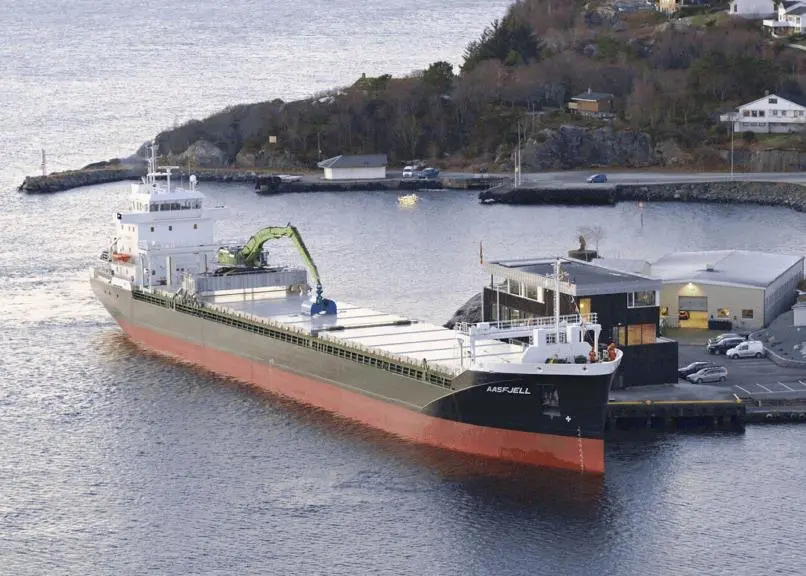
The medium-speed main engine drive is complemented by an electric motor and a bank of batteries, and the ship is fitted for cold-ironing in port. Promising inter-related fuel savings and reduced environmental impact, the arrangements are claimed to be the first of their kind in the minibulker category.
The investment is the latest in a growing line of fleet renewal projects implemented by the north European short-sea trading community that acknowledge the need for an energy transition in shipping.
Aasfjell has two holds providing a combined capacity of approximately 382,000ft3 and suited to the owner’s principal business in the transportation of stone, salt, cement, grain, scrap, round timber and other commodities, with scope also for breakbulk and project shipments.
Self-reliance in cargo working, a feature that permeates the Aasen fleet, is achieved by means of an electric excavator, supplied by the German manufacturer Sennebogen, mounted on rails spanning both hatchways and affording an outreach of about 13m. A full-cycle self-discharge rate 650t per hour is offered by the equipment, which also provides for loading from berths and ports with limited facilities.
Proven, compact main machinery has been chosen for the Aasfjell in the shape of an eight-cylinder model of the Wartsila L26 engine, producing 2,600kW delivered through a reduction gearbox to a controllable pitch propeller. The installation provides for a laden speed of 11 knots and delivers efficiency advantages by the inclusion of a shaft generator driven off the gearing. The PTO generator can additionally act as an electric motor in PTI mode, receiving its power from the battery pack in the engine room. In turn, with the main engine running, the batteries can be recharged using the PTO function.
The battery pack will enable peak shaving at sea. Whenever propulsion power needs to be augmented in heavy seas, the batteries will provide boost energy to the propeller, and whenever overload of the main engine is detected, the batteries will absorb and store the excess energy. This promises more stable engine performance in the varying, often adverse sea and weather conditions endemic to the region, contributing to fuel efficiency. Propulsion and manoeuvring in port, in the right circumstances, may be achievable on battery power alone.
Moreover, the electric excavator will draw power from the 535kWh energy storage system, obviating use of diesel generators and production of exhaust emissions. Alternatively, the ship has a connection that will allow the onboard, in-port load to be met from the shoreside grid.
In addition to the sistership rapidly taking shape for Aasen, shipbuilding contractor Royal Bodewes also has a further order from Norway encompassing excavator-fitted, hybrid-powered minibulkers, albeit smaller at 5,000dwt. Two vessels booked by Hagland Shipping of Haugesund are due to be delivered within the opening half of 2023, and options are held on third and fourth units.
MAIN PARTICULARS – Aasfjell
|
Length overall |
119.95m |
|
Length bp |
118.00m |
|
Breadth, moulded |
15.80m |
|
Depth |
10.15m |
|
Draught, maximum |
7.50m |
|
Deadweight, all-told |
9,430t |
|
Deadweight, carrying capacity |
9,100t |
|
Gross tonnage |
5,699t |
|
Holds |
2 |
|
Hold capacity |
381,832ft3 |
|
Self-discharge rate |
650t/h |
|
Main engine power |
2,600kW |
|
Speed, laden/ballast |
11/12kts |
|
Battery capacity |
535kWh |
|
Bow thruster |
450kW |
|
Class |
RINA |
|
Registry |
NIS/Haugesund |
Related Articles
 ELECTRIFICATION AND BATTERY HYBRIDS
 ELECTRIFICATION AND BATTERY HYBRIDS
 ELECTRIFICATION AND BATTERY HYBRIDS