



New polymer fuel cell power density advance
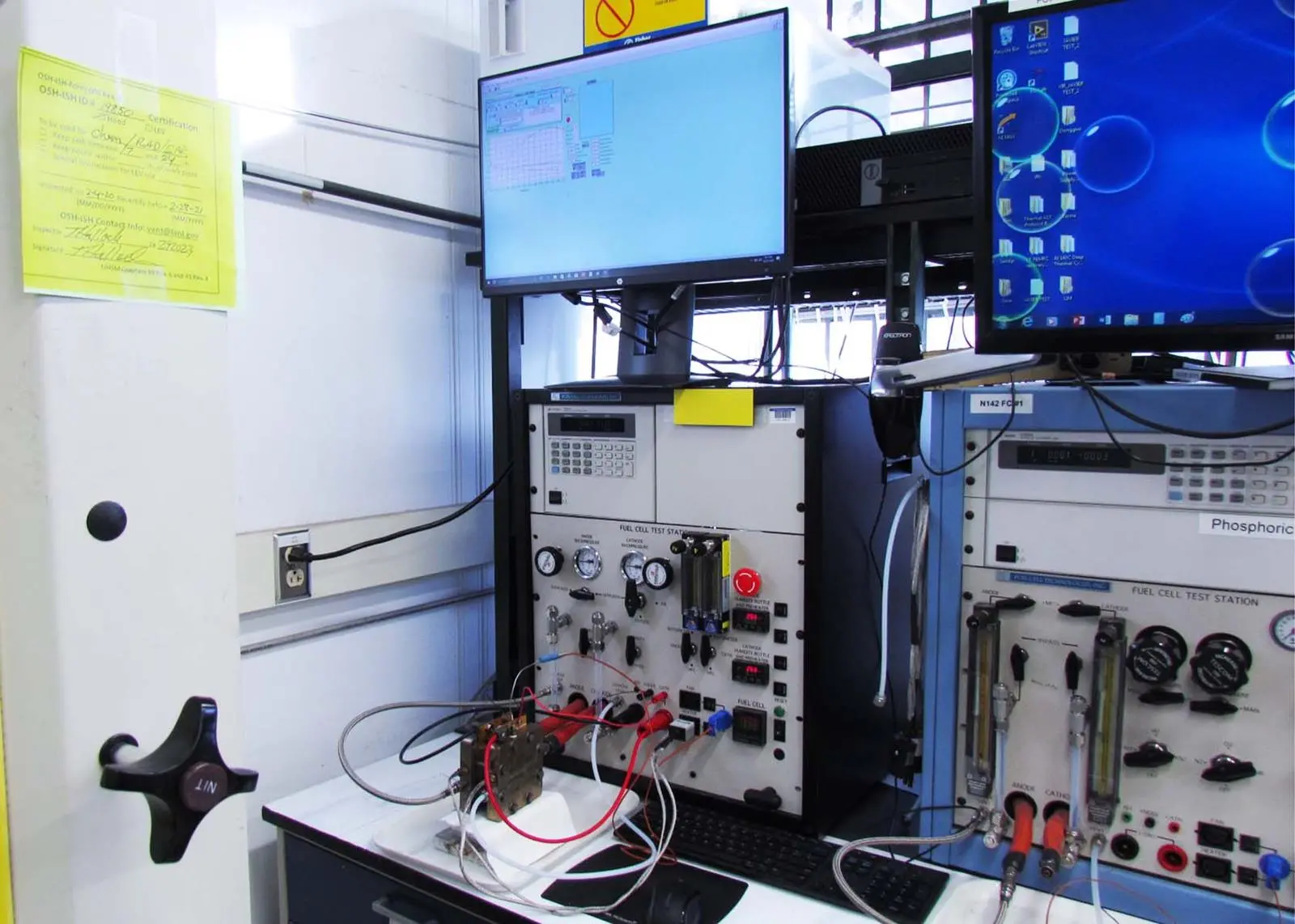
The technology solves the longstanding problem of overheating, one of the most significant technical barriers to using medium-and heavy-duty fuel cells in transportation vehicles such as trucks and buses and for marine and rail applications.
Current fuel cells operate at 60-80oC and require large radiators and air intakes in order to stay cool enough to operate. To resolve this issue, Los Alamos National Laboratory scientists developed the new polymer fuel cell that operates at higher temperatures.
Conventional high-temperature polymer electrolyte membrane (PEM) fuel cells use phosphoric acid as an electrolyte at the electrode. In this research, the Los Alamos team designed a polymer electrolyte composed of a phosphonated polymer and a perfluorosulfonic acid. In this composite electrolyte structure, the team found that a proton from the perfluorosulfonic acid transfers to the phosphonated polymer and dramatically enhances proton conductivity. Using the composite polymer electrolyte, the researchers were able to achieve a nearly 800 milliwatts per square centimetre rated power density for the fuel cell at 160oC, which is a 60% improvement over phosphoric acid-based fuel cells.
The paper Protonated phosphonic acid electrodes for ion-pair high temperature polymer electrolyte membrane fuel cells was published in Nature Energy.
Related Articles
 BATTERIES, SUPERCAPACITORS, FUEL CELLS AND OTHER ENERGY STORAGE TECHNOLOGY
 BATTERIES, SUPERCAPACITORS, FUEL CELLS AND OTHER ENERGY STORAGE TECHNOLOGY
 BATTERIES, SUPERCAPACITORS, FUEL CELLS AND OTHER ENERGY STORAGE TECHNOLOGY