Dutch Investment In Short-Sea Renewal
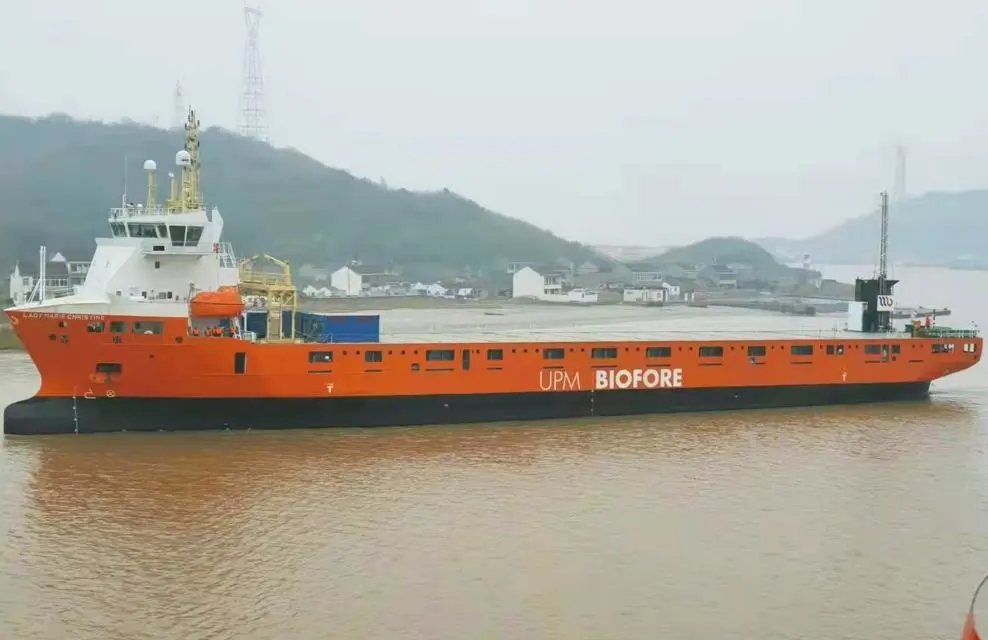
The newbuild project is underpinned by a long-term timecharter agreement with the Finnish forestry products group UPM covering all four lo-lo vessels. In addition to the primary capability for southbound shipments of paper, pulp, timber, plywood and other goods, and northbound loads such as china clay, woodchips and pulpwood, the design enables the transportation of project cargo on the flush deck or in open-top, hatchcoverless mode.
To better ensure unfettered, independent operation during Baltic winter ice conditions, the Lady Marie Christine has been constructed, fitted and powered to Finnish-Swedish ice class 1A standard.
The bridge and accommodation superstructure are arranged forward, maximising stowage space and lo-lo access, and affording greater protection to the freight and single hold when navigating in open-top mode. Expediency has also led to an offset starboard quarter location for the low-profile funnel casing. Deck capacity is claimed to have been increased by 25% relative to similar sized vessels with a conventional all-aft configuration.
Hold monitoring arrangements include acceleration sensors to minimise the risk of cargo damage in rough weather.
The hull shape was optimised using CFD calculations and model tank tests at HSVA’s Hamburg premises, and the layout was determined so as to house the LNG fuel tank underdeck aft with minimum impact on revenue earning volume.
The main engine is a six-cylinder model of the Wartsila L34DF medium-speed type, turning out 2,550kW and driving a nozzled controllable pitch propeller through a reduction gearbox for a design speed of 12.5 knots. Hull/propeller interaction has been addressed through Wartsila’s Opti Design concept so as to cut energy losses.
The emissions benefit of LNG is quantified as up to 85% reduction in NOx, virtual elimination of SOx and particulates, plus 25% less CO2. Moreover, the nature of the power installation and the LNGPac fuel storage system is conductive to future fuel choices such as bio LNG, bio methanol or ammonia.
Energy-smart features include a shaft generator PTO interposed on the drive line for the sea-going electrical load, acting at all power/speed combinations, and a comprehensive waste heat recovery system, working off the auxiliaries as well as the main engine, using cooling water heat to warm the accommodation in colder environs.
Lady Marie Christine, which was handed over on 24 January, is set to be followed during 2022 by the Lady Mathilde, Lady Menna and Lady Monique from the Wuhu yard, upstream of Nanjing on the Yangtse.