



6,000 inland vessels targeted for swappable battery power
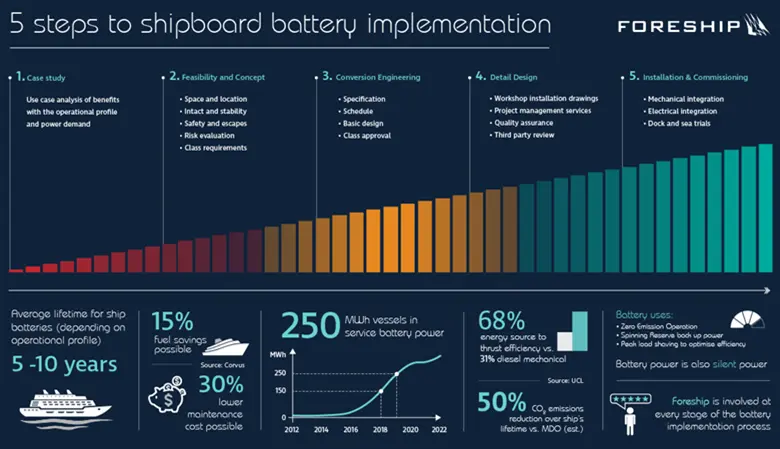
The market sector analysis was described in the naval architecture and marine engineering firm’s Ship Applicability Type Technical Report delivered to partners of the EU-funded Horizon 2020 Current Direct project underway until the end of 2023.
Foreship is developing specifications and requirements for the waterborne system and optimised ship design for the project whose 13 partners aim initially to demonstrate and commercialise a swappable ‘e-house’ containing batteries to power inland vessels.
The project has estimated that the use of swappable batteries and an energy-as-service platform could cut as much as 482,000 metric tonnes of CO2 equivalents from water transport emissions in Europe each year.
Waterborne transport emissions represent about 13% of the overall European greenhouse gas emissions from the transport sector, with the potential to increase between 50% and 250% by 2050 under a business-as-usual scenario. Current Direct aims to cut GHG emissions in Europe’s marine transport sector and trigger investments in this and the battery energy storage sector. Further goals include a 50% reduction in the total lifetime cost of waterborne transport batteries and a 300% increase in the installed energy of containerised energy storage systems.
Foreship is developing a framework for standardized interfaces to support the mechanical and electrical infrastructure that will be needed. The company was also instrumental in the core development of the Current Direct Voyage Energy Planner Tool, which provides vessel owners with a battery swapping energy plan for inland waterway vessels based on a limited number of vessel and journey parameters.
The Planner provides a selection from several generic power profiles that provide simplified percentage power versus percentage time journeys along the Rhine Corridor. The resulting Energy Plan provides the indicative energy needs of inland waterway vessels and fleets and can assist owners to commence planning for the transition to a zero-emission solution based on swappable battery container technology.
The energy-as-service platform will consider how many battery swapping systems of what size to build, and where to build them, as well as the deployment of chargers and reserve batteries, revenue management methods and charging strategies.
Increasingly scalable solution
Foreship Chief Technology Officer, Jan-Erik Räsänen, said that with the EU considering a marine tax on residual fuel oil from 2023 promising cases for low carbon liquid alternatives were being compromised by lack of availability, uncompetitive pricing, or both.
“Outside HFO, MGO and LNG, availability will be an issue for all other options until around 2035, whereas we have to do something now to meet decarbonisation goal,” said Räsänen. “Zero-emission battery power is already viable and increasingly scalable.”
Swappable battery containers
The Current Direct swappable battery solution envisages one or more batteries installed in an e-house. The swappable battery containers will be able to provide up to 1MW of power and at least 3MWh of energy to support long distance zero-emission voyages. Specially engineered for waterborne transport, the lithium-ion batteries will eliminate shore charging points and by swapping out the containerised solution in transit, costs will be controlled.
New cell technology
Blackstone Resources is developing a novel 3D printed cell manufacturing processes which enables thicker electrodes to increase cell level energy density. Additionally, an advanced anisotropic composite material being developed by the University of Brussels to reduce pack level costs and increase energy density through its combination of unique material properties.
A smart cell supervisor is being developed by Vito to provide wireless data acquisition and store highly granular information that could reduce costs and increase value in second life applications.
The amalgamation of these technologies into an optimised battery pack will be done by Spear Power Systems in close cooperation with Wärtsilä which will develop the fully integrated package based on a standard 20-foot shipping container.
Prototype development
Räsänen said that work on a prototype e-house was underway, with a demonstrator vessel in the Port of Rotterdam expected to start operating in 2023, creating a pathway towards commercialisation. In parallel, liaison with waterway authorities on the regulatory and classification requirements for battery-powered vessels to operate along Europe’s inland network is being handled by Lloyd’s Register.
“The standardisation we develop in the Current Direct project will be critical for the contribution battery power can make to GHG goals on a commercial basis,” he added. “As well as a standard footprint for the e-house and its foundations, we are developing the common power connections, standardised communications and fire precautions needed to deliver safe, flexible and green operations.”
A second study for the project, covering coastal ships applicability, is already under consideration.
Related Articles
 BATTERIES, SUPERCAPACITORS, FUEL CELLS AND OTHER ENERGY STORAGE TECHNOLOGY
 BATTERIES, SUPERCAPACITORS, FUEL CELLS AND OTHER ENERGY STORAGE TECHNOLOGY
 BATTERIES, SUPERCAPACITORS, FUEL CELLS AND OTHER ENERGY STORAGE TECHNOLOGY