Sustainable cruising
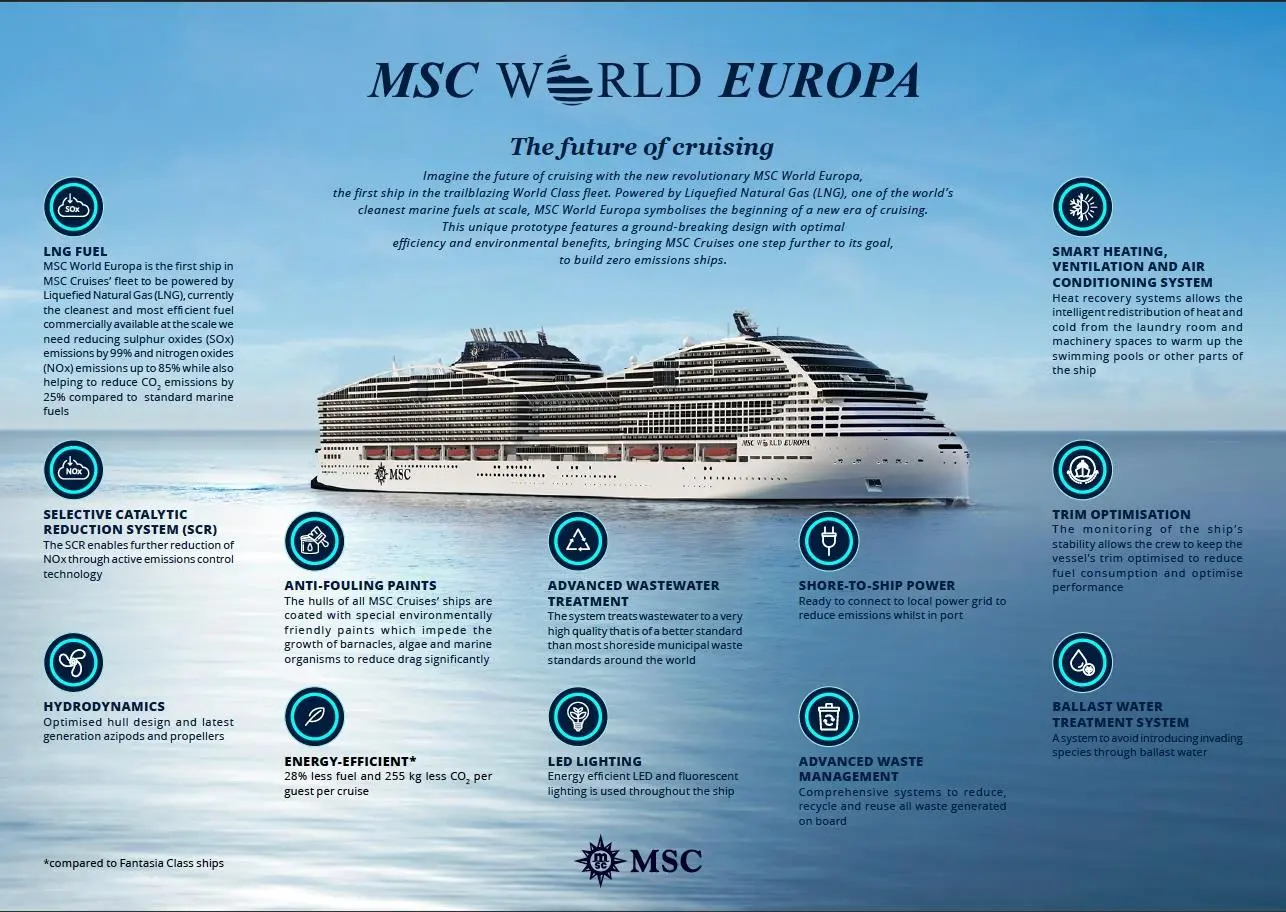
MSC Cruises’ World Europa will also be the first contemporary cruise vessel to feature solid oxide fuel cell (SOFC) technology powered by LNG, which has been developed by MSC Cruises, Chantiers de l’Atlantique and Bloom Energy.
“We are committed to a net-zero future, which is why we are investing heavily in the development of low-carbon fuels and solutions that will accelerate the decarbonisation of the maritime sector,” said Linden Coppell, director of sustainability for MSC Cruises.
“MSC World Europa will be our most efficient ship yet and help us prove and refine environmental technologies for the future of our fleet.”
The ship will include a 150-kilowatt SOFC demonstrator that will generate auxiliary power, increasing efficiency and reducing CO2 emissions compared to traditional internal combustion engines. It will be a testbed for the development of fuel cell technology for cruise ships and offers a potential to enable hybrid propulsion solutions in the future.
If LNG is not available the selective catalytic reduction system will reduce NOx emissions by 90% ensuring that the IMO’s Tier III NOx emissions standards will always be met regardless of type of fuel used. MSC World Europa is also fitted with shore-based power connectivity to minimise engine use at ports where the infrastructure is available.
MSC World Europa also features wastewater treatment technology which complies with the IMO’s MEPC 227(64) Resolution and the IMO’s Ballast Water Management Convention along with a range of smart ventilation and air conditioning systems, LED lighting and automatic systems for remote energy monitoring and analysis.
MSC Cruises has three firm orders for LNG-powered vessels, for delivery between 2022 and 2025, representing an overall investment of more than €3 billion. MSC World Europa will be followed by MSC Euribia, which is also currently under construction in Saint Nazaire and set to enter service in 2023. Construction of the third ship is set to begin in early 2023.