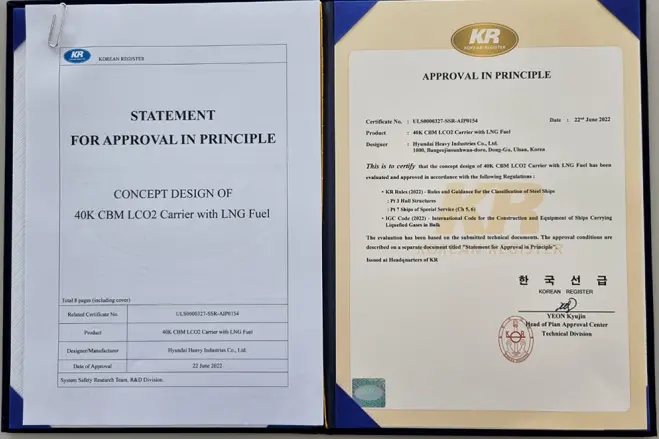
AiP issued for large LNG-fuelled LCO2 carrier
Transporting CO2 in a liquid state requires a pressure C-Type cargo tank capable of withstanding a high vapor pressure of over five atmospheres or greater. However, this type of cargo tank is usually used for smaller carriers, and there are technical difficulties in enlarging the size of the tank to meet the market need to transfer a larger amount of CO2 to storage facilities.
In addition, the tanks and supporting structures of LCO2 carriers must be designed with the greatest care because of the high specific gravity of liquefied CO2.
To address these technical challenges in designing LCO2 carriers, KR and HHI conducted a joint development project (JDP) to develop the new design. HHI carried out the basic and structural design of the 40K CBM LCO2 carrier, while KR verified the safety and conformity of the design reviewing the class rules and international conventions.
One of the main aims of the project was to explore the economic feasibility of large pressure-type CO2 storage tanks. To increase the size of the CO2 storage tanks, special materials with low-temperature and high-tensile need to be used instead of ordinary steel, which makes it challenging to control the thickness and weight of the tanks. The safety of the carrier’s cargo hold, cargo tank and supporting structure has been verified and approved using KR’s SeaTrust-HullScan software solution which was developed in house.
A KR official said: “This AIP is a significant achievement, bringing the commercialisation of large LCO2 carrier technology even closer. KR will continue to support the industry’s work to develop CO2 capture, storage and burial-related technologies, while proactively working to address the industry-wide challenge of decarbonisation.”