



Dawning Of Lightweight Hybrid Ro-Pax
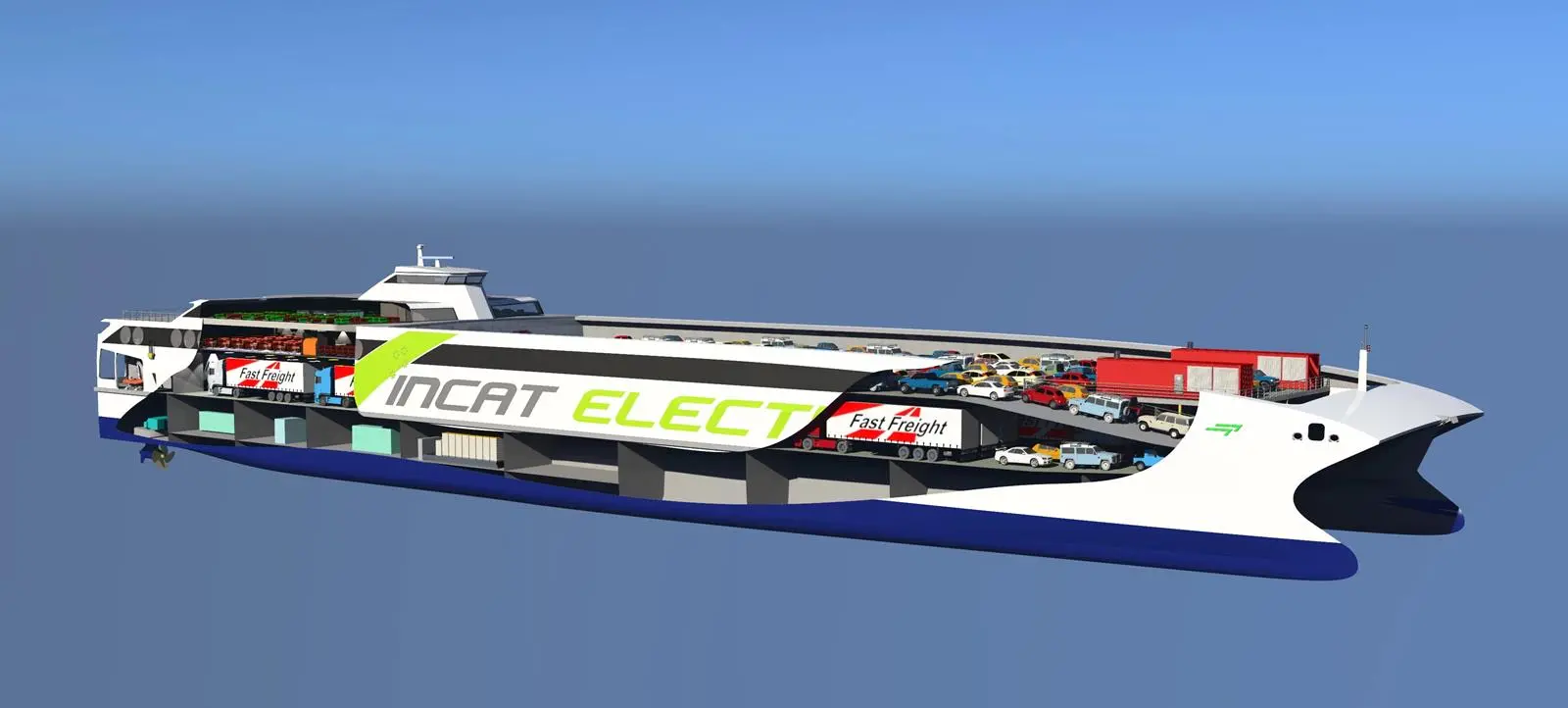
Conceived by the Incat Group company Revolution Design, the innovative new type is 148m in length, raising the bar in the context of wave-piercer capacity and scale economy, offering substantial savings in energy usage and power needs, and displaying ‘green’ credentials. A slightly larger version, at 151m, is also foreseen.
The Incat 148E design offers a transitional route to zero-emission performance in the ferry sector, enabling regular service at up to 21 knots in hybrid mode and adaptation to full battery operation at a later stage. On a waterline length of 146.4m and draught of 4.1m, the twin hull spans 30.5m.
As drafted, the 148E is laid out for a vehicular load equating to 2,194 linear metres in lanes of 3.1m and 2.3m, plus up to 1,200 passengers. The main garage deck offers 1,068 lane-metres for freight, while the weatherdeck ahead of the superstructure provides 914 lane-metres primarily for cars and vans. The balance of 212 lane-metres is available on the forward, internal ramps.
A clear height of 4.6m is obtainable throughout the main deck level, while a headroom restriction of 2.1m applies elsewhere. The ro-ro payload capability corresponds to approximately 60 tractor/trailer combinations plus 245 cars.
The location towards the stern of the passenger block, where seating for nearly 1,200 is arranged in lounges on two decks, promises a more comfortable voyage in head seas than would be the case were the accommodation placed forward.
Incat’s weight-saving approach to hull lines, structures and onboard systems fosters minimum energy consumption. The rationale behind the design and construction concept is that the same power will propel a light displacement aluminium ship through waves more effectively than its heavy displacement, steel counterpart. While a battery installation implies high density, the amount of batteries can be reduced by lowering the vessel’s average speed requirement.
The most efficient electric-powered ship, asserts Incat, will be light and will sail at medium to low speeds.
The designers indicate that the lightweight ferry will use up to 40% less power than a comparable capacity passenger/vehicle ferry, with corresponding savings in emissions. Furthermore, the aluminium wave-piercing ro-pax can more readily be converted to a zero-emission setup due to its lower power requirement.
Electric power is supplied by a battery outfit amounting to 10MWh of energy storage, with diesel augmentation for hybrid operation from CAT XQC containerised diesel gensets, or power modules, feeding two Azipod electric azimuth propulsors.
The podded units in the preliminary specification are of the DO1100 type, which yield an output in the 2,775-3,470kW range for ship speeds of around 20 knots. The Azipod D technology blends the best features of the original C-series with those of the high-output XO type.
It is foreseen that the gensets would cover 50% of power needs as a whole, and would effect battery recharging when alongside where no link with the shoreside grid is in place. At a future stage, the battery capacity could be increased to 30MWh, conferring greater range and speed in electric mode.
Incat recently entered a collaboration with ABB to further develop the 148m ferry concept and similar vessels. Seeking a viable pathway to zero-emission performance in the mid-sized segment of the ferry market, the two companies will evaluate hybrid operation and adaptability for a subsequent switch to full battery-electric mode. As and when shore charging facilities materialise, Incat-built electric ferries such as the 148E type and the slightly longer 151E would make greater use of batteries as proposed.
Besides the Azipod propulsion technology, giving assurance of precise control and manoeuvrability with maximised efficiency across the vessel’s operating profile, the ABB involvement in the 148E design would extend to the proprietary Onboard DC Grid power distribution, Ability power and energy management systems (PMS/EMS), 800xA distribution control systems and remote diagnostic system.
The orderbook at Incat’s Hobart yard in Tasmania comprises three wave-piercing ferries, including the 130m LNG dual-fuel newbuild contracted by Buquebus for River Plate crossing, a 76m vessel booked by a South Korean operator, plus a 120m cat to unspecified account.
Related Articles
 ELECTRIFICATION AND BATTERY HYBRIDS
 ELECTRIFICATION AND BATTERY HYBRIDS
 ELECTRIFICATION AND BATTERY HYBRIDS