



TECO 2030 produces its first fuel cell stack
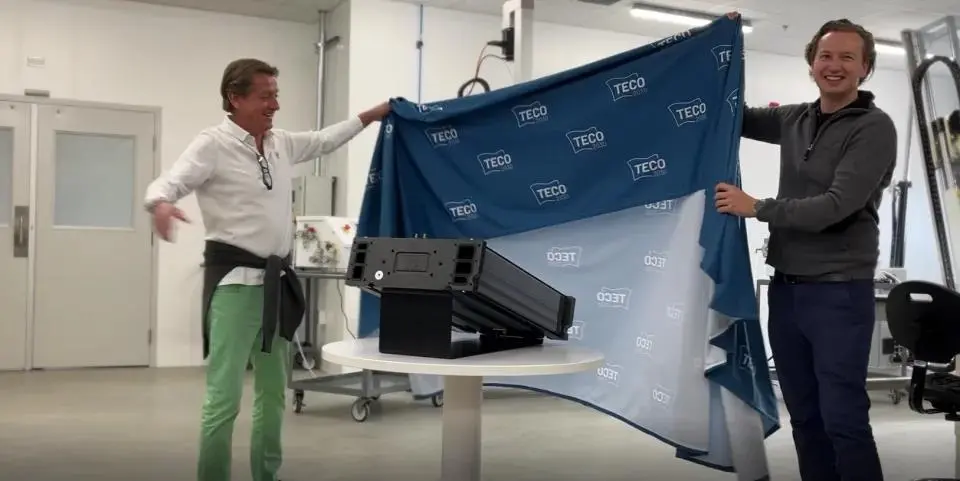
A fuel cell stack consists of a number of individual stack cells, each generating electricity from electrochemical reactions based on fuels such as hydrogen. TECO 2030’s PEM fuel cell stack contains a few hundred stack cells and provides a net output of 100 kW. The stacks are then combined together with balance of plant components into a fuel cell module.
Several modules, in turn, can be combined to supply the megawatts of output needed for applications such as ship propulsion, auxiliary power and other heavy-duty applications.
TECO 2030 plans to assemble and test the first FCM400 (Fuel Cell Module 400 kW) during the summer of 2023 at technology partner AVL’s facility in Graz, Austria.
TECO 2030 will gradually increase production during 2023 to supply fuel cell systems for a number of pilot projects, followed by automated volume production at its gigafactory in Narvik, Norway, from early 2024.
TECO 2030 has recently announced several pilot projects that will proceed in 2023, covering fuel cell systems for marine applications, trucks and construction sites. TECO 2030’s HydroPilot project, supported by ENOVA, is planned to be delivered in Q3 2023. The order value is NOK 20 million, and if the option is exercised the total will be brought up to NOK 30 million.
Another pioneering project is the announced HyEkoTank, where TECO 2030, Shell and partners received EUR 5 million from Horizon Europe. The HyEkoTank project aims to retrofit a product tanker with 2.4MW fuel cells during 2024 for zero-emission port operations and up to 100% emissions reduction.
TECO 2030 is also involved in pilot projects for construction applications. Implenia Norway has ordered an 800kW HydroPilot container, with an option to increase the power capacity up to 1.6MW. The project will demonstrate that construction sites can operate emission-free.
Related Articles
 BATTERIES, SUPERCAPACITORS, FUEL CELLS AND OTHER ENERGY STORAGE TECHNOLOGY
 BATTERIES, SUPERCAPACITORS, FUEL CELLS AND OTHER ENERGY STORAGE TECHNOLOGY
 BATTERIES, SUPERCAPACITORS, FUEL CELLS AND OTHER ENERGY STORAGE TECHNOLOGY