



CSOV chosen for LOHC-fuel cell propulsion
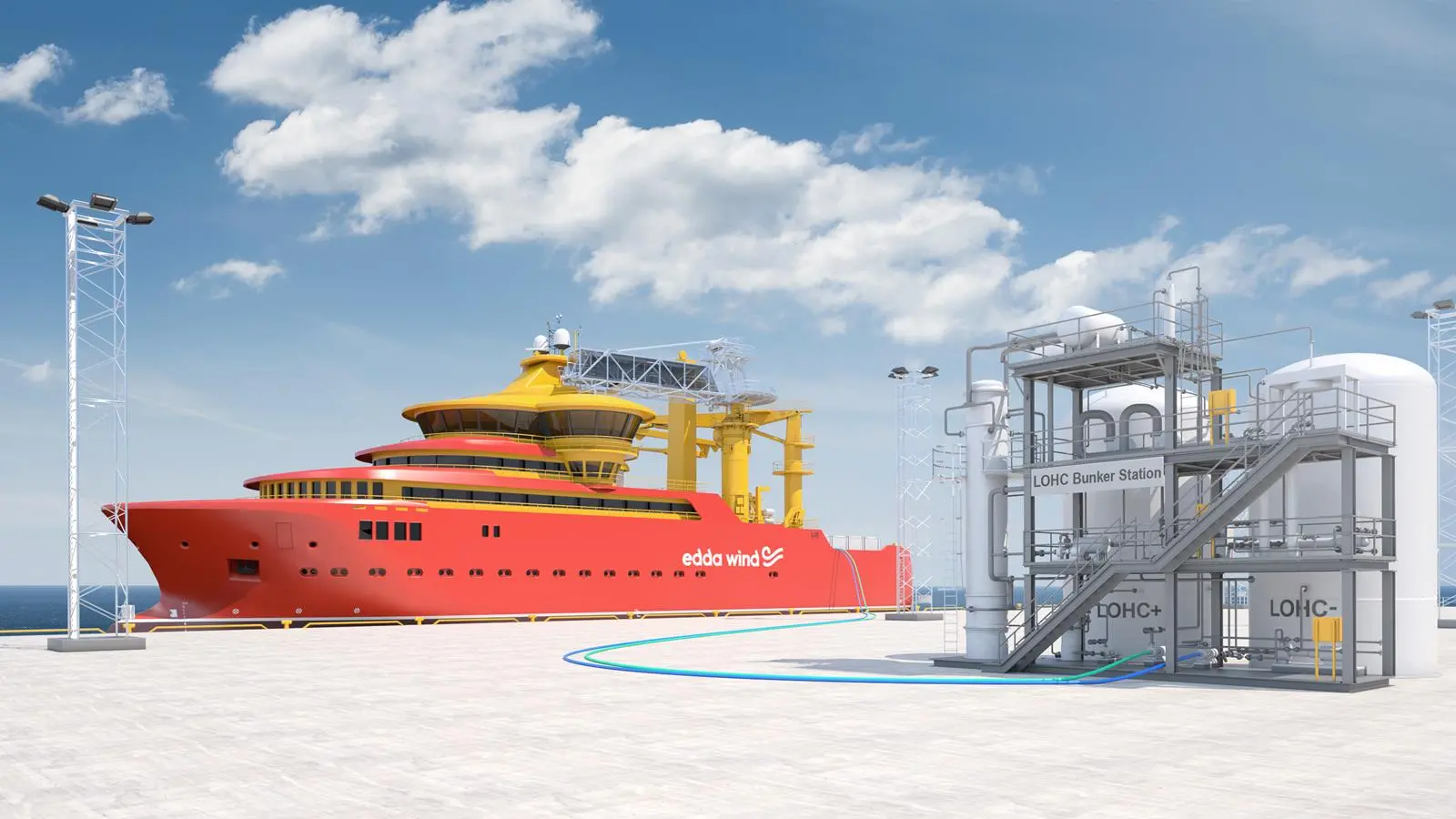
The Ship-aH2oy project is developing a zero-emission commissioning/service operation vessel (CSOV) using an SOFC fuel cell fuelled using green hydrogen stored in a LOHC. Edda Wind is providing a service operation vessel from their newbuild LOHC-ready fleet for the project.
Among other partners, the project includes Østensjø Rederi, project manager for the Edda Wind vessel, Hydrogenious LOHC Technologies which will oversee the detailed design of the LOHC release unit and the integration with the SOFC, and Hydrogenious LOHC Maritime which will interface with the external SOFC supplier and manage the entire system to be installed on the already-prepared vessel by 2025.
The CSOV will carry enough energy onboard to operate in normal intervals of up to four weeks without refuelling. “Hydrogen will be released in the onboard process plant, the Release Unit, where LOHC with bonded hydrogen is heated up in presence of a catalyst. It’s a chemical process. The hydrogen will be used to produce power in the SOFC on board,” explains Øystein Skår, General Manager at Hydrogenious LOHC Maritime.
In general, conventional infrastructure for fossil-based fuels, such as diesel, can be used for LOHC bunkering. LOHC can be pumped on and off from the vessel. Hydrogen-loaded LOHC will be pumped on board, and – after the release process – the “used” LOHC without hydrogen will be pumped off. This LOHC will be transported to a LOHC storage plant for reuse and again charged with new hydrogen. The tank system for bunkering and on board must have both tanks for LOHC with and without hydrogen stored.
The project partners expect that Hydrogenious’ patented LOHC technology will revolutionise the supply chain for hydrogen. “Direct onboard use of LOHC in shipping will benefit from the overall LOHC value chain being established especially in and around ports due to necessary large-scale imports via sea,” says Dr Daniel Teichmann, Founder and CEO of Hydrogenious LOHC Technologies.
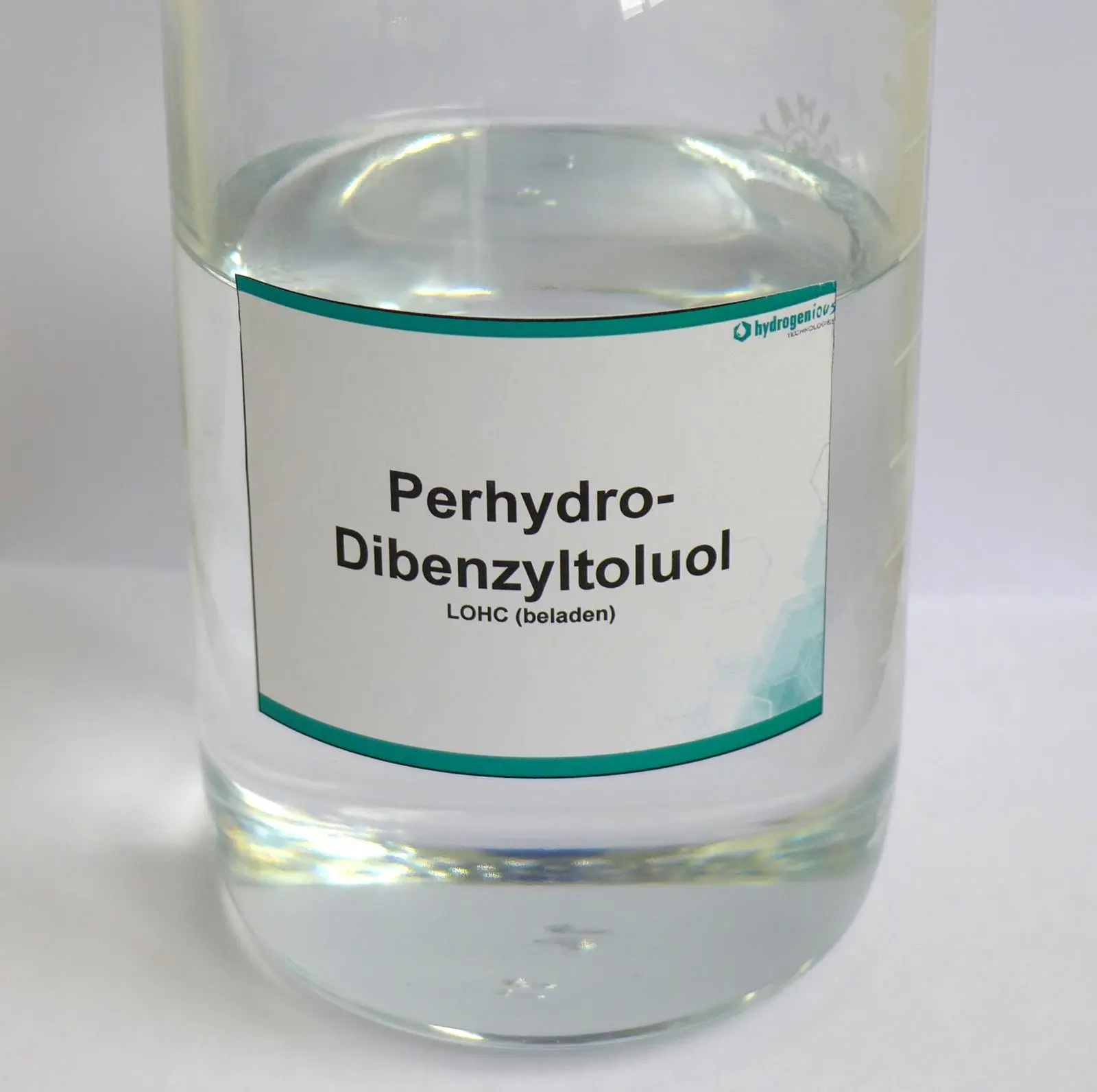
The carrier – benzyltoluene, a thermal oil – can be loaded and unloaded with hydrogen many hundreds of times and is recyclable many times over. There is no self-discharge over time, and the LOHC is hardly flammable with flash point 130 °C, non-explosive, even when loaded with hydrogen, and can be handled at ambient temperatures. It remains a diesel-like liquid down to -35°C.
This LOHC offers a competitive volumetric storage density of 54kg hydrogen per cubic metre of LOHC. The carrier material is commercially available and produces fuel cell grade hydrogen, achieving the required purity according to ISO 14687 by using off-the-shelf purification technology. No pressure accumulators are needed for the released hydrogen.
Dr Caspar Paetz, CTO of Hydrogenious LOHC Technologies, said: “The very special technological twist in the Ship-aH2oy project will be the targeted high-level thermal integration allowing SOFC residual heat to be used in the hydrogen release unit for the endothermic dehydrogenation process. With this targeted efficient heat integration, a high overall system efficiency can be achieved. Along with the inherent safety and handling benefits of LOHC, this makes it the very viable emission-free fuel for ships.” (Approximately 11 kWkth/kgH2 heat at approximately 300oC is required for dehydrogenation.)
The Ship-aH2oy project will run until 2027, and while the fuel cell supplier is yet to be confirmed, the partners plan to retrofit more vessels with LOHC/SOFC systems after the first successful demonstration of the 1MW powertrain. The consortium intends to design a scalable system architecture for larger ships and power plants by integrating several megawatt LOHC/SOFC modules, and six service operation vessels under construction by Edda Wind have been prepared for power systems of up to 3MW.
The consortium includes the whole value chain including design offices, class, ship builders, owners and operators, so the partners expect efficient commercialisation. “Within the Ship-aH2oy project, we will enter the range of megawatt drive power provided by emission-free LOHC technology. This depicts a relevant power range for a wide operation range of service operation vessels and other ship types,” says Skår, who also notes ROPAX as likely targets. “The project is a large step towards the serial production of on-board LOHC power systems in the megawatt range.”
The other project partners are: VTT, Friedrich-Alexander-Universität Erlangen-Nürnberg, Siemens Energy, DNV Hellas, Engitec, Demokritos, Gondan, Deltamarin, Teknotherm, ANEK, and the National Technical University of Athens.
Norway’s climate fund Enova provided funding for a 200kw pilot LOHC/fuel cell system as part of the HyNjord project in July 2021.
Related Articles
 BATTERIES, SUPERCAPACITORS, FUEL CELLS AND OTHER ENERGY STORAGE TECHNOLOGY
 BATTERIES, SUPERCAPACITORS, FUEL CELLS AND OTHER ENERGY STORAGE TECHNOLOGY
 BATTERIES, SUPERCAPACITORS, FUEL CELLS AND OTHER ENERGY STORAGE TECHNOLOGY