



Indian Yard Turning Out 12 Hybrid Coasters
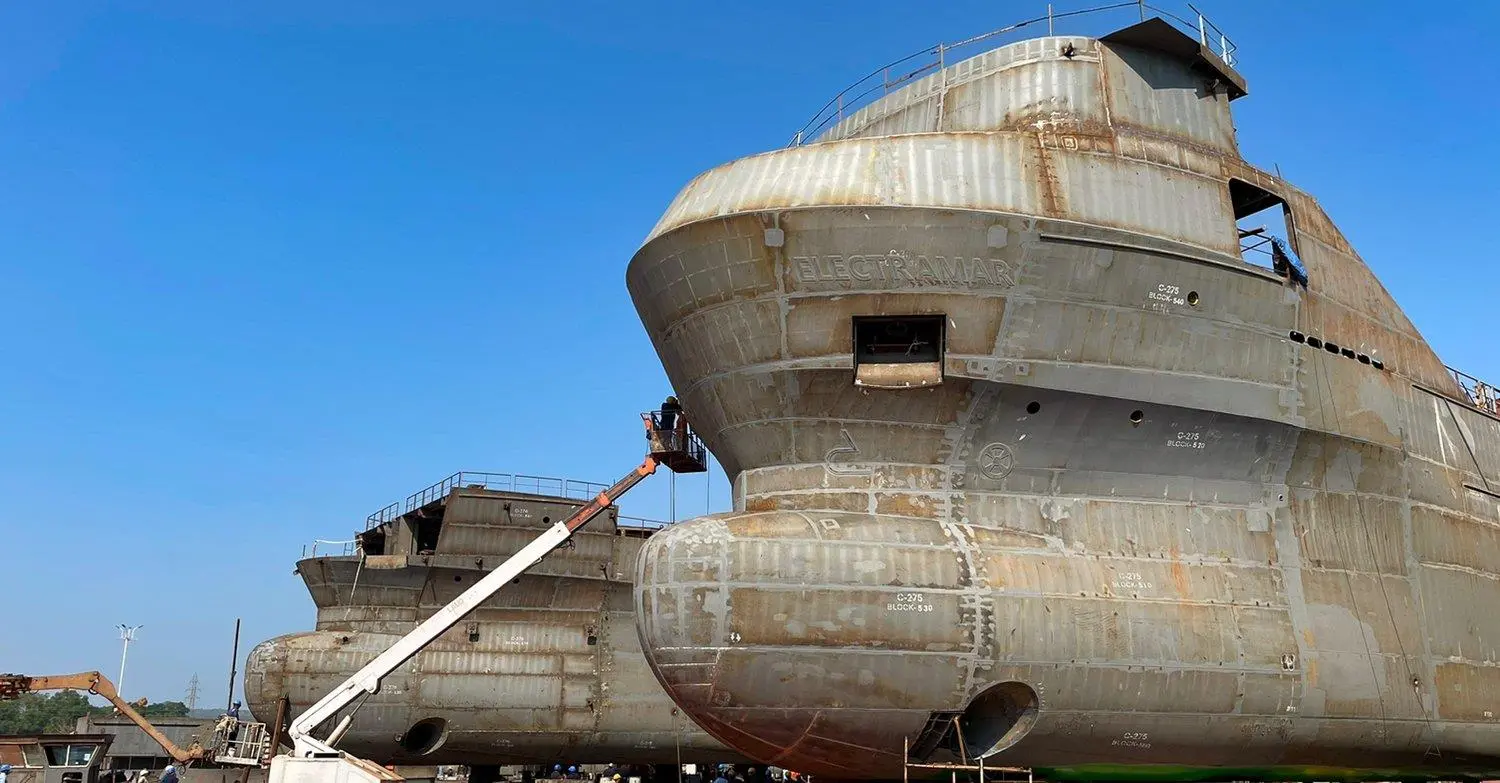
The 5,350dwt Electramar will give first form to a series of 12 newbuilds encapsulating a design claimed to cut overall greenhouse gas (GHG) emissions, including CO2 per cargo unit, by nearly 50% relative to existing ships of similar size. The bold investment initiated by the Swedish company AtoB@C Shipping, a subsidiary of Finnish dry bulk specialist ESL Shipping, entails a production programme extending through the first half of 2026.
The technical standing of the project is complemented by the commercial significance of the contract as an endorsement of the capabilities of Indian shipbuilder Chowgule & Co. The latter’s Goa shipyards have a track record in small, multi-purpose cargo vessels for North European owners and operators, but the AtoB@C assignment signals an advance in technological standard.
ESL is establishing a pooling arrangement, the Green Coaster Pool, within which the energy efficient, environmentally considerate Electramar class will be deployed.
The design of the new ships and model testing has been carried out in conjunction with the Dutch firm SMB Naval Architects & Consultants. Specified to 1A ice class, the 90m type is laid out with the bridge and accommodation forward, leaving an obstruction-free weatherdeck covered by flush panels accessing a box-shaped hold of 7,650m3 capacity. The ship’s configuration, and the compact nature of the machinery spaces, is claimed to yield up to 20% more cargo capacity than vessels of similar dimensions.
The distinctive technical feature is a hybrid electric power system. Energy storage and the electric drive solution will enable the vessels to enter and leave port solely on battery power, obviating both pollutant emissions and noise. Sized at 1MWh, the battery pack can be used for peak shaving, and for delivering boost power in ice conditions as well as when navigating port waters.
In addition, the onboard arrangements will allow for electrical power to be drawn from the landside grid when at berth, dispensing with the need to fire up a genset. The ‘plug-in’ nature of the system means that the batteries can be charged from the shore, as an alternative to being charged by the main engine when under way.
The main propulsion machinery will run on low-sulphur fuel oil and has the capability to ingest various renewable fuels or diesel blends such as Neste Marine 0.1 co-processed fuel, produced at Neste’s Porvoo refinery in Finland.
Second-of-class Stellamar is also slated for handover before the end of 2023, with subsequent completions due every quarter until mid 2026. Six of the 12 newbuilds at Goa will be to the account of AtoB@C, while the other six will be owned by institutional and private investors, under the guise of Green Coaster Shipping, with the entire series assigned to the pool of the same name under the commercial management of AtoB@C.
Full technical and crewing management responsibilities for the nascent 12-ship generation have been entrusted to GoTa Ship Management of Gothenburg, a long-term partner of AtoB@C. “The whole maritime industry is challenged by the tight availability of competent seafarers,” said AtoB@C’s business development director Frida Rowland. “We want to ensure that our seafarers can build and advance their careers within the company, and having a large number of vessels under the same management provides a good foundation for that.”
Ystad-based AtoB@C, founded in 2000, currently deploys ice-classed short-sea carriers in the 4,000-6,000dwt range, mainly transporting woodpulp, steel products, sawn timber, scrap and other bulk commodities and project cargoes. It has been part of ESL since September 2018.
Related Articles
 ELECTRIFICATION AND BATTERY HYBRIDS
 ELECTRIFICATION AND BATTERY HYBRIDS
 ELECTRIFICATION AND BATTERY HYBRIDS