



P&O Opts For Union Of Technologies
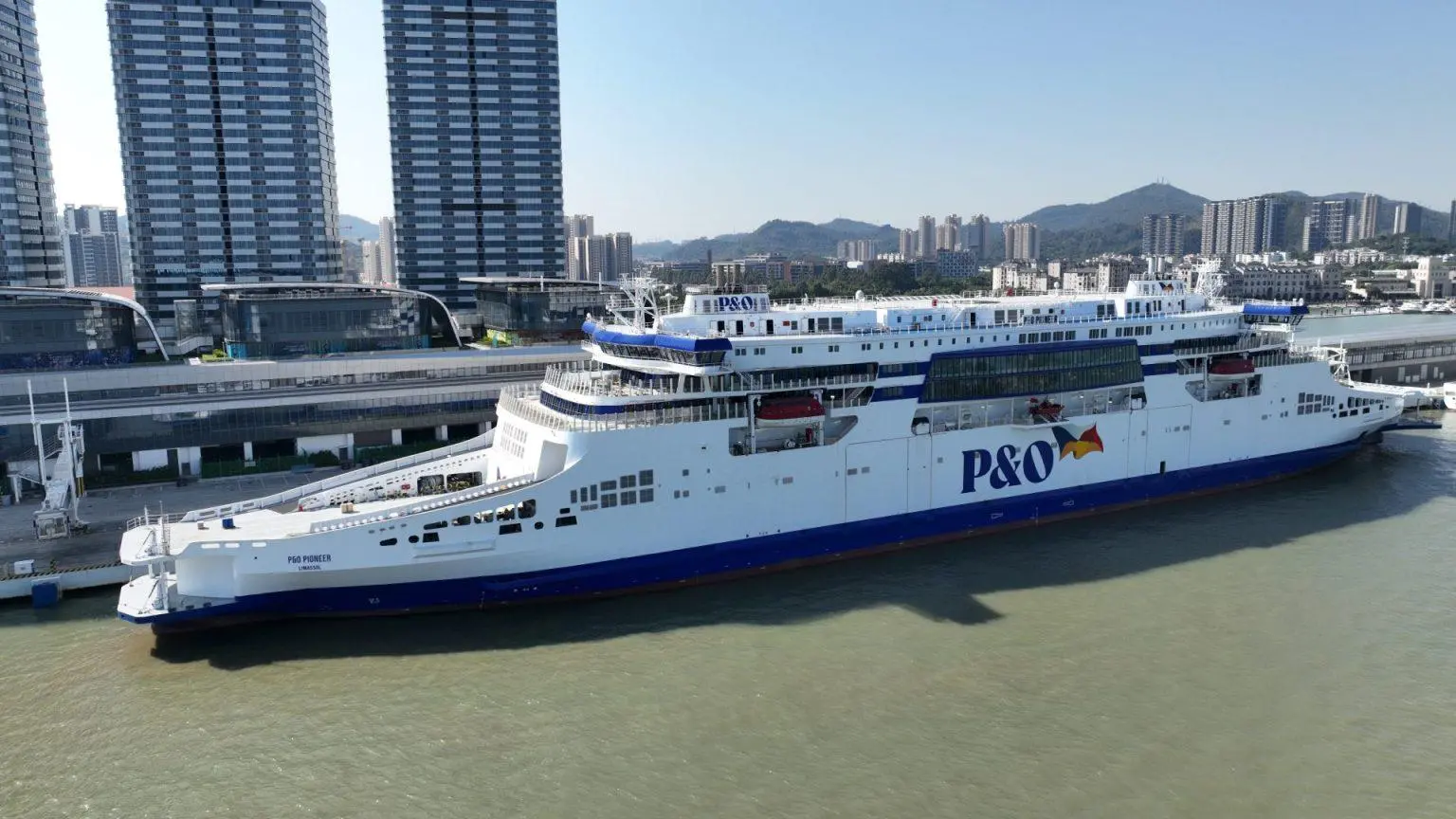
Ranking as the world’s largest double-ender, the 230m P&O Pioneer combines the company’s long-crafted UK operating expertise, advanced Nordic design, engineering and propulsion technology, and Chinese construction, so as to build long-term viability in one of the most competitive spheres of short-sea shipping. P&O Pioneer and sister newbuild P&O Liberte, currently fitting out at the premises of contractor Guangzhou Shipyard International, promise to raise the bar in cost efficiency, service dependability and long-run sustainability on the shortest UK/Continental link, the Dover/Calais run.
With the capacity to carry a maximum 1,500 passengers during peak periods, a freight payload intake corresponding to some 2,600 lane-metres, and a rapid turnaround capability, the vessels have been crafted for year-round high utilisation and productivity on a vital seabridge route between the British Isles and continental Europe. Coupled with the changes in crewing arrangements dramatically enforced by the company last year, the introduction of the new generation should have a resounding effect on the economics of P&O’s flagship route.
The hybrid power and propulsion system, using electrical energy from an 8.8MWh aggregation of batteries and four 9,600kW diesel generators, is expected to cut fuel consumption by 40% on the Dover/Calais run, yielding a corresponding carbon emission saving. The battery installation is sized to provide full power for harbour manoeuvring and port turnarounds. Moreover, overall manoeuvring time on each sailing and attendant fuel consumption will be reduced as a consequence of the adoption of a double-ended configuration with two bridges, obviating the need for the ship to turn in port.
The modular design of the ship facilitates future modifications that can open the way to a zero-emission future once the requisite electric shore charging infrastructure becomes available. In particular, this foresees the removal of individual generators and replacement with additional batteries. P&O’s decision to focus on increasing electrical energy assimilation rather than take the energy transition path by way of LNG dual-fuel prime movers, gives a distinctiveness to the company’s strategy.
The four gensets are driven by 16-cylinder models of the Wartsila 31-series engine in its diesel version, rated in each case for an output of 9,600kW at 750rpm. The widely-acclaimed medium-speed platform features two-stage turbocharging, rendered by ABB’s Power2 system, exerting a fundamental abatement influence on fuel usage and NOx emissions, in the order of 5% and 60% respectively.
The compact form of the W31 also chimes with a double-ender’s technical parameters, making for relative ease of accommodation in the engine rooms forward and aft. In normal conditions and scheduling, it is anticipated that only three of the four gensets will be fired-up, the fuel used being ultra-low sulphur marine diesel oil.
The 10,625kVA diesel generator aggregates feed electrical energy to the motors encapsulated within the Azipod azimuthing propulsion units, two at each end of the hull. The chosen DO1600 type, delivering 7,500kW of thrust in any direction, incorporates a 4m-diameter, fixed-pitch propeller and a steering module sufficiently compact so as to sit beneath the main deck of a ro-ro vessel.
ABB’s open-water DO design serves applications requiring speeds up to 22 knots, and melds the best features of the Azipod C type and the high-power XO range. It employs hybrid cooling of the propulsion motor, combining direct cooling to the surrounding sea water and an active air cooling system. The arrangement of the thrusters in the P&O vessels entails an axis of rotation that is slightly tilted from the vertical, for optimum hydrodynamic effect, and an 11m spacing between each pair.
The underwater hull lines in conjunction with the specific nature of the rudder-free propulsion and steering arrangements have been developed so as to maximise hydrodynamic performance, course keeping and manoeuvrability on the narrowest stretch of the heavily-trafficked English Channel, where passages have always to be made across a strong tidal current.
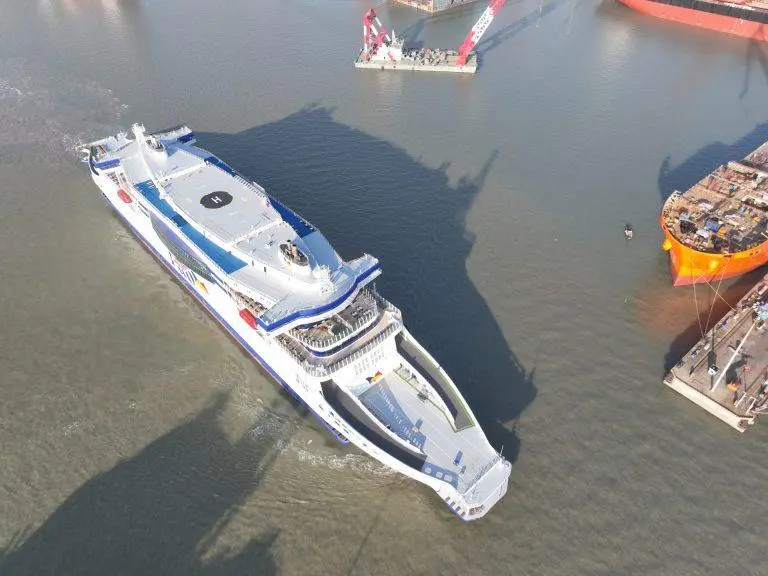
The energy storage system comprises a total of 1,160 batteries installed in four battery rooms amounting to a total capacity of 8,816kW. All surplus energy generated by the main power plant will be stored in the batteries, imbuing a charging function, and providing the means for load-levelling and for manoeuvring in harbour. The installation is suited also to charging from ashore while alongside, although neither Dover or Calais is presently equipped with the necessary facilities. Besides further investment in the battery installation, the corporate goal of fully carbon-neutral operations in the future is reliant on the development of electric shore charging stations.
The lithium-ion batteries were supplied by XALT Energy, part of German-owned Freudenberg Sealing Technologies, and are encapsulated in multiple cabinets forming part of the company’s XRS-2 configurable rack system. Meeting the strictest regulatory criteria, the racks have been designed to minimise weight and size and to give protection against the corrosive marine atmosphere.
ABB’s scope of supply included the proprietary Power and Energy Management System (PEMS), integrated with the onboard electrical infrastructure, and optimising use of the ship’s genset and battery power resources.
Heat recovery will help to further reduce fuel consumption and carbon footprint. The system will raise steam for the ultra-low sulphur fuel oil heaters and tanks, fuel oil/lube oil purifier heaters, and HVAC (heating, ventilation and air conditioning) system reheating.
As with P&O’s previous newbuilds, the 2011-commissioned, 213m Spirit of Britain and Spirit of France, the Fusion-class is equipped for double-level ro-ro access and egress at both Dover and Calais, ensuring expeditious working of the intensive, all-year traffic in commercial vehicles to the two freight decks. The centreline casing divides both decks into four lanes either side, while open, fixed ramps on both sides of the vessel fore and aft lead to an upper vehicle deck with space for 182 cars and sufficient headroom for vans and camper vans. On the main (No3) deck, the watertight, side-hinged inboard doors are located behind the side-hinged, clamshell-type main doors.
Although symmetrical in profile, the two ends of the hull are not totally identical, because of the need to suit slightly different linkspans at Dover and Calais. In particular, the upper ramp loading platform at one end is wider than that at the other end of the ship.
The adoption of separate navigation bridges, with duplicated controls and other equipment, at each end of the ship provides the complement to the mechanical and structural means of dispensing with the need to go about at each end of the run, which offers a seven-minute saving on both outbound and return voyages. When the ship is operating on the engines rather than battery power, this promises as much as a one-sixth reduction in the entire fuel burn for the entire 21-mile crossing.
The vessel boasts a high level of automation, with over 12,000 alarm points built into the various systems, all overseen from one engine control room and two wheelhouses. Moreover, overall ship control can be transferred from one wheelhouse to the other by means of a simple changeover switch located in each, while a shift from propulsion in diesel mode to battery power and vice-versa can be achieved equally as easily and quickly.
While the long-term value of the investment is founded on the technical and operational attributes of the newbuilds, based on a concept design emanating from Danish consultancy OSK-ShipTech, the companion bid to enhance the passenger travel experience and thus income means that both exterior styling and interior design have commanded significant attention. From an aesthetic standpoint, the small size of the funnel casings and exiting exhaust pipes is salient.
The passenger capacity is 500 less than on the Spirit-class, but the layout and range of facilities is of a high standard, with more attention having been given to open deck spaces relative to other new cross-Channel ferries. Each of the Fusion-class has 1,550m2 of outside deck area for passengers, and double-height windows on the port and starboard sides amidships along decks 8 and 9 will give panoramic views of both the French and British coastlines, including one of the most famous landmarks, the White Cliffs of Dover.
Significantly in terms of long-run operating costs, the ferries have been designed and equipped to allow adjustments in the extent of passenger facilities available. In accordance with reduced demand during off-peak sailings and the winter period, up to two-thirds of the passenger spaces can be closed. The ‘intelligent’ power management system uses special software to turn off lighting and ventilation in areas unused.
The Finnish-built Spirit of Britain sisters had the distinction of being the first passenger-carrying ferries ordered worldwide to comply with IMO’s Safe Return to Port (SRtP) requirements, and also featured lifesaving arrangements based on shipsets of six marine evacuation systems (MES) and liferafts, but no lifeboats. Each of the new ships carries four lifeboats as well as four MES and multiple rafts.
Schulte Marine Concept (SMC) provided project management support through technical consultancy and plan approval services, plus construction and outfitting supervision at Guangzhou. For the shipbuilder, the completion of P&O Pioneer adds to an already extensive reference list of export contracts in the ro-pax domain. P&O Liberte is expected to be ready towards the end of 2023. At the time of the EUR260m contract award in 2019, options on third and fourth vessels were appended to the deal, but these have not been exercised.
P&O Pioneer made her positioning voyage from Guangzhou to the English Channel by way of Cyprus, where the ship is registered and where she took on bunkers at the owning group DP World’s Limassol Terminal. P&O Ferries’ decision to register the newbuilds in Cyprus, as has been the case for some while with its existing cross-Channel fleet, is testament to the country’s favourable Tonnage Tax System and its government’s efforts to make the Cyprus flag more competitive. Ownership of P&O Pioneer is vested in DP World France, while shipmanagement is effected by P&O Ferries Holdings of Dover.
Unfortunately, the arrival in UK waters was followed by a lifeboat mishap during crew familiarisation and equipment testing procedures when at anchor off the Isle of Wight. The vessel subsequently sailed to Dunkirk, where she arrived on April 4, for investigative and potential rectification work.
MAIN PARTICULARS – P&O Pioneer
| Length overall | 230.5m |
|---|---|
|
Breadth, moulded |
30.8m |
|
Depth, moulded |
9.8m |
|
Draught, maximum |
6.7m |
|
Draught, design |
6.2m |
|
Gross tonnage |
47,653t |
|
Deadweight, maximum |
8,850t |
|
Passenger capacity |
1,500 |
|
Ro-ro capacity |
2,592 lane-m(freight) + 182 cars |
|
Propulsion system |
Diesel-electric + ESS |
|
Main genset engine power |
4 x 9,600kW |
|
Battery(ESS) capacity |
8.8MWh |
|
Propulsors |
4 x 7,500kW |
|
Service speed, on 6.7m draught |
20.8kts |
|
Eco speed, at 12,250kW, on design draught |
17.8kts |
|
Class |
Lloyds Register |
|
Class notations |
+100A1, Passenger/Vehicle Ferry, IWS, L1, +LMC, UMS, Hybrid Power, NAV 1, IBS, CAC2 |
|
Registry |
Limassol, Cyprus |
Related Articles
 ELECTRIFICATION AND BATTERY HYBRIDS
 ELECTRIFICATION AND BATTERY HYBRIDS
 ELECTRIFICATION AND BATTERY HYBRIDS