



Shore power: confusion and piecemeal adoption slow the current
The source of the confusion likely stems from the differing operating profiles of a plug-in hybrid car and its maritime counterpart. P&O will still be able to operate these vessels 40% more efficiently than a conventional diesel electric propulsion setup without ever plugging in.
Nevertheless, sources told the UK’s Daily Telegraph that P&O did not consult with authorities at Dover and Calais over charging points. “In light of current shore power capacity, our new hybrid ships were never designed to operate on a complete zero-emission basis and be ‘charged up’ in-port,” a P&O spokesperson said, although the vessels are designed to be future-proof as and when the solution becomes commercially available.
Despite the fact that it is based on technology predating the diesel age, it is this sense of confusion that has come to characterise the slow rollout of shore power. A British government report referred to shore power as an established technology, but details of the UK government’s plans in the area await the publication of the refreshed Clean Maritime Plan, which will be published later in 2023.
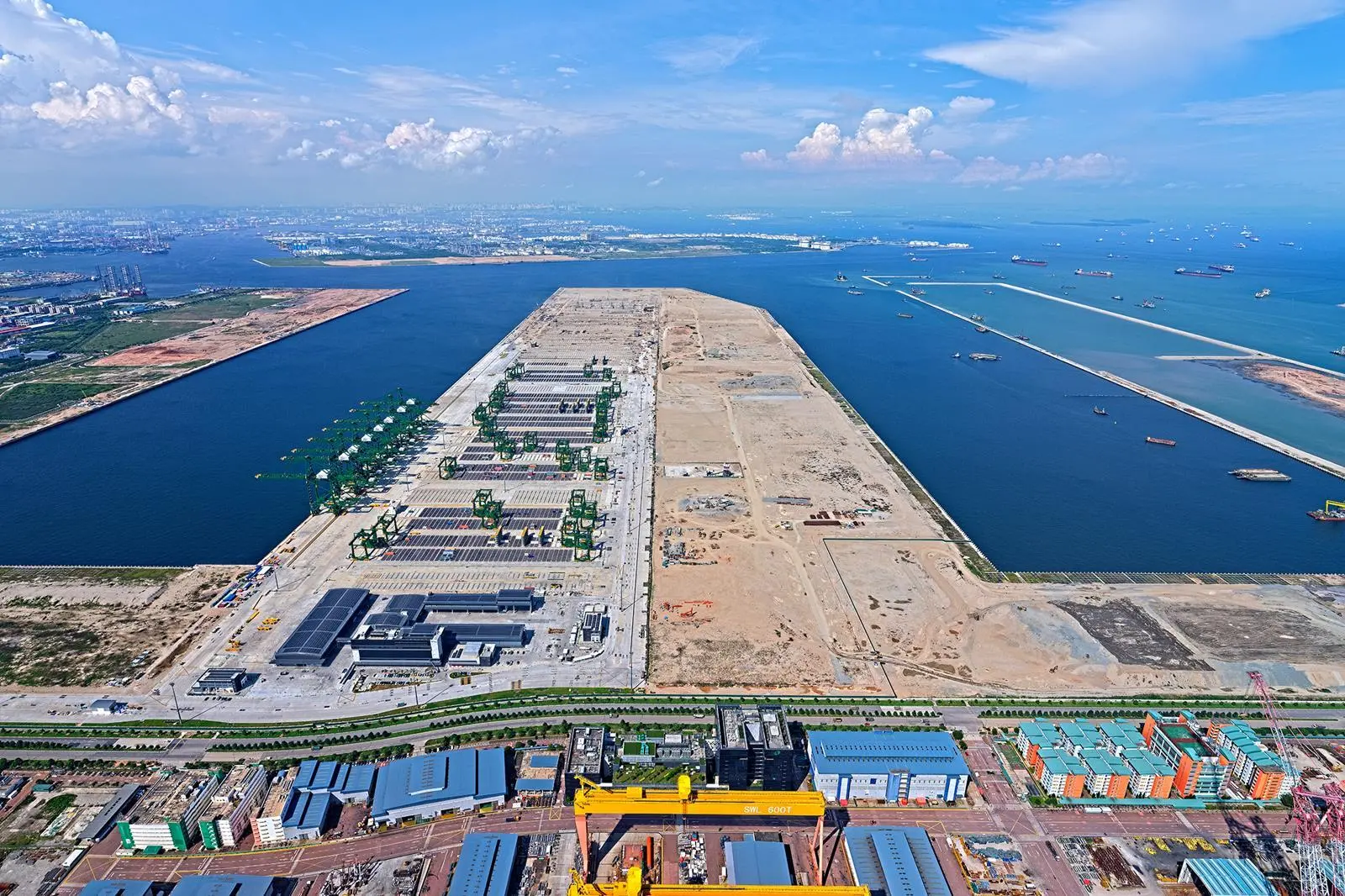
Nor are such doubts a British preserve. At Singapore’s new Tuas super-port, boasting all-electric cranes and equipment, questions about shore power were met with bewilderment. “It was as if they hadn’t even heard of it,” a source told The Motorship. Given the scale of the Tuas megaport, and Singapore’s reliance upon imported energy supplies, the decision is likely to make economic sense.
Yet even in countries with more abundant domestic source of energy, shore power is dependent upon the strength of local energy grids – and demand from ship operators. In September last year, shore power pioneer the Port of Los Angeles had to backtrack on its efforts to mandate the use of shore power and prevent ships from plugging in, when a heatwave saw peak power demand rising beyond the point at which the local grid could provide for ships’ hotel load. And on a recent press visit to the Port of Drammen, operators of Norway’s main car terminal revealed that since their installation, its four shore power stations – an investment of around NOK25m (EUR2.1m), over a third of which was provided by Norwegian state funds through ENOVA – had never been used. This, despite the fact that the cars coming through the port, bound for the Norwegian market, are primarily electric.
“While the shore power is operable, ships need to be adapted to use it, and it would be rational for shipowners to do so,” said Port Director Arne Fosen. “Ultimately, this will be the push needed to reduce pollution at the waterfront.”
The Port of Oslo has similar complaints. From 2024, it will likewise have the ability to offer clean power from the Norwegian grid, over 95% of which is powered by renewables. But Heidi Neilson, the port’s head of Planning and Environment, said that shipowners were “reluctant” to convert their fleets, “despite a relatively low cost to retrofit,” of around EUR45,000.
“Shipping companies are reluctant to invest… in their aging fleets,” she added. “We can assist using our expertise with shore power and applications to Enova for financial support. We only need one or two container ships to convert to shore power to move forward… then the barrier is broken, and others are likely to follow.”
Full-electric vessels have been mooted for feeder trades, as one strategy for overcoming the IMO CII’s hostility to the operating profile of these smaller vessels. But to do this, they would need to ‘charge up,’ as was suggested for Pioneer and Liberté, and this power demand will pose an even more daunting prospect for national power grids.
But this is only one respect in which the popularity of shore power is set to spiral. Up until this point, shipowners have been reticent to plug in in some locations, citing the high wholesale cost of electricity; something from which Germany, Denmark and Belgium, with particularly high cost of electricity have traditionally suffered.
This was the case even before the onset of the Russo-Ukraine war, which has caused a near-trebling of energy prices, on average, across the EU. Despite this, considerable port electrification drives are underway in these countries: the ports of Hamburg, Kiel, and Antwerp Bruges today all offer shore power; ferry-sized systems are available in Copenhagen and Stockholm, and in Bremen, two shore power units are scheduled to come online by the end of this year. (Norway’s energy costs, meanwhile, soared by more than 80% last year in response to higher export prices in interconnected Germany and the neighbouring Nordic Pool.)
But the IMO’s CII, a measure of transport work done versus fuel burned, takes into account ships’ emissions while in port, meaning that burning fuel in auxiliary generators alongside while no work is being done could have a dramatic and disproportionate impact on a vessel’s rating. Meanwhile Europe has prefigured IMO with its own pump-priming environmental regulation, FuelEU Maritime, which demands that containerships plug into shore power while alongside, whether they like it or not.
Related Articles
 ELECTRIFICATION AND BATTERY HYBRIDS
 ELECTRIFICATION AND BATTERY HYBRIDS
 ELECTRIFICATION AND BATTERY HYBRIDS