



Appliance of data science to new PBST radial turbo
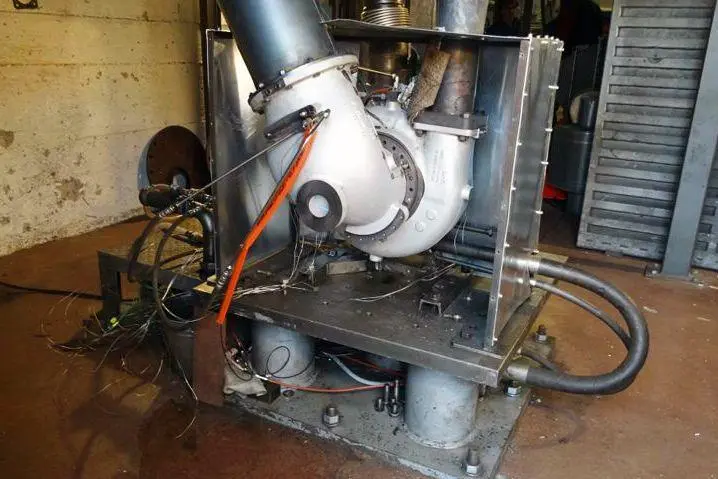
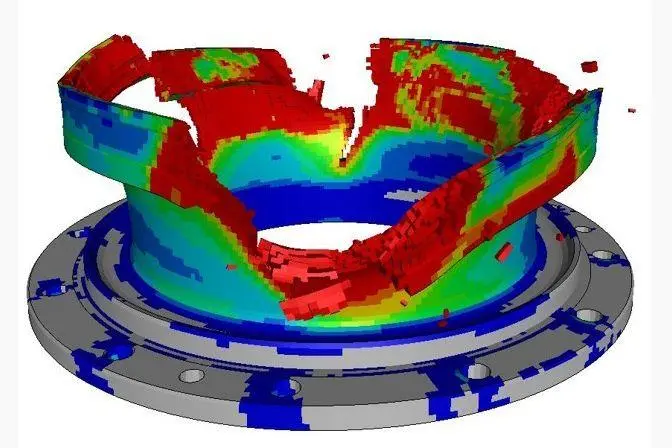
In PBST’s latest turbocharger containment test, the company’s specialists deliberately accelerated a brand new PBST TCP16 turbine outside of its safe operating zone until centrifugal forces ripped it to pieces. The turbine essentially disintegrated, but the high energy fragments were safely contained in the turbocharger housing. In the case of the TCP16, this means that burst protection can be implemented in the casings and no external cover is needed, which offers significant advantages in terms of installation space.
Dr. Mark Michael, one of the simulation specialists in the turbocharger engineering containment team based in Augsburg, noted that the turbine performed exactly as the numerical models predicted. “We can validate our simulation models via testing to make holistic observations about containment behaviour in different situations,” he said.
At CIMAC 2023, some of the simulation specialists discussed the numerical modelling behind tests such as this as well as the modelling of other key components of the series’ design.
TCP design
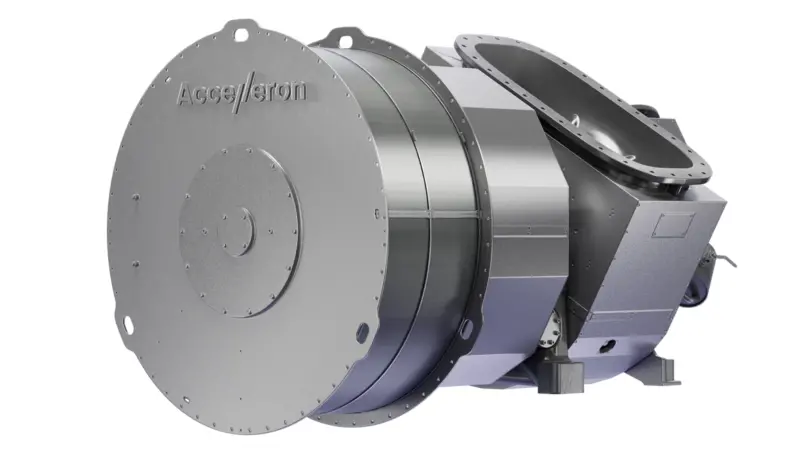
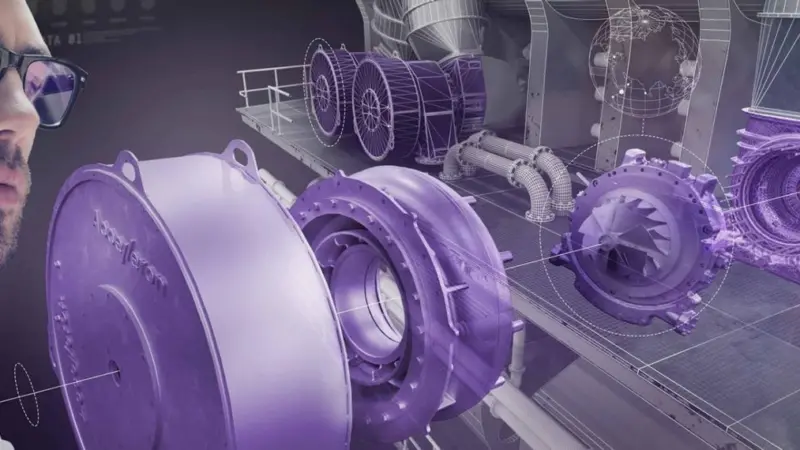
TCP (pressure) turbochargers are radial turbochargers suitable for high-speed and medium-speed engines and are designed with both conventional and future fuels in mind. PBST says they offer 1-stage efficiency levels > 70% and a reduction of rotor moment of inertia of 25% which results in a significant improvement in dynamic behaviour. The aim is to enable significantly higher engine power while maintaining engine size and weight.
Assessing the containment was particularly important due to the increased speed, newly developed rotor parts and casing design of the TCP series. Material properties were evaluated statistically and accounted for variation expected within the volume of individual parts. Impact areas from blade fragments led to optimization for specific load cases – even though such a catastrophic burst is extremely unlikely in practice.
A design loop using 3D FEM analysis led to a casing design with the structural integrity needed to counter thermo-mechanical fatigue and creep deformation at constant high temperature loading.
The compressor stage was developed from scratch to accommodate the targeted compressor pressure ratios. Again, numerical modelling played a key role – optimising flow and efficiency early in the design process. An early prototype was tested on a component test rig to ensure the modelling was on-track before the full design was developed. 3D CFD simulation was used in combination with verification tests to finalise the design.
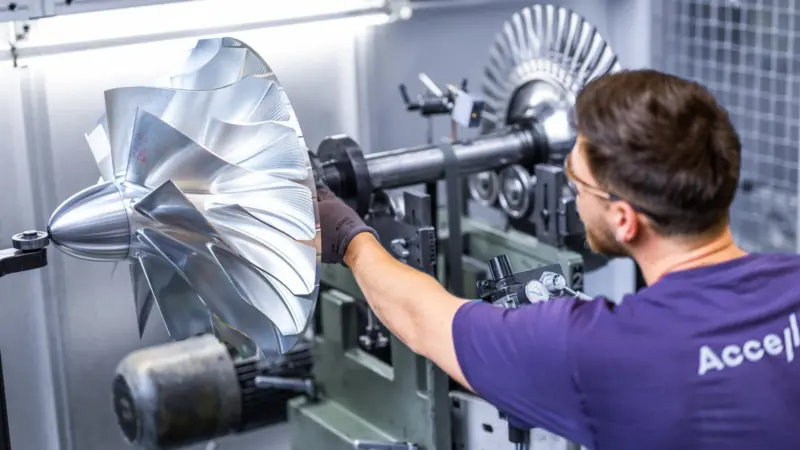
The compressor wheel geometry was optimised for static safety, low cycle fatigue and creep. The higher pressure ratios and circumferential speeds reached with the new design meant that fresh consideration had to be given to heat generation in the fluid cavity between the compressor wheel and other non-rotating parts.
The cooling system for the compressor backside cavity was developed using numerical modelling tools, including CFD. Even with the higher pressure ratios and speeds, the exchange intervals achieved were higher than those of PBST’s current TCR turbocharger series. The resulting channel design also ensured easy installation on the engine and is capable of managing the temperature of the bearing case, flange connections and the oil and sealing system.
CFD was used to maximise the aerodynamic performance of the turbine stage by optimising the blade speed ratio with the new compressor wheel. The result was a relatively small nozzle ring cross section compared to the turbine throat area. High cycle fatigue was a key design consideration, and every resonance crossing relating to stator excitation mechanisms was simulated and modelled. High rotor speeds, and therefore increased loading of the turbine wheel, led to static and dynamic load modelling as part of the development of the turbine geometry.
TCF design
TCF (flow) turbochargers are high performance solutions aimed at 2-stroke low-speed engines or for two-stage turbocharging on 4-stroke engines. With the introduction of the TCF, PBST’s ECOCHARGE (two-stage turbocharging) can achieve efficiency levels of up to 70%.
The compressor pressure ratio is relatively low, up to 5.0 (continuous operation), so the design effort was focused on achieving the highest specific flows to ensure optimal dynamic response for a wide compressor map in a system suitable for the highly-compact ECOCHARGE units.
The high specific flow required meant the turbine stage development was independent from that done for the TCP turbine. CFD and FEM analysis balanced the aerodynamic, thermodynamic and mechanical constraints of casing weight and turbine efficiency to achieve a low solidity rotor concept. The design was optimised for greatest efficiency at medium and lower turbine pressure ratios, reflecting the TCF target applications.
High cycle fatigue
The rotating components of the TCP/TCF turbochargers operate at their mechanical and aerodynamic limits, and advanced numerical methods have played a role in pushing these limits by enabling a multi-disciplinary approach to the analysis of fluid structure interactions and their impact on high cycle fatigue. Early design work involved fully 3D solvers with moving meshes to simulate aerodynamic and structural mechanics for damping, excitation, and modal behaviour. This enabled highly accurate predictions of compressor and turbine blade amplitudes especially given that aerodynamic behaviour is non-linear.
It is important to have a valid temperature field, and this was defined using conjugate-heat-transfer calculations involving simulation of the fluid and structural parts. Cavity and cooling features can influence the elasticity and resonance speed, so these characteristics were included in the modelling.
Early prototypes were used to validate the calculations and modelling that went into the early design process. Digital twins of some components were also used to develop the required level of model and simulation accuracy. Ensuring a design suitable for series production also involved implementation of improvements for robustness based on choices between multiple variant designs that had similar thermodynamic, aerodynamic and structural features. This lead to the definition of the final geometry and the development of an appropriate test program.
The researchers conclude that making use of the validated models meant that unwanted loops late in the project were avoided. “There is a clear need for this huge high cycle fatigue evaluation effort, as modern turbocharger impellers are extremely highly loaded, while nevertheless a safe operation of the series product has to be guaranteed.”
Frame sizes
The TCP and TCF turbocharger series both consist of seven frame sizes, including the introduction of a new TCP/TCF 19 size. The modular design of the turbochargers ensures that compressor and turbine sizings are suitable for various engine needs.
All TCP frame sizes can be operated at pressure ratios clearly about 6, says PBST, tending towards 6.6 for larger frame sizes. The wide TCP compressor map achieved means that, in comparison to the TCR-42, the charge air pressure can be increased by over 1 bar.
According to the PBST researchers, the TCP is a compact single-stage turbocharger series with a pressure ratio and efficiency level far beyond current single-stage turbochargers. It is a well-balanced compromise between operating cost, compactness and CAPEX.
For engine outputs from 800 to 5,800 kW per turbocharger, a maximum pressure ratio of up to 7.0 is possible. The turbocharger increases engine power density up to 20% and reduces specific engine costs up to 20%. It is designed for “plug and play” using the same connection dimensions as similar previous turbochargers, and its features are suitable for future fuel readiness.
For outputs from 1,000 to 7,200 kW per turbocharger, the TCF series features an increase in specific flow of 20% and offers significant improvement in dynamic behaviour over earlier models, along with future fuel readiness. The series uses “well-known” connection dimensions and is maintenance-friendly.
“The TCF series offers a very competitive charging solution for small 2-stroke engines with MAN B&W high-efficiency requirements. Further, the TCF enables the possibility to downsize the turbocharger on 4-stroke medium-speed engines.”
Test schedule
The numerical design process for the new turbochargers began in 2019, and the first TCP16 prototype has been undergoing testing since mid-2022. On-engine prototype tests are scheduled. A TCF technology carrier is undergoing testing this year, and validation of a first prototype will start in 2024.
PBST attributes the success of the development process to the company’s holistic design strategy which included customer-centred frame sizes and product safety concepts from the beginning.
Related Articles
 2-STROKE & 4-STROKE
 TURBOCHARGER
 TURBOCHARGER