



New battery chemistries on the horizon after land-based development
The resulting fires can be difficult to extinguish with water, because lithium-ion batteries have high reactivity to water. LG Chem has therefore developed a plastic battery pack that can delay thermal runaway in electric vehicle batteries.
The plastic consists of various material groups such as polyphenylene oxide, polyamide, and polybutylene terephthalate. As well as being flame-retardant, the new material maintains its shape despite temperature changes. According to LG Chem’s in-house test results, the material can block flame propagation caused by thermal runaway more than 400 seconds at 1,000 degrees. This is 45 times better than general flame-retardant plastics.
LG Chem is also expanding production of its single-crystal high-nickel cathodes, made from single particles of several metals such as nickel, cobalt, and manganese. These cathodes can help boost battery lifespan by over 30% and increase capacity by at least 10%.
Battery materials company Sila says graphite anodes and simple silicon compounds (Si, SiO, SiO2) for lithium-ion batteries have reached their energy limit. The company has released Titan Silicon which it says can deliver up to 100 extra miles for some EVs. Battery charging time from 10% to 80% can be achieved in 20 minutes, and the technology results in a 15% reduction in battery weight.
ProLogium has developed a large-footprint lithium ceramic solid-state battery, following the release of a solid-state battery with a 100% silicon oxide anode last year. The company says increasing battery size to reduce the number of cells in a pack is an effective optimisation strategy and cites the current trend of cylindrical battery dimensions transitioning from 21 x 70mm to 46 x 80mm.
While a solid electrolyte allows faster movement of ions and greater tolerance of high voltages and temperatures, the technology has been associated with shorter battery life. Solid electrolytes repeatedly expand and contract as the battery charges and discharges which can create cracks that inhibit the movement of ions between the cathode and anode. Toyota has announced a newly discovered technology to overcome this challenge and is striving for commercialisation in 2027-2028. The company also says it has the technology for solid-state batteries with a range of 1,200km that can charge in 10 minutes or less.
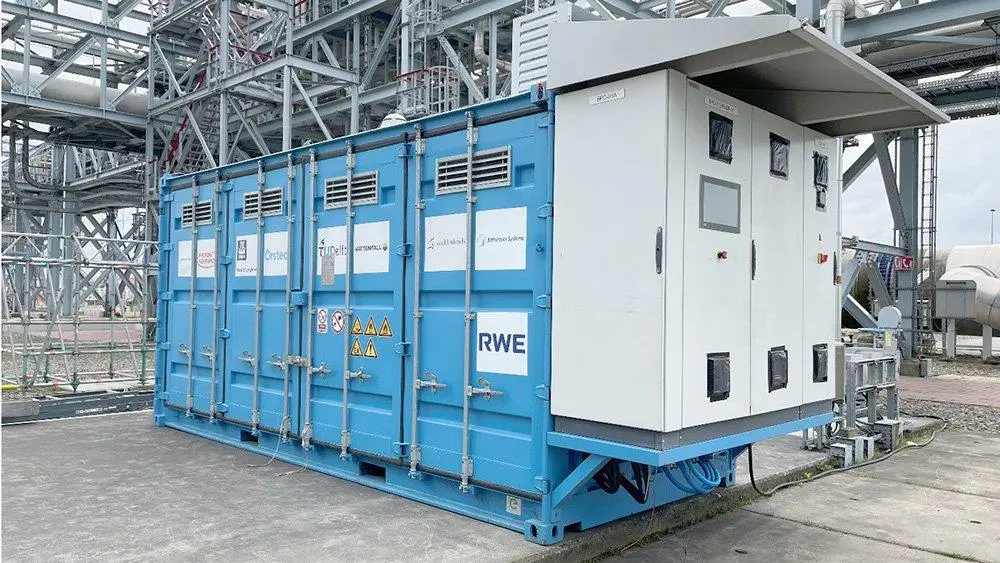
Battolyser Systems has installed its first industrial-scale Battolyser system at the RWE Magnum power plant in the Netherlands. A Battolyser is a combination of a battery and a hydrogen generator (electrolyser) in one device. As soon as the system’s battery functionality is charged, the Battolyser can use the excess electricity to split water into hydrogen and oxygen.
Research into battery chemistry continues, and scientists at the Argonne National Laboratory in the US have developed a new electrolyte for lithium metal batteries (with anodes made of lithium metal in place of the graphite normally used in lithium-ion batteries). The new fluorinated cation electrolyte could greatly increase range and reduce costs and is also non-flammable.
In lithium metal batteries, the electrolyte is a liquid consisting of a lithium-containing salt dissolved in a solvent. While it can deliver more than double the energy density possible with a lithium-ion battery, performance diminishes within less than a hundred charge-discharge cycles because the electrolyte does not form an adequate protective layer on the anode surface during the first few
cycles. This layer allows lithium ions to freely pass in and out of the anode to charge and discharge the battery. The new fluoride solvent maintains a robust protective layer for hundreds of cycles.
In testing with laboratory cells, the new electrolyte has retained stable energy storage capacity for 400 charge-discharge cycles at minus 4oF. Even at that sub-zero temperature, the capacity was equivalent to that of a cell with a conventional carbonate-based electrolyte at room temperature. The development is expected to therefore overcome the current problems experienced when charging electric vehicles in cold regions and seasons.
Researchers at the Illinois Institute of Technology and the Argonne National Laboratory have developed a lithium-air battery with the solid ceramic polymer electrolyte that can potentially boost the energy density by as much as four times that of lithium-ion batteries. It can operate with oxygen supplied by air from the surrounding environment. The researchers say the technology could be transformative for electrifying transportation, especially heavy-duty vehicles such as aeroplanes, trains, and submarines.
Related Articles
 BATTERIES, SUPERCAPACITORS, FUEL CELLS AND OTHER ENERGY STORAGE TECHNOLOGY
 BATTERIES, SUPERCAPACITORS, FUEL CELLS AND OTHER ENERGY STORAGE TECHNOLOGY
 BATTERIES, SUPERCAPACITORS, FUEL CELLS AND OTHER ENERGY STORAGE TECHNOLOGY