



New Chapter In Vehicle Carrier Evolution
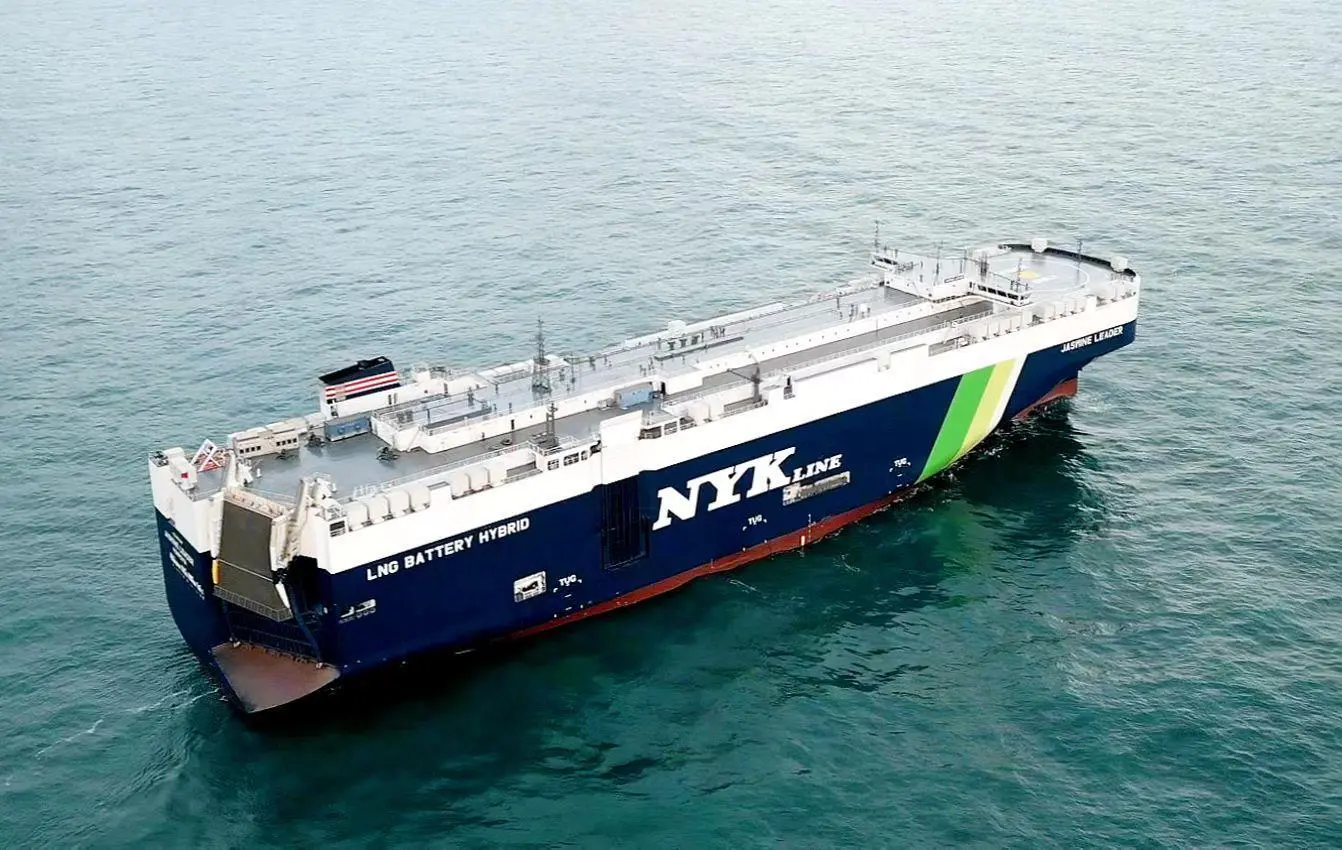
Over the course of the first half of this year, the 7,000CEU (car equivalent unit)-capacity Jasmine Leader, Wild Rose Leader and Freesia Leader have been handed over by China Merchants Jinling Shipyard (Nanjing), where a fourth sister is in hand. A further 12 PCTCs of similar intake are on order to NYK account at Japanese yards for delivery from 2025 onwards.
One of the main features of the Jinling series is a hybrid control system with battery power, which affords a peak-shaving capability, obviates or reduces the risks of blackout, and also supports bow thruster operation.
NYK’s first LNG dual-fuel, deep-sea vehicle carriers, the 7,000CEU Sakura Leader and Plumeria Leader, were brought into service during 2020 and 2022, respectively, from Shin Kurushima Toyohashi Shipbuilding. The shipowner plans to have a total of 20 LNG-powered PCTCs in its fleet by 2028, indicating that contracts for another two newbuilds are in the offing.
The adoption of LNG as the main fuel, in conjunction with hull form optimisation and other fuel economy measures, renders the Jasmine Leader class some 40% more energy efficient than conventionally HFO-powered ships in the NYK fleet. The ships are Tier III NOx-compliant in gas mode, and the efficiency level takes the vessels well beyond current and future Carbon Intensity Indicator (CII) requirements and past IMO’s present greenhouse gas (GHG) emission target for 2030.
NYK has set a long-term target of net-zero emissions of GHG by 2050 from its ocean-going fleet, which encompasses all main types of merchant vessel. LNG is seen as a transition, low-carbon fuel until the focus switches to zero-emission ships. Ammonia and hydrogen are two of the main options under consideration for possible application from 2029 onwards.
Significantly, NYK completed the concept design of an ammonia-ready PCTC in conjunction with Finnish consultancy Elomatic and Monohakobi Technology Institute (MTI) of Tokyo in March 2022. Furthermore, the LNG-fuelled 7000 PCTC series developed by Shanghai Merchant Ship Design & Research Institute (SDARI), and on which the new Jasmine Leader class is based, has provided the platform for an ammonia-fuelled version, for which SDARI has recently secured DNV Approval in Principle (AiP) certification.
Jasmine Leader is powered by a seven-cylinder example of the X62DF-2.1 two-stroke, low-pressure dual-fuel engine designed by Winterthur Gas & Diesel (WinGD) and manufactured in China by CSSC-MES Diesel Co, with direct drive to a fixed pitch propeller. The installation has the distinction of being the first-ever worldwide to apply X-DF2.0 iCER technology, designed to cool and recirculate part of the exhaust gas through a low-pressure path in gas mode. The iCER configuration is claimed to reduce methane slip by up to 50% while yielding appreciable energy gains.
The main engine is fitted with a MET71MB turbocharger developed in Japan by MHI-MME and tailored to the iCER system. Particular consideration has been given to dealing with the liquid droplets and fuel residue that could be introduced from the intake side.
The 7X62DF-2.1 ‘cathedral’ engine, representing the largest bore size supplied to a PCTC, has been specified for a maximum continuous output of 15,400kW at 103rpm, slightly derated from the model’s nominal MCR of 16,695kW. The power concentrated in the LNG-ingesting design, ensuring a speed of some 19.5 knots, is in excess of that provided to the seminal Sakura Leader, which is equipped with an 8X52DF unit rated for 11,920kW at 105rpm.
Besides the prime mover, the WinGD LNG-battery ‘package’ contract for the Jasmine Leader, as with the subsequent sisters, comprised shaft generator, 570kW energy storage system, DC (direct-current) links and bow thruster drive. Recourse was made to the Japanese company Nishishiba for the 1,240kW in-line shaft generator. The first-of-class also provided the opening reference for WinGD’s proprietary X-EL Energy Management system. This is a new battery-hybrid power integration and sustainability service which melds the two-stroke engine control with the electrified vessel power system, optimising energy flow and efficiency.
The PCTCs also employ the Swiss two-stroke specialist’s WiDE engine monitoring and diagnostics, whereby a digital twin of the specific system compares ideal, simulated behaviour with actual performance based on vessel operation and sea-going conditions. This allows for anomalies to be detected early, diagnosed and communicated to crew and shoreside support staff with advice for troubleshooting and maintenance.
LNG dual-fuel capability extends to the ship’s auxiliary outfit, which is composed of three main gensets driven by HiMSEN four-stroke engines. The eight-cylinder H22CDF units emanate from the Hyundai Group and are individually rated at just over 1,600kW, primarily to provide manoeuvring power and meet the in-port electrical load, with the shaft alternator supplying the ship’s net when on passage.
Two 2,000m3 LNG fuel tanks are located on the tank top, immediately forward of the engine room bulkhead.
The hull breadth of 38m is some 6m greater than that of ships built to the constraints governed by the Panama Canal prior to its expansion, while the length overall at just under 200m ensures global trading versatility while meeting the physical restrictions imposed by many Japanese terminals.
Cargo space subdivision and loading flexibility in the Jasmine Leader type is achieved by 12 ro-ro vehicle decks, of which four are hoistable, and wherein four provide the clearance and strength to bear shipments of trucks, buses, agricultural, construction and mining equipment and machinery, heavy plant and trailer-borne project cargo, containers and hazardous freight. The increased average height and weight of cars and the growing transportation activity involving electric vehicles is reflected in the internal configuration and outfit of the new generation of PCTCs.
The genre’s trademark starboard quarter ramp is of 150t capacity and is complemented by a 20t side ramp, with cargo distribution effected by means of an internal ramp system. The powering arrangements are focused on electric motors rather than hydraulic cylinders. The entire cargo access solution was delivered by Cargotec’s Macgregor division, and includes the latter’s patented Load Monitoring System, which has increased the safe working load of the quarter ramp by up to 50% without additional structural weight.
Initial shipments from Japan by Jasmine Leader and second-of-class Wild Rose Leader involved vehicles produced by Mazda Motor Corporation and Honda Motor Co. The new vessels from Jinling are registered under the Liberian flag and husbanded by Singapore-domiciled NYK Shipmanagement.
Beyond fourth-of-class Sumire Leader, which is nearing completion in China, NYK’s PCTC build programme currently encompasses six ships booked at Shin Kurushima Toyohashi and six from Nihon Shipyard. All 12 are in the 7,000CEU category, employing a similar 199.9m x 38m hull envelope as the Jinling quartet, and specified with WinGD LNG dual-fuel propulsion machinery. The domestically-built tonnage is scheduled to be delivered at regular intervals between the latter stages of 2024 and 2028.
MAIN PARTICULARS – Jasmine Leader
| Length overall | 199.9m |
|---|---|
|
Length bp |
195.6m |
|
Breadth, moulded |
38.0m |
|
Depth |
15.5m |
|
Draught |
10.1m |
|
Gross tonnage |
71,846t |
|
Deadweight |
19,359t |
|
Cargo capacity |
7,100CEU |
|
Cargo decks |
12 |
|
Main engine power |
15,400kW |
|
Speed |
19.5kts |
|
Main gensets |
3 x 1,600kW |
|
Shaft generator |
1,240kW |
|
Class |
DNV |
|
Class notations |
1A Car carrier, BIS, battery(Safety), BWM(T), COAT-PSPC(B), DG(P), E0, Gas fuelled LNG, LCS, MCDK, NAUT(OC), Recyclable, TMON(oil lubricated), ER(EGR, Tier III) |
|
Flag |
Liberia |
Related Articles
 ELECTRIFICATION AND BATTERY HYBRIDS
 ELECTRIFICATION AND BATTERY HYBRIDS
 ELECTRIFICATION AND BATTERY HYBRIDS