



Battery Power For Thames Clean Air Zone
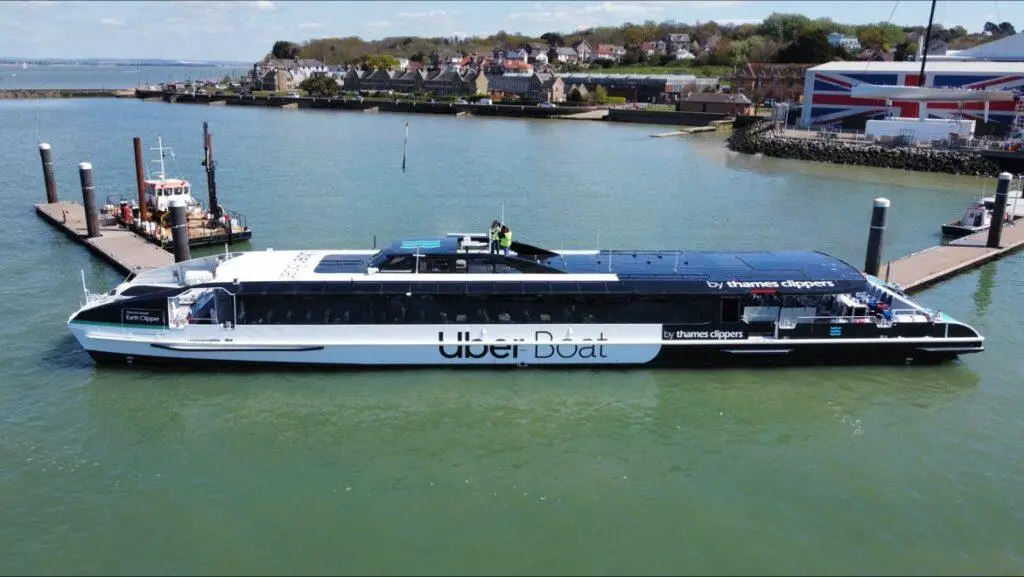
The 40m Earth Clipper will run exclusively on batteries when sailing through the mid-city zone, and will switch to operation on bio-fuel elsewhere on the River Thames tideway. Recharging of the battery installation during the day will be effected from the engines when in bio-fuel mode, and from the landside grid when lying alongside at night.
Constructed by Wight Shipyard, Britain’s leading aluminium shipbuilder, and developed in conjunction with Australian consultancy One2three Naval Architects, Earth Clipper pushes the bounds in hybrid twin-hulled vessels built to the high-speed craft (HSC) code. The newbuild generation will accommodate 231 passengers for Thames Clippers’ extensive service network catering to both commuters and tourists.
While similar in internal layout and capacity to the company’s previous Hunt-class vessels, the series is distinguished by the hybrid capability, enabling 28 knots to be made on the twin diesels or 12 knots on electric power. The sleek form engendering a low air-draught profile to allow navigation under the central London road and rail bridges at all states of the tide is complemented by a design that affords optimum views of the waterfront scenery.
Besides the many bridges and the Thames Barrier further downstream, the London River imposes a number of other constraints, including the fast tidal stream and the shallow waters in the upper reaches, influencing vessel parameters and handling characteristics. Relative to earlier vessels, the addition of banks of batteries in the latest ferries has increased weight and necessitated alterations in the layout of many of the onboard systems, all of which has had to be balanced against the dimensional and operational limitations.
Working with both owner and shipbuilder, UK consultancy provided guidance and oversight during construction to ensure compliance with the design specification, and advice on technical and regulatory aspects, including the operational complexities associated with battery technology.
Wight Shipyard engaged SEC Marine of Southampton for the power system specification, integration and installation, Danfoss’ Editron division for the complete high-voltage, direct-current(DC) distribution network, motors and inverters, and battery system supplier Spears Trident.
Excess power from the biofuel-ingesting MAN high-speed engines is used to feed the onboard alternating-current (AC) supply and charge the batteries, obviating the requirement for separate, diesel-driven auxiliary gensets. Moreover, in power take-in (PTI) mode, the solution adopted enables energy stored in the batteries to be drawn back into the propulsion line.
Thus, in what is categorised as a parallel hybrid arrangement, the ferry can sail on electric propulsion only, or combine the battery energy with the main driveline machine, reducing fuel consumption and providing a generally quieter and more comfortable journey for passengers.
Each of the newbuilds is fitted with the same engines as those used in the 2017 repowering of the fleet’s 200-passenger catamaran Hurricane Clipper, namely two V12 models of the MAN D2862 series incorporating selective catalytic reduction(SCR) technology. In the latest vessels, the machinery will run on hydrotreated vegetable oil (HVO). Use on existing units of the fleet has achieved NOx and SOx reductions in the order of 70%.
Wight Shipyard, through an earlier working association with Danfoss’ Editron division and SEC Marine on a newbuild project involving a crew transfer vessel, already had experience of the type of hybrid concept applied in the Thames Clippers contract.
Located at East Cowes on the Isle of Wight, off the southern English mainland, Wight Shipyard has previously delivered three catamarans to Thames Clippers. Having earlier looked to Australia’s lightweight shipbuilding industry for new tonnage, the London company awarded a contract in 2016 for two Scania-engined, low-wash, 35m vessels to Wight Shipyard, retaining Sydney-based One2three as design contractor. A 38m version, designated the Hunt Class Mk3, was subsequently booked with the UK yard and handed over in 2019.
Wight Shipyard is a modern-day success in UK shipbuilding. Although only established in 2016, the company has consistently attracted orders from UK and overseas customers, resulting in a prolific output of small aluminium ferries and other craft. A merger was agreed in March 2022 with French counterpart OCEA. The combined group is focusing on new opportunities in the ferry and offshore renewable energy markets.
Related Articles
 ELECTRIFICATION AND BATTERY HYBRIDS
 ELECTRIFICATION AND BATTERY HYBRIDS
 ELECTRIFICATION AND BATTERY HYBRIDS