



Brightest Stars Rise Across The Baltic
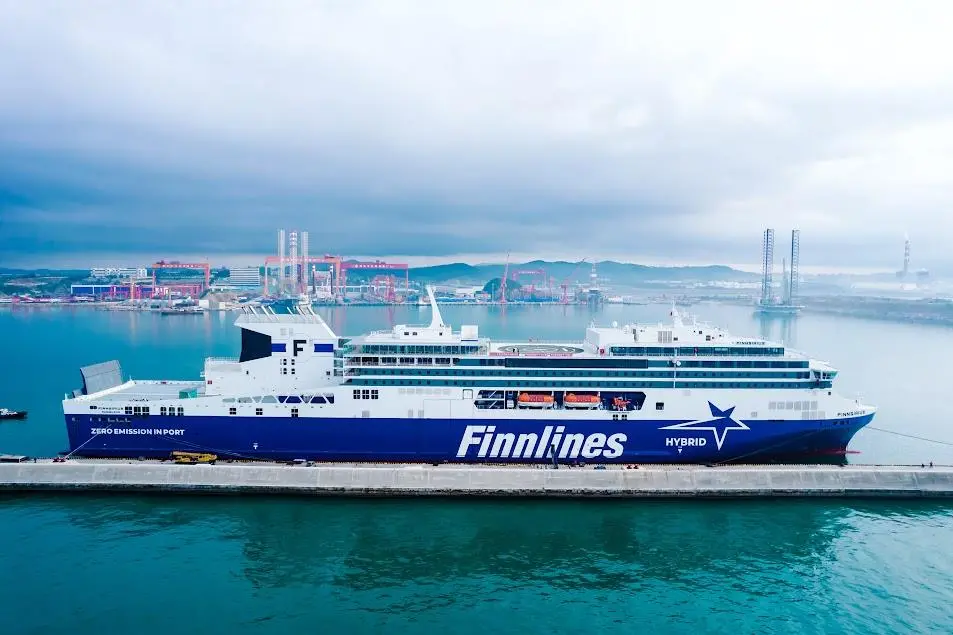
The first of two sisters ordered from the prolific Chinese ferry builder, the 65,700gt vessel incorporates hybrid power arrangements among a raft of emission-reducing, fuel-saving features. Besides a substantial battery pack, the design includes a shore power connection, under-hull air lubrication, exhaust gas abatement, waste heat recovery, and auto-mooring.
The brace of ro-pax ferries constitutes a $270m investment in the route linking Naantali, near Turku, with Kapellskar, which also entails the briefest of calls in the Aland Islands at Laangnas. The year-round operation across the central Baltic, which provides a conduit for freight and passengers on a capital-to-capital (Helsinki/Stockholm) corridor, has necessitated comprehensive provision for a challenging environment, as expressed in construction to 1A Super ice class standard and in elements conductive to onboard comfort.
Finnsirius is to be phased into the September timetable by undertaking evening departures from Kapellskar and morning sailings from Naantali. Fitting out of Finncanopus at Weihai is on track for her introduction in December 2023.
Designated the Superstar generation, the design’s 5,200 linear-metre ro-ro intake denotes a 24% increase in freight loading compared with the existing mainstays of the route, while the 1,148 passenger capacity is more than double that currently available. The vessels that will be superseded, the 219m sisters Finnswan (ex-Nordlink) and Europalink, are products of the Italian shipbuilding industry, having been completed by Fincantieri in 2007. Finnsirius has become the largest ro-pax in the Finnlines fleet.
The Superstar project forms the second phase of the Green Newbuilding Programme implemented by the Helsinki-headquartered company, part of Italy’s Grimaldi Group, following delivery from China of the three hybrid ro-ro freight carriers of the Finneco series during 2022.
Both concept and tender design for the Finnsirius type was entrusted to the Copenhagen consultancy Knud E Hansen, consequently rendering arrangement and structural drawings, specification, stability calculations as per SOLAS 2020 requirements, and machinery diagrams, with recourse to computational fluid dynamics (CFD) techniques for hull optimisation.
Each ship’s operational remit, embracing one overnight sailing and one day sailing on every 24-hour cycle, called for measures to ensure fast turnarounds through expeditious handling of ro-ro cargo, and optimisation for 16-knot and 19-knot voyage speeds, with a significant margin of power and speed assured for schedule recovery. The bar was set high as regards onboard comfort, and as to the overall level of travel experience for passengers and commercial drivers alike. A wider range of shipboard facilities, compared to the older ships, is complemented by ample scope for viewing the scenic archipelago passage.
Efficient capability for the prescribed speed profiles, whereby 16 knots can be maintained with two engines, and 19 knots with all four fired-up, is conferred by an innovative two-speed gearbox solution, claimed by Kongsberg Maritime to give a propulsion efficiency increase of about 3% compared with a single-speed gearbox. It forms part of the propulsion and manoeuvring system contract entrusted to the Norwegian vendor.
The twin shafts turn Kongsberg controllable pitch propellers. The Superstar application entails an integrated propeller/rudder system, in which hydrodynamic performance is maximised, thrust is enhanced and drag is reduced. Moreover, the rudder is of ‘twisted’ design, further improving manoeuvrability. The combination of aft-end measures in the twin-screw vessels is expected to realise efficiency gains of up to 6%.
The overall Kongsberg delivery is categorised as an Ice Class 1A propulsion package, allowing the vessels to work in sub-Arctic or Arctic conditions, coping with floating ice and extreme cold.
Thoroughly-proven, wide-bore medium-speed diesel machinery, in the shape of the Wartsila 46F series, has been nominated for the multi-engine installation in the new ferries. Each shipset comprises four units delivering 7,200kW for a primary power concentration of 28,800kW.
Wartsila’s involvement extended to the thrusters and a hybrid shaft generator system comprising a fully integrated Multidrive capable of driving the shaft alternators in both directions, as either electric motors or generators. Operation on batteries or shore power while in port is encompassed by the proprietary energy management system.
Manufactured at the Corvus plant in Norway, the battery system comprises banks of Orca Energy modules for an aggregate 5,096kWh capacity. The energy storage installation, charged from the shore or by the shaft generators, gives the potential for the vessel to effect peak shaving when under way and to manoeuvre on battery power, saving fuel and avoiding emissions close to shore and in port. Both the batteries and the onshore power connection provide sources of energy to feed the ship’s net and cover the hotel load while alongside, obviating the need to run gensets and thereby cutting emissions and noise.
Finnsirius is a new showcase for the air lubrication solution developed by the UK company Silverstream Technologies. The system uses lines of air release units (ARUs) fitted in the flat bottom to generate a carpet of microbubbles that travel the full length of the hull, creating a boundary layer that reduces friction as the ship travels through the water. The Grimaldi Group had used the Silverstream system on its GG5G ro-ro freight vessels, initial test applications having yielded fuel and emission savings of just over 5%.
‘Intelligent’ LED lighting management and ‘smart’ air control systems save energy by automatically adjusting settings in the cabins. Recycled and ecological material choices have been considered throughout the design process and figure in furnishings and fittings.
Finnlines and the Finnish Seafarers’ Union reached an agreement to ensure that the Superstar generation would operate under the Finnish flag and employ Finnish personnel. The vessels will offer 200 new, permanent jobs and take on extra crew during the high season.
MAIN PARTICULARS – Finnsirius
| Length overall | 235.6m |
|---|---|
|
Length bp |
217.7m |
|
Breadth, moulded |
33.3m |
|
Depth |
10.2m |
|
Draught |
7.0m |
|
Gross tonnage |
65,692t |
|
Deadweight |
12,540t |
|
Decks, complete |
11 |
|
Decks, partial |
1 |
|
Passenger capacity |
1,148 |
|
Ro-ro freight |
5,200 lane-m |
|
Cars |
200 |
|
Main engine power |
4 x 7,200kW |
|
Speed, service |
16/19kts |
|
Speed, maximum |
21kts |
|
Battery capacity |
5,096kWh |
|
Class |
RINA |
|
Class notations |
C+, +AUT-UMS, BWM-T, COMF-NOISE-B, COMF-VIB-B, Green Plus, HVSC-NB, Ice Class 1A Super, INWATERSURVEY, SRtP, +SYS-IBS, +SYS-NEQ-1, TAS |
|
Ice class |
1A Super |
|
Flag/registry |
Finland/Mariehamn |
Related Articles
 ELECTRIFICATION AND BATTERY HYBRIDS
 ELECTRIFICATION AND BATTERY HYBRIDS
 ELECTRIFICATION AND BATTERY HYBRIDS