



Wider Dangers Of Battery Fires
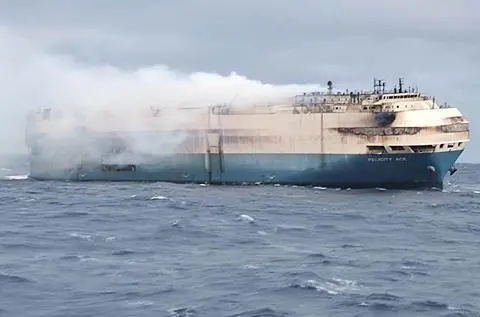
A spate of conflagrations on pure car/truck carriers (PCTCs) involving shipments of electric vehicles has drawn greater attention of late to the control of fires and fire risks associated with li-ion batteries.
However, the TT Club considers that there is less awareness of the highly toxic combustion products that are released, and of their impact on the health and wellbeing of those exposed to the gases. Pertinent to those that work at sea, the dangers are accentuated in confined environments.
The failure of such batteries has the potential to occur with no prior warning, or with such speed that there is typically no time to react to any warning signs. Fires involving electric vehicles on board ships can prove very difficult to extinguish, compounded by the rapid development of the situation.
TT Club described such scenarios as follows: “Based on the evidence of past fires, the time between the initiation of a failed battery igniting to a discharge of toxic vapour can be measured in seconds rather than minutes. This is due to a process known as thermal runaway. The rapid sequence of events typically occurs where an internal electrical short within one of the battery cells generates heat; this breaks down the internal structure of the battery, increasing the rate of the reaction in an ever-increasing cycle. There is often a dramatic release of energy in the form of heat and a significant emission of toxic gases.”
An irreversible thermal event in a li-ion battery can start in several ways, such as by spontaneous internal or external short-circuiting, overcharging, external heating or fire, or mechanical damage, leading to thermal runaway.
During a lithium battery thermal runaway event, research has shown that significant amounts of vapour can be produced per kilowatt hour(kWh), forming accumulations. Even when the clouds are able to disperse, the potential toxic effects may still occur at lower concentrations.
Ships’ crews, stevedores and first responders attempting to control the blaze encounter what might appear to be smoke but is in fact a mix of toxic gases, generated quickly in large volumes. Once in the atmosphere, these gases behave differently to smoke, often pooling at floor level due to their density. Thus, whereas individuals would normally stay low to avoid smoke inhalation in conventional fires, doing so where lithium battery fires are concerned is likely to prove problematic.
“The toxicity of gases given off from any given lithium-ion battery differ from that of a typical fire and can themselves vary, but all remain either poisonous or combustible, or both. They can feature high percentages of hydrogen, and compounds of hydrogen, including hydrogen fluoride, hydrogen chloride, as well as carbon monoxide, sulphur dioxide and methane among other dangerous chemicals,” observed TT Club.
Hydrogen fluoride is regarded as a particularly problematic component in the context of hazards to the wellbeing of those in the vicinity of such an incident. Moreover, the hydrogen content of the released gases as a whole can give rise to vapour cloud explosion risks and potential, consequent damage.
TT advocates a range of measures to mitigate the risks, starting with fire risk assessment, considering the hazards presented by li-ion batteries. It proposes providing crew or operatives with certified, full-face self-contained breathing apparatus, chemical-resistant boots and other protective equipment, as well as drench showers for post-response decontamination.
Early detection of such an incident can also be pivotal in managing the response, and this favours the use of cameras and thermal imaging. The mutual also underscores the importance of post-event clean-up, as the gases produced can leave toxic deposits on all surfaces and in the atmosphere.
Related Articles
 BATTERIES, SUPERCAPACITORS, FUEL CELLS AND OTHER ENERGY STORAGE TECHNOLOGY
 BATTERIES, SUPERCAPACITORS, FUEL CELLS AND OTHER ENERGY STORAGE TECHNOLOGY
 BATTERIES, SUPERCAPACITORS, FUEL CELLS AND OTHER ENERGY STORAGE TECHNOLOGY