



The Switch to supply DC power and protection devices to full-electric RoPax
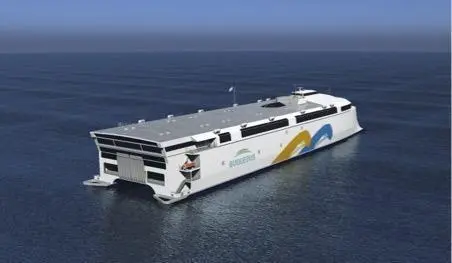
Wärtsilä will provide the uniquely designed, fully battery-powered vessel with e-motor driven Wärtsilä waterjets as the main propulsors. Corvus Energy will supply an energy storage system (ESS) battery storage that will be four times larger than any battery installation installed on a hybrid-electric ship currently operating, offering over 40 MWh of energy storage.
DC power distribution in ships is widely recognized as being more energy-efficient than AC systems in many cases. However, DC power distribution needs a different protection philosophy. Moreover, today’s larger batteries require ultra-fast and fail-safe protection to withstand larger battery short-circuit currents. In addition, ultra-fast protection devices reduce the size of the total system by reducing the short-circuit current levels in the system.
“We’re very proud to be contributing to this milestone project at a time when marine battery systems are getting bigger and bigger,” says Paul Atherton, General Manager Operation Unit Norway at The Switch. “The project represents a big leap for the industry, which our proprietary DC-Hub power distribution drives and protection technology are helping to enable. Without our game-changing protection devices, it simply wouldn’t be possible to make battery systems safe on this scale.”
“Our suite of ultra-fast disconnect devices are specifically designed to guarantee safe DC distribution under all sailing conditions. Our protection devices also help to find optimal and compact solution especially with large batteries. This makes DC increasingly attractive for future-flexibility,” says Teemu Heikkilä, Head of Product Line Converters at The Switch.
The catamaran will be built by Incat shipyard of Tasmania, which specializes in lightweight aluminum ship solutions for ferry operators, special service providers and military applications. With an overall length of 130 meters and a width of 32 meters it will be able to carry 2,100 passengers and 226 cars on services between Argentina and Uruguay. Delivery is scheduled for 2025.
The Switch’s DC Hub, ECL and BSCL Explained
The Switch Electronic Current Limiter (ECL) handles faults toward the batteries from the DC-Hub, protecting them from external failure and ensure ride-through.
The Switch Battery Short-Circuit Limiter (BSCL) restricts any short-term current from batteries, immediately blocking the short-circuit system. This allows more batteries to be connected to the electrical system and fewer DC-Hubs, making the entire system more compact. It is optimized for the much higher inductance of battery banks that a bus link cannot handle.”
The Switch Electronic DC Breaker (EDCB) protects against short-circuit faults inside a DC-Hub and ensures ride-through. This semiconductor-based device disconnects any failing drive module within 10 microseconds from the common DC link.
The Switch Electronic Bus Link (EBL) connects the vessel’s DC-Hubs and protects against faults between DC-Hubs. The DP3-rated and DNV-approved EBL provides protection outside the DC-Hub by spitting onboard grids in microseconds to isolate any faulty DC-Hub.
Related Articles
 ELECTRIFICATION AND BATTERY HYBRIDS
 ELECTRIFICATION AND BATTERY HYBRIDS
 ELECTRIFICATION AND BATTERY HYBRIDS