



Tailor-Made Service Vessels For Largest Wind Farm
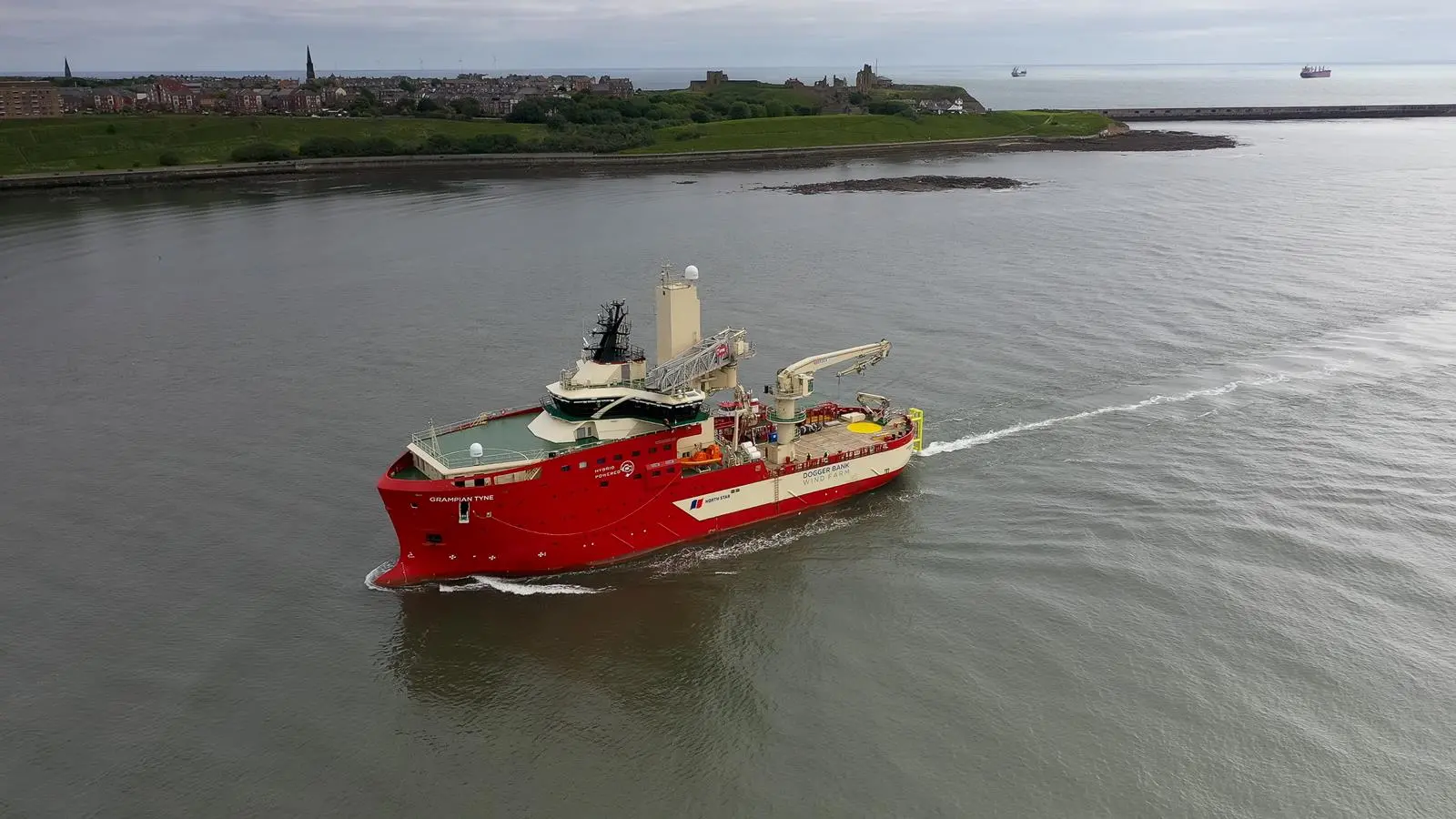
Two of four service operation vessels (SOVs) contracted from the VARD Group have been delivered so far this year, and a further order spanning up to four ships in the commissioning service operation vessel (CSOV) category have been placed with the Norwegian international shipbuilder.
Grampian Tyne and Grampian Derwent have given first form to the SOV series, with the third newbuild, Grampian Tees, in hand at VARD’s Vietnamese premises and expected before the end of 2023. She is to be followed by the fourth ship, Grampian Tweed, some 12 months later.
Each of the SOVs has been committed on 10-year charter to support operations and maintenance (O&M) work on the Dogger Bank offshore wind farm in the North Sea, some 130km from the Yorkshire coast. Once fully completed in 2026, the 3.6GW development will be the largest of its kind worldwide, with capacity to supply 6m British homes.
All four vessels will work from the Port of Tyne, where the O&M base has been established by the Dogger Bank partnership. Dogger Bank is being built in three consecutive phases of 1.2GW, and is being delivered by a joint venture composed of SSE Renewables (with a 40% stake), Equinor (40%), and Vaargronn (20%). SSE Renewables is leading on construction and commissioning, while Equinor will operate the wind farm on completion.The charter terms on the new SOVs include options for three one-year extensions beyond the initial 10 years.
Endorsing the effectiveness both of North Star’s project management and the Norwegian-Vietnamese pairing in the construction, entailing primary build at VARD Vung Tau shipyard and final outfitting and equipping in Norway, both Grampian Tyne and Grampian Derwent were completed ahead of schedule. In fact, Grampian Derwent was delivered to the owner three months earlier than planned. This has enabled early mobilisation to support SSE Renewables with a new scope of work at the Dogger Bank Wind Farm.
Developed by VARD’s Norwegian design office in close cooperation with North Star, drawing on the latter’s experience in the often rigorous North Sea domain, the Grampian Tyne plus the nascent Grampian Tees and Grampian Tweed embody the 80m VARD 4-12 type, while the second ship in the series incorporates a larger iteration, the VARD 4-19 design. Diesel-electric main propulsion using cycloidal propellers, bolstered by a battery hybrid power system, is complemented by an array of manoeuvring thrusters to meet the exacting handling and positioning precision demanded of such vessels.
All the SOVs have been specified with high-grade accommodation for offshore wind turbine technicians and to act as centralised logistics hub configured to both handle cargo and act as a functioning warehouse at the offshore location. The ability to sustain service in the harsh environment that characterises the central North Sea for much of the year, while imposing a low carbon footprint, has been a prerequisite of the design project.
While the 4-12 design has been developed to undertake corrective maintenance on the Dogger Bank C wind turbine arrays, the 4-19 is intended for planned maintenance operations on the development’s A and B arrays. The commanding central feature of the new generation is an integrated tower-mounted 30m height-adjustable, motion-compensated gangway, enabling direct access between the ship and the wind turbine. The walk-to-work system from the Norwegian company Uptime is fundamental to the efficient, logistical capability of each vessel.
In the VARD 4-12, a total of 60 single-berth, en-suite cabins cater for 39 windfarm personnel plus 21 crew, and the facilities include a large mess, gym, four day rooms and two meeting rooms, and multiple offices.
Derwent Tyne and the two 4-12 newbuild sisters each have a 2t 3D motion-compensated crane plus ancillary 1t and 2t deck cranes, all manufactured by the Norwegian firm Red Rock. The adoption of a side-loading logistics concept allows freight and equipment transfers from the quayside direct to the SOV’s 510m2 covered warehouse facility at main deck level.
By comparison, the 4-19 design version as applied to Grampian Derwent accommodates up to 50 client technicians, and has increased internal warehousing. In addition, the vessel is equipped with a 17m helideck and higher-rated(5t) 3D crane for offshore lifting.
Onboard decision support software and a digital twin solution created with MO4 is being rolled out in the new vessels and across the fleet to enhance operational planning and performance, referencing client scheduling, metocean forecasts and collated KPI monitoring reports.
Each SOV is equipped with bespoke, hybrid-powered daughter craft to be used primarily as crew and equipment transfer vessels and able to operate in sea states corresponding to a 1.7m significant wave height. The craft have been designed in collaboration with Southampton naval architects Chartwell Marine and built in Great Yarmouth by Alicat Workboats. Each is gyro-stabilised and arranged for eight passengers and up to one ton of deck cargo.
The diesel-electric propulsion system is based on Japanese medium-speed diesel power, whereby four main aggregates each incorporating a six-cylinder Yanmar EY22ALW engine rated at 1,370kW (1,300kWe) deliver energy to a pair of Voith eVSP cycloidal propellers. The latter achieve maximum thrust in all directions, and each unit’s directly integrated permanent-magnet, synchronous motor ensures high torque and fast response, in a system that dispenses with gears.
The solution ensures a more direct and almost loss-free conversion of the electrical drive power into thrust and keeps noise emissions to a minimum.
North Star’s chief technology officer James Bradford re-affirmed that the use of Voith electric eVSP units for main propulsion yielded benefits in terms of instantaneous response to vessel motions, improving stability for operations, enhancing onboard comfort and reducing the fuel burn by around 13%. Rim drive tunnel thrusters mounted forward also provide highly responsive thrust while being “very quiet”, thereby enhancing habitability.
“Our propulsion system is fully electrically driven, allowing us to utilise hybrid technologies, including just under 1MWh of batteries used for spinning reserve in dynamic positioning and peak-shaving. We believe this saves a further 20% of fuel burn versus standard technologies,” added Mr Bradford. In fact, Corvus Energy’s description of the Orca ESS installation supplied quantifies the capacity as 745kWh.
In reference to the choice of engines, he said “Having four identical generators allows us to spread the load, and the medium-speed approach allows the engines to work closer to optimal load in operations. This was more expensive than a father-and-son approach but we believe the Yanmars will offer efficiency and reliability in the long run, saving opex and improving available days. Yanmar also has a development plan for the its EY22 engines for modification to dual-fuel with methanol, and we have a lot of trust in its R&D approach and credibility in the development of new solutions.”
Grampian Tyne has two Kongsberg Maritime PMTT2200 bow tunnel thrusters and a Kongsberg retractable azimuth thruster. Dynamic positioning to DP2 standard is realised through a system from Marine Technologies using SceneScan, Rangeguard, Cyscan and twin DGPS reference sensors.
Following the SOV contract, the subsequent tranche of newbuild work awarded by North Star to VARD entails two commissioning service operation vessels(CSOVs) of the unique VARD 4-22 design, specified with battery packs and prepared for future adaptation to methanol fuel. Deliveries have been stipulated within the first half of 2025, again making recourse to hull fabrication in one of the contractor’s overseas yards, followed by outfitting and completion in Norway. The agreement was signed earlier this year, and includes options on third and fourth vessels.
The latest order denoted a further stage in the Aberdeen company’s ambition to expand its fleet with 40 vessels tailored to servicing the renewables sector by 2040, acting on growth prospects in the UK and European markets.
MAIN PARTICULARS – Grampian Tyne/VARD 4-12 design
| Length overall | 79.8m |
|---|---|
|
Length bp |
72.8m |
|
Breadth |
19.0m |
|
Depth |
7.4m |
|
Draught |
5.6m |
|
Gross tonnage |
5,033t |
|
Deadweight |
1,852t |
|
Open deck area |
330m2 |
|
Interior warehouse |
510m2 |
|
Propulsion system |
Diesel/battery-electric hybrid |
|
Main engine power |
4 x 1,370kW |
|
Main propulsors |
2 x Voith eVSP |
|
Manoeuvring thrusters |
2 x tunnel; 1 x retractable |
|
ESS(battery) capacity |
745kWh |
|
Class |
DNV |
|
Class notations |
1A, BIS, Battery(Power), BWM(T), Clean(Design), COMF(C-2, V-2), DYNPOS(AUTR), E0, LCS, NAUT(AW), Recyclable, Shore power SPS, Walk2work, ER(SCR) |
|
Registry |
UK/Newcastle |
Related Articles
 ELECTRIFICATION AND BATTERY HYBRIDS
 ELECTRIFICATION AND BATTERY HYBRIDS
 ELECTRIFICATION AND BATTERY HYBRIDS