



CONVERTER TECHNOLOGY BOOSTS ONSHORE POWER SOLUTIONS
Sea transport is one of the most energy-efficient means of moving goods and people around the world, yet it continues to produce a substantial – and growing – carbon footprint. In fact, shipping is responsible for approximately 3% of global greenhouse gas emissions. With projections indicating that maritime trade may triple by 2050 and the ever-growing popularity of cruise vacations, the industry is under pressure to significantly reduce emissions from all existing and future sea-faring vessels.
An area that has come under intensifying scrutiny is the air and noise pollution caused by ships while docked. Even when a ship is berthed, electricity is required for lighting, air conditioning, cooling, and control systems – collectively referred to as “hotel loads” – with cruise ships being a prime example. Consequently, many of these ships rely on diesel generators to keep their onboard electrical networks going while docked, causing significant air and noise pollution.
One way to mitigate these environmental impacts is to adopt direct-to-shore electrical connections. This practice involves vessels docking at ports and plugging into the onshore electricity grid, provided the ships and ports have the infrastructure. By doing so, the ships can power down their auxiliary engines, resulting in a cutback of emissions and a reduction in noise and vibrations in the port. Known as “cold ironing,” this concept dates back to the days when coal-fired ships, upon reaching the dock, no longer needed to burn coal to keep their boilers running. Hence the metal (“iron”) of the boilers would go cold when berthed for lengthy periods.
Ship-to-shore power technology is well-established and commercially available, with more ports upgrading their berths and facilities to accommodate it. As infrastructure continues to develop, its potential to significantly lower the shipping industry’s contribution to global emissions is considerable. Implemented correctly, it can also help improve air quality near the port areas.
Yet, despite its advantages, widespread adoption of cold ironing is still on the horizon, pending the establishment of compatible infrastructure across all ports. A critical aspect of ensuring a smooth transition from ship-generated power to a shoreside electricity supply is the use of converter technology, but it must meet some challenges first. With continued innovation and investment, this technology could be the linchpin that unlocks the full potential of cold ironing as a sustainable practice in ports globally, clearing the path toward a cleaner maritime environment.
But what makes converter technology so central to enabling docked vessels to utilise shore power? And what is being done to facilitate its adoption?
Smooth power transition with converter technology
The key obstacle in establishing shore-to-ship electricity connections is the discrepancy in frequency and voltage between land-based power systems and those found on maritime vessels. Most ships have onboard systems designed for 60 Hz electricity, whereas many regions across the globe – particularly throughout Europe – utilize a 50 Hz grid. Grid converters are an essential piece of technology to bridge this gap.
These converters enable seamless connections between ships and onshore power systems, ensuring a constant electricity supply even in regions with less stable grid infrastructure. The systems are flexible and equipped to handle a wide array of electrical loads, provided that the demand remains within the rated capabilities.
The first vessels to pioneer the transition to shoreside power were cruise liners, cargo container vessels, and vehicle and passenger ferries, as they tend to spend considerable time in ports and require an uninterrupted power supply for their hotel loads. Using shore-to-ship power in this way enable these ships to deactivate their power systems while maintaining the operational continuity of their onboard facilities.
As environmental regulations tighten around the globe, other sea-going vessels, including modest-sized fishing boats and large military ships, have started to implement shore connection technologies. Initiatives like the FuelEU Maritime, recently endorsed by the EU Council, will make it mandatory for container ships to connect to onshore power supplies when docked at major EU ports from 2030. Similarly, countries like Norway are accelerating the rollout of shore-powered installations at their ports, positioning themselves at the forefront of this environmental initiative.
These regulatory shifts echo a growing recognition of the environmental benefits offered by shore power connections and represent a concerted effort by governments to curb maritime emissions and other pollution. The impact of these changes will likely ripple across the maritime industry, propelling advancements in shore power technology and infrastructure and setting a new standard for sustainable practices in ports worldwide.

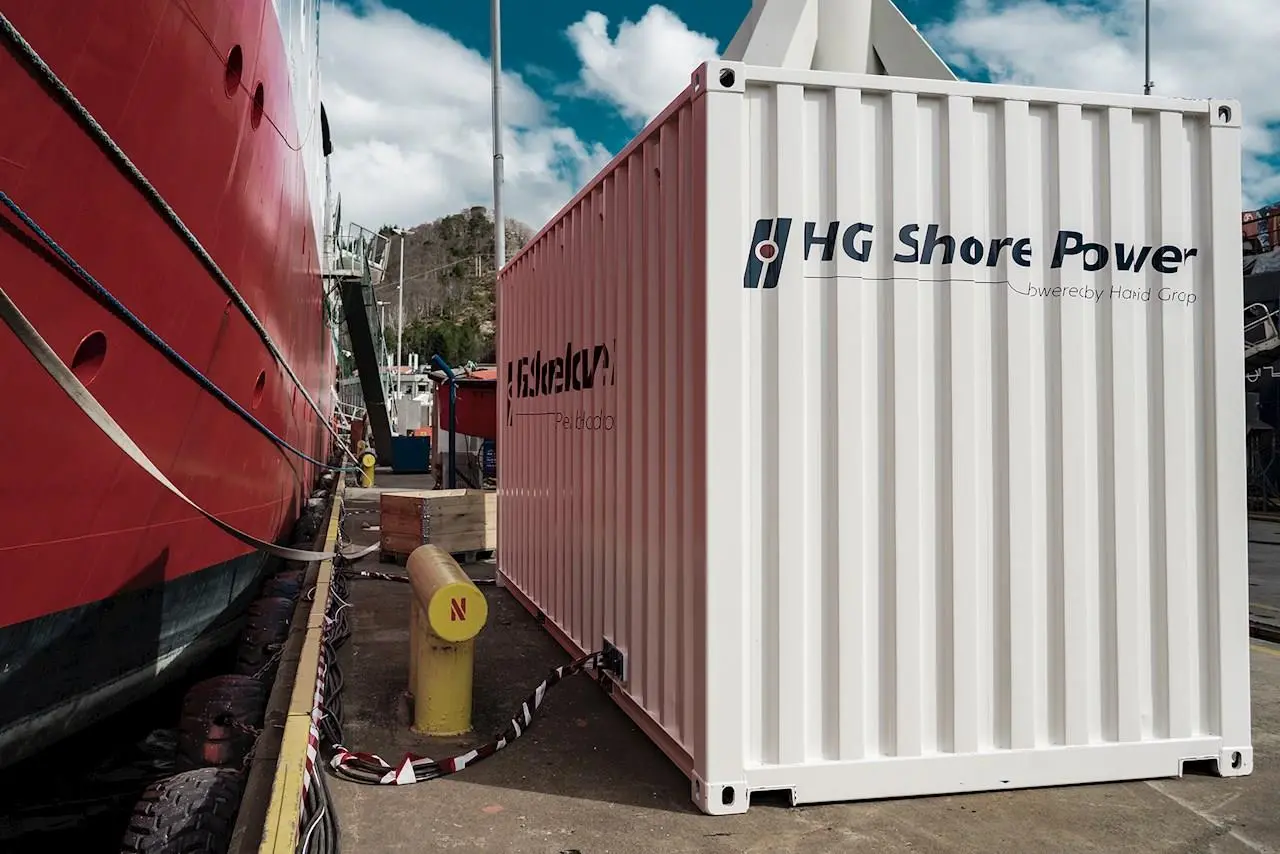
The Norway-based Hareid Group illustrated this nearly two years ago when it unveiled its HG Shore Power™ solution, which has since been put into operation at various shipyards and ports along Norway’s western seaboard. Positioned conveniently on the dock and encased in portable units, the shore power systems adjust the local grid’s voltage and frequency to meet the specific requirements of the docked ship. Offered in 550 and 1000 kVA power levels, these self-contained solutions draw upon ABB’s ACS880 Multidrive technology, effectively eliminating emissions, noise, and vibration. A user-friendly interface enables simple vessel connections and power consumption tracking, while offering the flexibility to customize power levels and frequency.
Shore power’s wide-ranging benefits
The increasing adoption of shore-to-ship power across a wide range of vessels has led to notable reductions in emissions during their time at port. This positive environmental impact has been seen across a diverse fleet – from cruise ships and passenger ferries to container ships, fishing vessels, and military craft.
By tapping into the power supplied by onshore grids, these vessels have managed to cut down their CO2 emissions by up to 35% while berthed. This reduction translates to a daily savings of more than 13.77 metric tons of CO2 emissions for each ship, an equivalent environmental benefit to taking over 1,000 combustion engine cars off the road every day.
Moreover, the switch to shore power offers significant financial incentives for ship operators. They can expect a likely decrease in maintenance costs for auxiliary engines since operators will be scaling back on their running time. Furthermore, shutting down diesel generators and connecting to onshore energy grids means tapping into a cleaner and often less expensive energy source. This could even be from renewable energy, further enhancing sustainability.
Even with the clear benefits of shore-to-ship power connections, realizing widespread adoption demands close collaboration between port authorities, ship operators, and global governments.
Meeting cabling challenges with MV technology
While the push for global implementation of shore-to-ship power is promising, there are other barriers standing in the way of widespread adoption. One comes in the form of electrical cabling. The high-power requirements for energizing docked ships typically require an extensive and complex network of cables, incurring high costs and posing operational difficulties.
A key solution to this is medium voltage (MV) technology, which enables electrical power transmission at higher voltage levels. By doing so, it significantly lowers the current, which in turn reduces the number of required cables. This simplifies the installation process and cuts down on expenses related to cable materials, maintenance, and infrastructure.
Shore-to-ship power solutions that offer low voltage (LV) and medium voltage (MV) technology are the most effective as they are designed to operate in tandem with the ship’s electrical systems. The MV solution can deliver power in a broad spectrum, ranging from 15 to 20 megawatts (MW), depending on the specifics of the port and the class of ship being serviced. These solutions offer flexible configurations to meet the distinct demands of each harbor and vessel. Some suppliers go a step further, offering comprehensive turnkey shore-to-ship power packages that encompass connecting to the public power grid and installation on ships.
This range of technology solutions adds momentum to establishing robust shore-to-ship power infrastructures.
Onshore power is the cleaner option
Connecting to onshore power grids allows vessels to slash their greenhouse gas emissions and reduce noise pollution while simultaneously cutting operational expenses. To realize this globally, ship and port operators must embrace converter technology and seek alternatives to costly and extensive cabling.
Considering that the shipping industry accounts for nearly 3% of global greenhouse emissions, there’s a vital need to address its environmental impact. The implementation of shore-to-ship electrification could offer considerable benefits worldwide.
Related Articles
 ELECTRIFICATION AND BATTERY HYBRIDS
 ELECTRIFICATION AND BATTERY HYBRIDS
 ELECTRIFICATION AND BATTERY HYBRIDS