



RO-RO BEHEMOTH WITH SMALLER FOOTPRINT
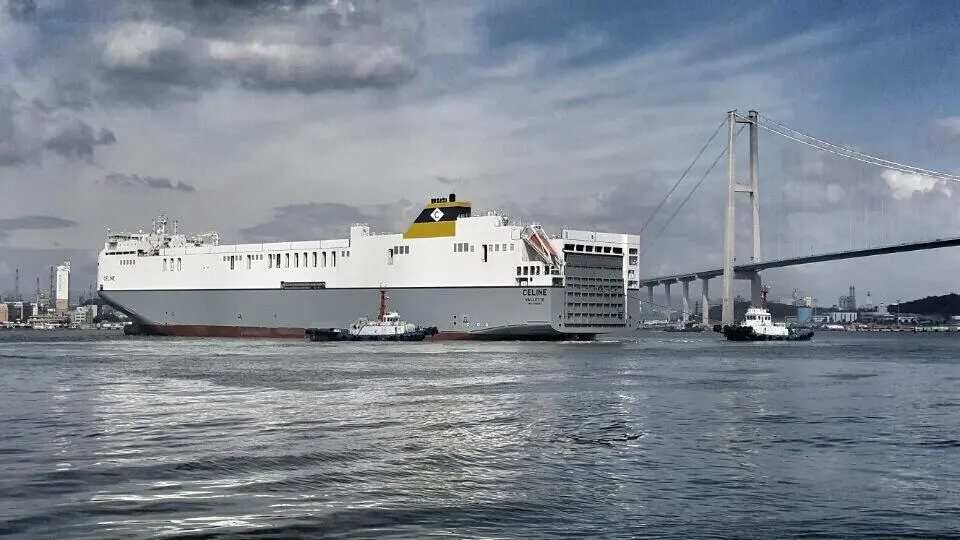
The first of two sisters ordered by Luxembourg-based through-transport operator CLdN, the newbuild design features a technologically advanced, hybrid propulsion train offering the possibility to make transits in electric mode at speeds up to 17 knots.
In terms of cargo carrying arrangements, the nascent generation is modelled on the 8,000 lane-metre ships Celine and Delphine, delivered by HMD in 2017 and 2018, and which hold the title as the world’s largest ro-ros deployed in short-sea traffic. The 235m pair is currently operating on the Killingholme/Zeebrugge run across the southern North Sea between eastern England and Belgium. The newbuilds are expected to enter service during the first half of 2025.
While reinforcing the economies of scale strategy applied to key routes in the CLdN network, the new class will also realise a further stage in corporate energy- and emission-reduction goals. Compared to the Celine and Delphine, greenhouse gas (GHG) emissions will be cut by 40%, according to the company.
The sophistication of the engineering arrangements comes at a price, of course, to the extent that the two 234m newbuilds constitute CLdN’s largest-ever investment. Each has been specified with two LNG dual-fuel, two-stroke main engines plus two very powerful shaft generators sized to individually yield 6MW for the ship’s net or for electric propulsion.
The nominated main engine type is from the MAN gas-injected ME-GI portfolio, whereby a pair of six-cylinder models of the S60ME-GI design specified at some 11,000kW will together provide a power concentration of 22MW for a speed of 20 knots-plus. The dual-fuel plant, incorporating proprietary exhaust gas recirculation (EGR) systems, will be fully IMO Tier III-compliant.
The PTO/PTI installation entails two 6MW machines that can be clutched to the respective shaftlines to deliver electrical propulsion power, with the potential to engender fair weather speeds of 16 to 17 knots. Each ship is also to be fitted with two 678kWh banks of batteries. Wartsila was contracted to supply the hybrid setup, including the PTO/PTI generators and electric motors, energy storage systems, multi-drive converters, and energy management system.
The new ro-ros will also be equipped to draw electricity from the shoreside grid when alongside, obviating emissions. Over-and-above the immediate capability for operating as either gas/diesel-mechanical or gas/diesel-electric vessels, the design has been conceived to afford greater flexibility by facilitating future adoption of new fuels, fuel cells and/or augmented battery capacity.
Besides setting a capacity record in the short-sea ro-ro stakes in 2017, the first of the earlier 8,000 lane-metre class, Celine, had brought two-stroke, single-screw powering to a new level, via an MAN 9L60ME-C engine turning out 18,700kW.
As with the Celine and Delphine, the upcoming fleet additions will use a MacGregor axial stern ramp for all cargo handling and an internal, multi-deck configuration suited to the broadest range of range of freight. Manifests can encompass everything from road trailers and rolltrailer-borne industrial goods to containers on cassettes, and the owning group’s extensive business in the automotive sector, including factory-new cars, vans and inter-plant components.
Since the completion of the previous 8,000 lane-metre duo, CLdN’s contractual relationship with HMD has subsequently encompassed two iterations of a 5,400 lane-metre class, totalling six ships delivered between 2019 and 2022. The initial four were powered by an MAN two-stroke diesel, but prepared for LNG (dual-fuel) conversion, while the latter two vessels were specified from the outset with high-pressure, gas-injected ME-GI main machinery and PTO/PTI technology.
Related Articles
 ELECTRIFICATION AND BATTERY HYBRIDS
 ELECTRIFICATION AND BATTERY HYBRIDS
 ELECTRIFICATION AND BATTERY HYBRIDS