FINNISH TRIO SHARPENS STEEL SUPPLY CHAIN
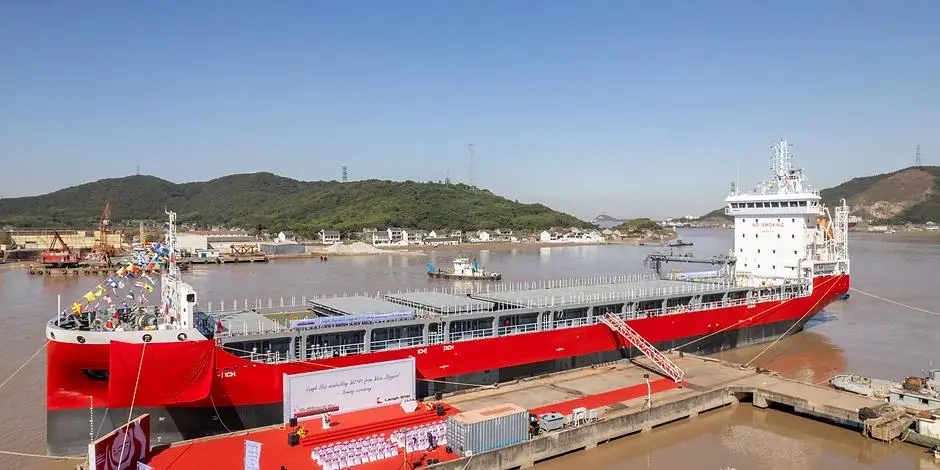
The 7,800dwt Lovisa is the first of a trio of dual-fuel newbuilds ordered from Wuhu Shipyard by the Finnish operator Langh Ship. The entire series is dedicated to the two-way traffic generated by stainless steel producer Outokumpu between its Tornio mill in northern Finland and the northwest Continent, ultimately replacing the three vessels hitherto employed. The new ships hoist loading capacity per sailing to some 7,300t from the maximum 6,000t hitherto.
The design has been formulated in close cooperation between the shipowner and charterer, and finalised by Shanghai Merchant Ship Design & Research Institute (SDARI) with hydrodynamically-optimised body lines. Such is Langh Ship’s business compass that the specification includes equipment and technology originating from various subsidiaries.
Southbound voyages from the Tornio plant in Roytta port to Outokumpu’s finishing lines and handling terminal at Terneuzen, in the Netherlands, consist of stainless steel coils and semi-finished stainless steel products, while return traffic to the Finnish mill comprises raw material in the form of stainless and ferrous scrap.
The box-shaped is suited to block-stowed containers and bulk commodities, while portable bulkheads offer compartmentalisation opportunities for various cargoes and parcel sizes. However, the primary role of the new vessels is implicit in the adoption of tailored systems developed in-house for steel coils by Langh Ship affiliate Langh Cargo Solutions, notably as concerns the cradle tweendeck feature, well-proven over the years in reducing damage and enhancing cargo handling efficiency.
The patented cradle tweendeck sections provide secure stowage of coils on panels incorporating V-shaped grooves, creating an indented holding pattern with space between each coil.
Heavy steel coils have traditionally been transported at sea on the tank top ceiling at the bottom of the hold spaces, making for a very low centre of gravity and a ‘stiff’ ship whereby the rolling period is very short for a larger heeling angle, causing jerky, violent movements in a seaway.
Coil loading on both the hold bottom and tweendeck, as practised by Langh Ship, results in weight distribution in a way that modifies ship movements. By raising the centre of gravity and reducing the metacentric height(GM), the heavily-loaded tweendeck actually results in a more ‘tender’ ship, with a longer rolling period and less heel, creating improved habitability for crew and lessened risks of cargo damage, especially in foul weather.
Moreover, for the handling of other goods, the panels can be turned so as to present a flush surface, functioning as a conventional tweendeck.
Lovisa is powered by a nine-cylinder Wartsila 34DF dual-fuel, medium-speed engine turning out a maximum 4,500kW. In addition to burning, and switching on command between, marine gas oil (MGO) and LNG, the machinery provides for future operation on liquefied biogas (LBG) and biodiesel. The ship’s refined lines coupled with the technological advance encapsulated by the W34DF design mean that the new tonnage requires a lower engine power while taking more cargo and ensuring the same service speed as current vessels in the trade.
The fuel gas supply system (FGSS) derives from the Korean maker Gas Entec, with whom the Langh Ship affiliate Langh Tech has entered into a cooperation for applications in the European market. Langh Tech’s involvement with the Lovisa series features the supply of the ballast water management system.
Each of the series has been prepared for link-up to the onshore power grid when alongside, obviating emissions during port calls.
The Tornio/Terneuzen connection is of pivotal importance to Outokumpu in transporting exports to the European market and bringing recycled steel to the melt shop at the Tornio works. Second-of-class Olivia was named in January, to be followed by the third sistership Sofia. The service will be maintained by six Langh vessels, comprising the three newbuild plus three other units of the fleet that have been earmarked for retrofitting with carbon capture systems.
The investment programme is fundamental to Outokumpu’s target of reducing annual carbon emissions from short-sea shipping by at least 25% come the end of 2024. This forms a key part of the organisation’s environmental agenda, focused on decreasing direct and indirect emissions as well as emissions from the supply chain by 42% for every tonne of stainless steel produced by 2030, compared to the 2016 baseline.
Langh Ship also has three 1A ice-class container feeder vessels on order in China, at the Paxocean Engineering yard in the Zhoushan area near Shanghai. The series of 1,200TEU, gearless newbuilds is intended for intra-European trade, and delivery of the first of the 150m sisters is expected later this year. All three boxships will have hybrid scrubbers, plus carbon capture and ballast management systems from Langh Tech, and biofuel-capable propulsion machinery.
MAIN PARTICULARS
Lovisa
| Length overall | 119.94m |
|---|---|
|
Length bp |
117.99m |
|
Breadth |
16.50m |
|
Depth |
10.40m |
|
Draught |
7.20m |
|
Gross tonnage |
6,402t |
|
Deadweight |
7,896t |
|
Propulsion system |
LNG dual-fuel |
|
Main engine power |
4,500kW |
|
Class |
DNV |
|
Registry/flag |
Pikis/Finland |