



Electric power gains momentum in ferry industry
A lot has happened in the meantime and it is now widely assumed that electric power would be the answer to the demands of green transition when it comes to short haul vessels.
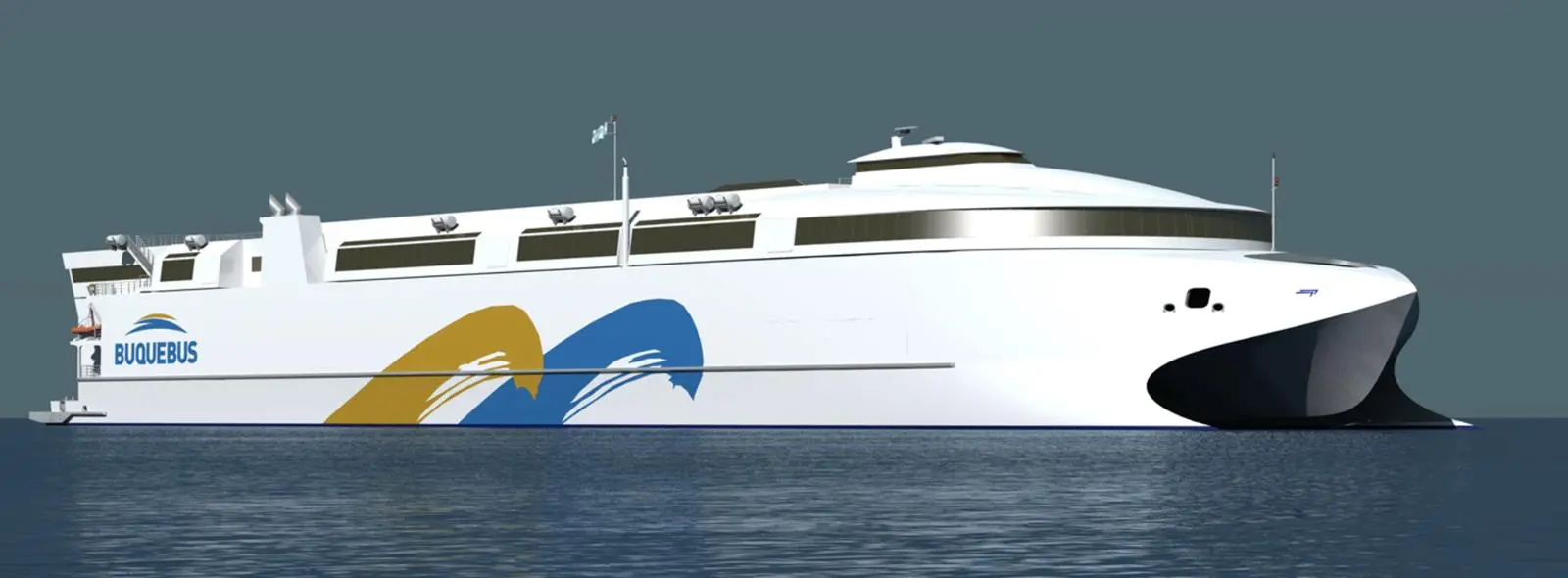
The use of battery power at sea took a major leap forward recently, when Buquebus placed an order with Incat Tasmania for catamaran fast ferry on services on the River Plate: the 130 metre long vessel will be able to carry 2,100 passengers and 226 cars and have a battery pack of some 40MWh, four times bigger than anything that has gone to sea before.n The ferry, which will have a speed of 37.5 knots, is scheduled to be delivered in 2025, had originally been intended to run on LNG.
Meanwhile, DFDS, the Copenhagen based ferry and logistics operator, unveiled at a capital markets day event near the end of 2023 that the company plans to have six new vessels in service between 2024 and 2030. Two of these would be battery powered ropax vessels that would operate in the Dover Strait between the UK and France. This follows an agreement between the company and the ports of Dover, Port Boulogne-Calais and Dunkerque Port too decarbonise the maritime traffic in the Straits. “A sufficient power supply on land and infrastructure to accommodate recharging facilities in ports are equally important to be able to complete the fleet electrification,” DFDS said in a statement in October last year.
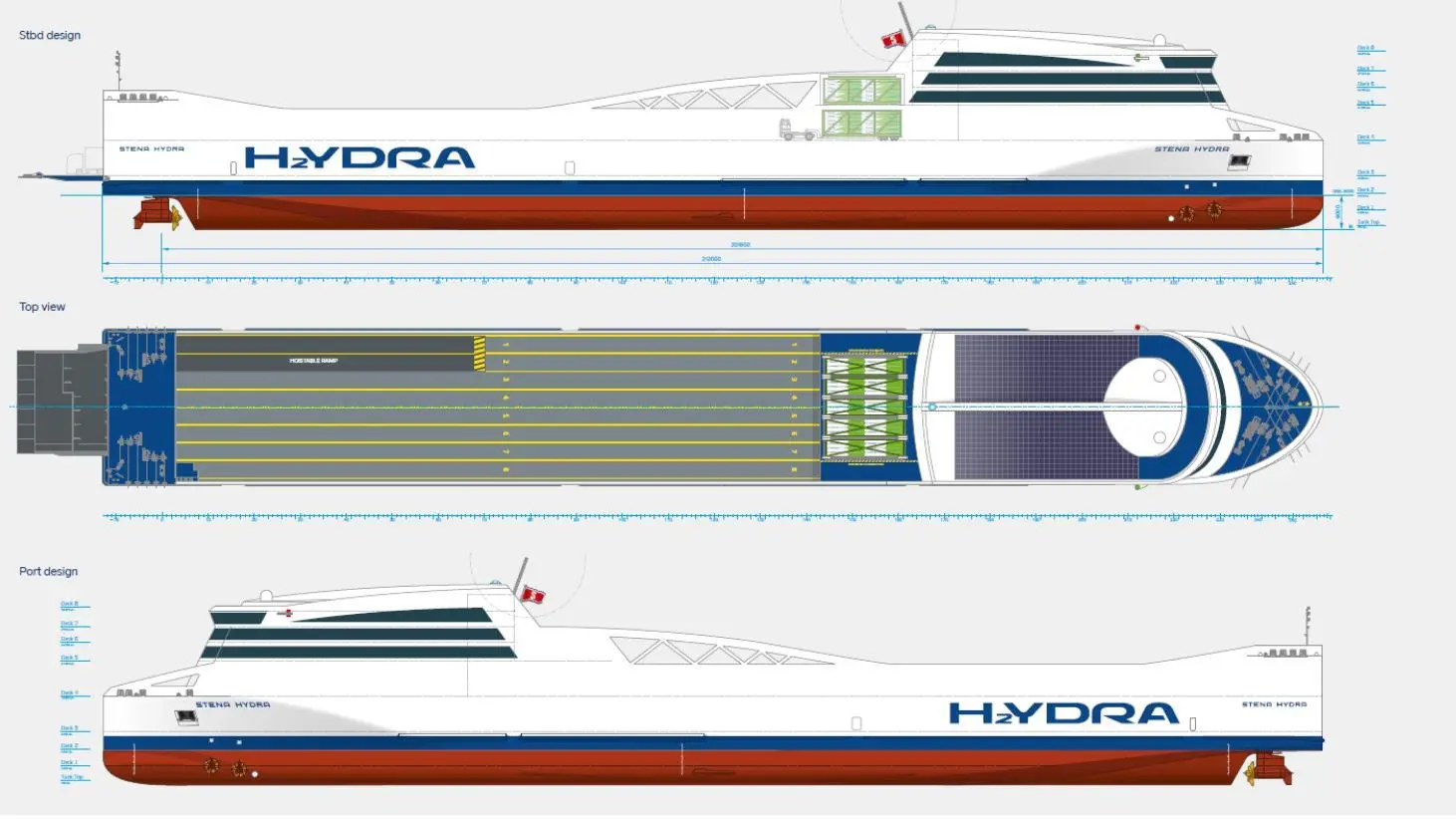
Indeed, the land based facilities can play a major role in the practical execution of ferry projects based on the use of battery power. Stena Line, the Swedish ferry giant, recently decided switch focus from a battery and solar powered Stena Electra design to a new concept design called Stena Hydra, which as the name would suggest, is based on hydrogen fuel cell technology.
Charging infrastructure poses challenges
The first named design that was earmarked for the Gothenburg – Fredrikshavn service, called for a 215 m long vessel with 3,100 lane metres for freight and accommodation for 1,200 to 1,500 passengers. It would have required 70MWh of battery power capacity for the 50 mile crossing. It had been intended to enter service by 2030.
Stena Hydra, meanwhile, has a length of 212 metres and lane metre capacity of 2,500. Its superstructure is much smaller than that of Stena Electra, indicating a significantly lower passenger capacity. With a 10 ton net hydrogen load, it is expected to have a range of 150 miles. The hydrogen fuel cell installation would have an output of 25 MW and the electric motors would deliver 20MW, Swedish Environmental Research Institute says in a report on the new concept, adding that this would offer the lowest round trip costs.
“The reason that Stena Elektra is currently a vision rather than a concept is that the (land based) infrastructure isn’t there yet. Few ports, let alone regions, have what it takes to charge a fully electric ferry. Charging infrastructure is crucial for this technology to be viable, so we are in dialogues with authorities and other external stakeholders around the infrastructure needed prior to moving ahead with this project,” Maria Hellbjörn, PR & communications manager at Stena Line, told The Motorship.
Scandlines in Denmark have, however, been able to move ahead with the land based power installations and as a result, its battery powered ropax new building called Futura that is currently under construction in Turkey is due to enter service between Rodby Havn in Denmark and Puttgarden in Germany this year. Two existing vessels have already been converted as hybrids and Scandlines plans to operate the service without direct emissions as the remaining two will undergo a similar conversion.
This will entail charging the 10 MWh battery packs on each vessel that have a cruising speed of 18.5 knots to 80% of full charge in just 12 minutes while the vessels are in port. Both ships are expected to have been converted by some time 2025 and the total investment in decarbonising the route would amount Ito EUR 31 million, Scandlines said in a statement.
Norwegian Electricity Systems will deliver a 30MVA grid transformer and other equipment and Scandlines recently signed a contract with a German utility company to receive power for its installation in Puttgraden. In Rodby Havn, a charging facility has been operational since 2022.
Kristian Knaapi, sales manager at Finnish consultant naval architect firm Deltamarin that is involved in the ferry market, said that the outlook in the electric ferry business is encouraging – he described the market as booming – but a lot would depend on two things, the development of shore based infrastructure on one hand and battery technology on the other.
Combination of batteries with other green energy sources an option
“If a ship should rotate between ports A, B, C and A, a it is a big open question if there will be charging capacity for batteries to allow it to do this,” he told The Motorship. Many passenger carrying ferries shuttle just between two ports, but the picture changes considerably in the case of freight only roro vessels, which are often used on services that include calls in several ports.
One way forward in extending the range of electric ferries could be combining batteries with wind assisted systems and e.g. solar panels and this approach could also be used to minimise the use of diesel engines in cases when they could not be eliminated from the power train, he said.
The development of more powerful and also lighter battery packs will drive the development of electric ferries. Currently, the weight of battery packs is a consideration that needs to be taken into account when designing a ship as these need to be placed low in the vessel, for stability reason. Their weight will also reduce the dw- capacity of the ship.
Ice conditions will pose challenges of their own as a ship needs a lot more power to push through ice than what is the case in open water conditions. This means that a service like the crossing between the Finnish and Estonian capitals, a distance of about 51 miles, that might otherwise be well suited for an electric ferry in the future, may not be among the first busy, short haul ferry services of such length to employ a ferry relying on battery power.
The cost of electricity can vary even significantly between various ports in a single country and there is little ports can do to effect the price, said a report published by Lighthouse, the Swedish Maritime Competence Centre, in 2018. It also warned that in some cases, an investment made in power supply from ashore can become unprofitable or that the price of electricity will discourage such an investment.
Ferries have led the way in the development of the use of electric power at sea and according to a report by IDTEchEx in the UK, 37% of all battery installations for marine use in capacity terms delivered in 2019- 22 went for use on these types of ships. Norway, perhaps unsurprisingly, was the biggest market, with some 100 electric ferries now in service. The report forecast that hybrid cargo vessels would emerge as the next major development of electric power at sea.
Most of the ferries that operate in Norway are in use on short crossings e.g. across a fjord, which allows their battery packs to be charged easily and quickly. Domestic short haul services have led the way of the use of battery power elsewhere as well.
Study finds major potential for electric ferries in China
In China, a study made in 2021, showed that on five key coastal ferry services, more than half of fossil fuel emissions could be replaced by electric ferries, Xiaoli Mao, Elise Georgeff, Dan Rutherford, and Liudmila Osipova said in a report published by the International Council of Clean Transportation. In the Pearl River, the figure is highest, at 95%, followed by the Hainan Strait (92%) and Yangtze River Delta (74%). For the Bo Sea, the figure was 61% and Taiwan Strait 56%.
“The analysis finds that current battery technologies can already satisfy most application scenarios for China’s coastal fleet. Most ferry legs in coastal China are shorter than 200 km, which is well within the battery range values of most ferries studied. Battery technology improvements would help electrify other more difficult segments of the existing ferry operations, namely larger ropax ferries deployed on longer routes,” the authors say.
Higher charging power would help to improve the continuity of ferry operations using batteries, which is crucial for application scenarios where one route is exclusively served by one ship. “If policymakers wish to prioritise better electric ferry deployment, they may wish to focus first on electrifying smaller ships and shorter legs. Electrifying passenger ferries up to 55 m that sail on legs up to 100 km could replace 50% of fossil fuel use with electricity. For ro-pax ferries, the same fossil fuel replacement target can be attained by targeting ships up to 170 m in length traveling on legs up to 200 km,” they conclude.
Related Articles
 ELECTRIFICATION AND BATTERY HYBRIDS
 ELECTRIFICATION AND BATTERY HYBRIDS
 ELECTRIFICATION AND BATTERY HYBRIDS