Spanish ferry operator champions LNG power
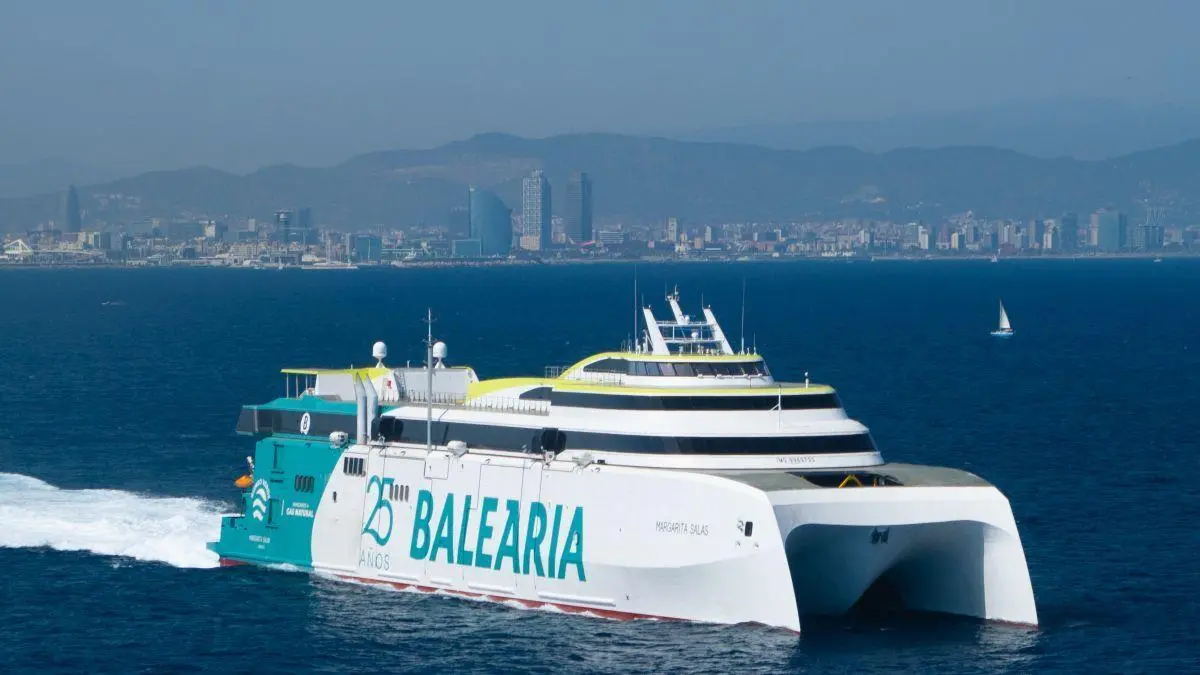
Melding Australian prowess in catamaran technology with the construction, outfitting and project management skills of northern Spain’s maritime industrial cluster, the 123-metre Margarita Salas has doubled capacity and boosted efficiency on a service linking the mainland at Barcelona with the islands of Mallorca and Menorca.
The twin-hulled, multi-engine vessel represents a further progression on the innovation and sustainability encapsulated in her 2021-delivered counterpart, Eleanor Roosevelt, assigned to Balearia’s Denia/Palma di Mallorca/Ibiza run. Margarita Salas is a product emanating from the same contractual team, construction having been undertaken at the Gijon premises of Astilleros Armon to a design from Incat Crowther, and with architectural and interior work by Madrid-based Oliver Design.
While offering a near-identical payload capacity as the previous vessel, at 1,200 passengers plus some 425 cars or up to 500 lane-metres of trucks plus 250 cars, the new entrant features 10% greater engine power plus larger passenger spaces with a second deck and higher wheelhouse, imbuing an increased gross tonnage. At EUR126 million ($141m), the capital intensity is significantly greater than that of the EUR90 million ($101m) recorded at the order stage for the Eleanor Roosevelt.
Balearia has kept faith with the Wartsila 31 medium-speed engine platform in its dual-fuel version, as used in the first of its Incat Crowther 123-series ferries, while exploiting the advance in potency available with the latest iteration of the four-stroke design. Wartsila had announced the power gain from 550kW per cylinder to 600kW/cyl at 750rpm for W31DF models in 2021.
Thus, whereas each of the four 16-cylinder units that drive the earlier ferry yield 8,800kW at maximum continuous output, the machinery in the Margarita Salas affords individual ratings of 9,600kW, making for a concentration of 38,400kW of primary power.
This is transmitted through four Reintjes gearboxes to an equivalent number of Wartsila waterjets. These are the latest-generation WXJ steerable-reversible type, with Protouch propulsion control. The axial flow arrangement of the WXJ1500 waterjets is said to reduce the installation footprint by an average of 25% compared to more conventional systems.
Scheduling is ensured on the basis of a service speed capability for 35 knots at 85% MCR, such that adequate reserve is present in the system to allow for time to be made up on passage in the event of delays due to weather or other factors.
One of the benefits of a functionally integrated drivetrain package as supplied by Wartsila, and relevant to the high-speed subject vessel, is the scope it offers to achieve comprehensive optimisation with regard to power-to-weight ratio.
Running wholly in gas mode, with recourse to a pair of Wartsila proprietary (LNGPac) storage tanks of 190m3 combined volume, the vessel has a range of approximately 470nm. This increases to some 1,000nm through judicious use of both LNG and distillate, while a considerably greater endurance factor is attainable by falling back on a diesel-only operation. The auxiliary outfit similarly confers flexibility in fuel usage, whereby two of the four gensets are LNG-fed and two are diesel-fired.
Although Balearia has for periods when the LNG bunker price has been very high erred towards greater reliance on diesel in those of its fleet capable of sailing on the fuel, and has thereby better maintained competitiveness, it is understood that the company has, more recently, progressively moved to 100% or mainstream LNG consumption in those ships.
Over-and-above the effectiveness of LNG-firing in combating CO2 and NOx emissions and virtually eliminating sulphur and particles, environmental gains issue from the scale efficiencies realised by the newbuild as the replacement for the smaller, 1999-built catamaran on the Denia/Alcudia(Mallorca)/Ciutadella(Menorca) route. Relative to the previous mainstay, an Austal Auto Express-type, all-diesel fast ferry, laid out for some 800 passengers and 200 cars, it is estimated that total CO2 emissions by the Margarita Salas will be 22% less, for a major gain in carrying capacity and power concentration.
Margarita Salas is the company’s 11th vessel to be equipped with LNG dual-fuel engines, a large percentage as a consequence of retrofit initiatives, placing Balearia in a leading position on the path towards achieving both industry and corporate goals as to ultimate decarbonisation.
The new ship’s Wartsila propulsion machinery offers future options in terms of environmentally-compatible fuels, through the ability to ingest 100% biomethane and mixtures of up to 25% ‘green’ hydrogen. During port turnarounds, the carbon footprint of Margarita Salas may also be reduced by exploiting the vessel’s provision for connecting with the shoreside electrical grid, obviating the need to run gensets.
Not only power, but manoeuvrability and comfort have been enhanced in the light of three years’ day-in, day-out operational experience with the latest vessel’s predecessor, which is understood to have been well received by the travelling public at large. To enhance low-speed manoeuvrability, twin bow thrust units were written into the specification for the Margarita Salas from the outset, following the retrofit of such equipment to the Eleanor Roosevelt a year on from the ferry’s service debut.
The foreship form of the Incat Crowther 123 and ride control system utilise a retractable T-foil abaft the centreline bow, plus aft interceptors to modify vessel motions, enhancing comfort in difficult sea conditions. Moreover, the isolated superstructure attenuates noise and vibration transmission from the expansive engine plant to the passenger areas. Scheduled journey times are three and a half hours between the Catalan capital and the first or last island port, and one hour between islands, such that smooth as possible passages are equally important to crew habitability as to passengers’ wellbeing.
In fact, the ferry has been designed and equipped overall with an elevated passenger experience in mind, as expressed in the adoption of technologies such as a QR code system for access to the vessel and assigned seats.
For its part, Oliver Design observed that the interior design of the Margarita Salas posed certain challenges due to restrictions on the use of non-combustible and low-weight materials, given the weight criteria associated with such a high-speed vessel. The interior panels are made of an aluminium honeycomb and the ceilings incorporate lightweight aluminium slats with integral LED lighting.
Armon used more than 1,200t of aluminium in the construction. Besides saving weight and hence promoting lower fuel consumption, the material is highly recyclable, facilitating re-use at the end of the ship’s life.
In the face of the continuing erosion of Europe’s shipbuilding competitiveness vis-a-vis an ever-widening eastern and southern Asian capability and ambition, the fulfilment of the sophisticated Balearia project on home ground speaks to the technical and organisational scope and logistical benefits offered by determined industry players such as the Armon Group.
By way of an allocation from the Next Generation Recovery and Resilience Mechanism (NG-RRM), a degree of EU support has eased the capital burden of the latest newbuild scheme.
The Gijon orderbook includes a third 123m fast ferry in the series, provisionally a repeat of the Margarita Salas, indicating Balearia’s confidence in tested contractual associations and resulting build quality, and underscoring the Denia-domiciled company’s unerring drive for fleet transformation and business growth, to ensure long-term viability. Anticipated delivery at the end of 2025 suggests introduction to the service network in 2026.