LNG carrier sector losing steam
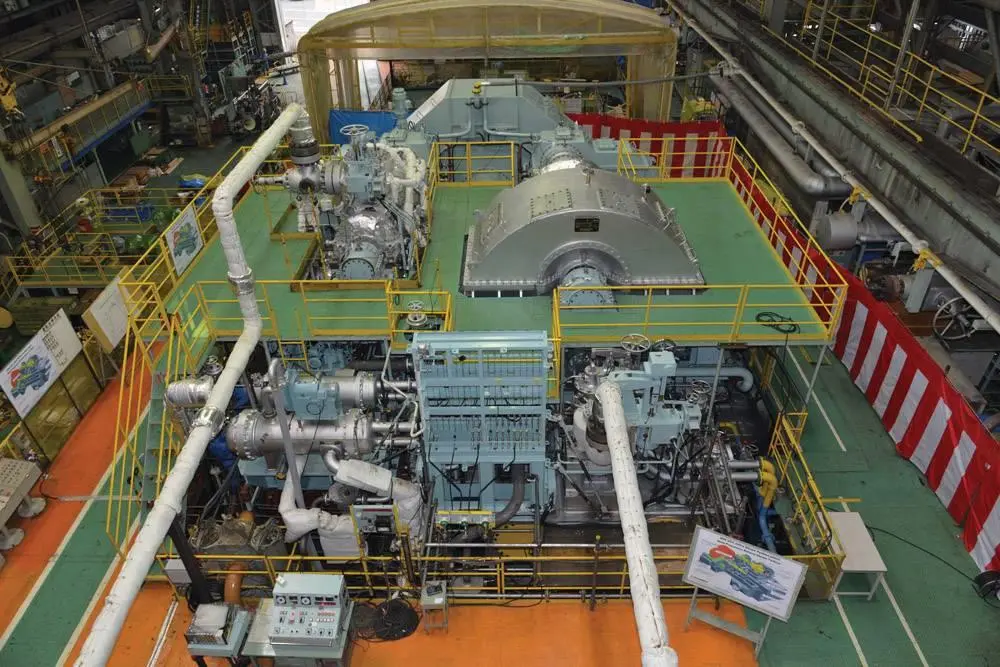
The steam turbine is a device for obtaining mechanical work from the energy stored in steam and was long the first choice for very large power main propulsion units. Over recent decades, the LNG carrier segment has become the last bastion of the steam turbine in commercial shipping.
Continuity of the steam turbine through a period of rapid advance in marine engineering technology has been abetted, until comparatively recently, by some major operators of LNG carriers undertaking fleet investments that endorse the design improvements achieved by Japanese makers championing the reheat principle.
In fact, and excluding floating storage units, there are still over 200 steam turbine-powered LNG carriers in existence, equating to at least 25% of the active global fleet.
Economic and environmental challenges
Oversupply of LNG tankers resulting from the ordering of tonnage on an unprecedented scale, followed by a slump in charter rates, have brought the energy performance shortcomings of the steam turbine relative to the latest powering options into sharper focus. High specific fuel consumption figures now outweigh all the time-served advantages of the mode.
The widening differentials in fuel burn, coupled with ever-tightening emissions legislation, mean that older representatives of the steam LNGC fleet are increasingly marginalised in the charter market and face withdrawal in the near future if not tied into the long-term assignments hitherto prevalent in the deep-sea gas trades. Although the latest LNG carriers incorporating reheat-type turbines are only six or so years old, the writing seems to be on the wall for steam turbine mechanical propulsion in merchant shipping.
Shipping consultancy Drewry observed that last year’s slump in charter rates for LNGCs of all power types was especially dramatic for steam turbine vessels, for which spot rates averaging $23,000 per day had plummeted to $5,000 per day by the end of 2024, recording a historic low. Furthermore, the oversupply of LNGC capacity as a whole outpaced the increased tonne-mile demand generated by the re-routing of ships via the Cape of Good Hope, with the steam carriers failing to reap any benefits from longer voyages. In March this year, Drewry stated:“This trend is likely to continue in 2025-2026, with rates for steam carriers remaining lower throughout the year.”
The fall in rates questions the economic feasibility of older vessels in particular, given the difficulty now in covering operating costs. In fact, the cost differential between LNG ships of 10 and 15 years of age is said to be of the order of 16-17% and growing further, suggesting that the in-service lifespan for steam turbine-powered gas tankers that are not engaged in long-term transportation contracts may be shorter than originally contemplated.
Steam turbine systems running on boil-off gas (BOG) and heavy fuel oil (HFO) prevailed as the propulsion system for LNGCs before the early 2000s. The emergence of more efficient alternatives such as dual-fuel diesel-electric (DFDE), tri-fuel diesel-electric (TFDE), and slow-speed diesel with reliquefaction plant (SSDR) was spurred by increasing fuel costs and stricter emission regulations.
As observed by the International Gas Union (IGU) in its World LNG Report, “In recent years, the modern containment systems that generate lower BOG, and the rise of short-term and spot trading of LNG, have spawned demand for more flexible and efficient propulsion systems to adapt to the varied sailing speeds, distances and conditions. These factors have resulted in a new wave of dual-fuel propulsion systems that also burn BOG with a small amount of pilot fuel or diesel.” This has included MAN high-pressure ME-GI two-stroke and low-pressure ME-GA types, and successive generations of low-pressure injection X-DF series engines from Winterthur Gas & Diesel(WinGD). The latter has been markedly in the ascendant over the past two years especially.
The lowest overall efficiency ratings lay with steam turbines, at some 30% for conventional plant up to about 35% at full load in the latest re-heat design. Four-stroke DFDE is reckoned at about 40%, on a par with the SSDR diesel installations in the largest LNGCs of the Q-Max and Q-Flex classes. Two-stroke, direct-drive DF machinery has pushed total efficiency ratings up to the 48-50% range.
Steam turbines account for the powering of the majority of LNGCs over 10 years of age. Japanese industry rallied steam 10 years ago through the development of the Mitsubishi Ultra-Steam Turbine (UST) series, which quickly attracted a succession of orders for LNGCs placed with builders in Japan and also South Korea. Key to the enhanced performance of the UST series, attributed with 15% greater efficiency relative to the previous generation of conventional steam turbines (CST) from MHI, is the application of the reheat/regeneration cycle.
The boilers produce steam at a higher pressure and temperature than in CST plant while adopting a reheat cycle. Main steam is led from the boilers to the high-pressure (HP) turbine and then exhausted to the reheater with decreased pressure and temperature. Reheat steam is then fed to the intermediate pressure (IP) turbine and subsequently to the low-pressure (LP) turbine. By comparison, the steam flow in a conventional installation is boiler-HP turbine-LP turbine.
A follow-on series of LNG carriers of the Sayaringo STaGE type from Mitsubishi incorporated the UST turbine and reduction gear in combination with dual-fuel diesel generator sets and electric propulsion motor. The innovative, twin-shaft, hybrid STaGE (steam turbine and gas engine) system made its sea-going debut in a 2018 LNGC newbuild delivery.
Both the dual-fuel reciprocating engine machinery and the UST can operate on cargo BOG, while waste heat from the generator engines is recovered to heat the feedwater flow to the boiler and the steam turbine plant. The combination of two propulsion systems confers flexibility, efficiency and redundancy.
Through the consecutive Sayaendo and Sayaringo STaGE series of Moss-type, Mitsubishi-designed LNGCs, the UST turbine figures in 20 vessels commissioned between 2015 and 2019.
The market fragmentation that is clearly under way now on the basis of engine/propulsion type is expected to become more pronounced as a flurry of newbuilds adding to the present surfeit of capacity puts pressure on older steam turbine gas tankers. It is also anticipated that steam carriers will face the steep brunt of regulations such as the Carbon Intensity Indicator (CII) and EEXI.
Drewry is unequivocal as to the global fleet’s transformation in the coming years, projecting that 100 steam turbine LNGCs, or 50% of the current fleet, will be demolished or withdrawn by the end of 2030. Following considerable scrapping to restore the supply-demand balance, the expectation is that rates will start to stabilise in 2027 and follow an upward trajectory thereafter.
Last October, one of the hitherto well-received options for LNG tanker propulsion was withdrawn, evidently due to rapidly intensifying emission rules. In a communication to licensees and other stakeholders, MAN ES gave notice of its decision to discontinue sales of its first low-pressure LNG dual-fuel, two-stroke engine, the G70ME-C10.5-GA.
The move came only five years after the announcement of the engine’s development and three and a half years after its launch as a competitor to WinGD’s X-DF Otto-cycle, dual-fuel low-speed. Over the intervening period, more than 260 ME-GA engines had been ordered for a range of vessel types.
Methane is admitted during the compression stroke in the Otto-cycle process, which allows for a lower supply pressure compared to ME-GI engines. This was considered especially interesting for LNG tanker designs where boil-off gas handling and engine fuel gas supply are integrated.
However, methane emissions from lean-burn Otto engines can be a challenge. Given the expectation of new IMO edicts governing methane slip coming into force in 2027, and notwithstanding the use of exhaust gas recirculation (EGR) in the ME-GA, MAN ES considered that the design would require significant technical updating and investment. Unburnt methane emissions are also the target of the EU’s FuelEU regulation, while GHG emissions as a whole are also on the line under the EU’s Emissions Trading Scheme (ETS).
In December 2024, a late-stage switch by the contractual shipowner yielded orders for a total 16 dual-fuel two-strokes of WinGD’s X-DF type in eight LNGC newbuilds.
Efficiency enhancements
Recent upgrades to the X-DF have included the application of variable compression ratio(VCR) technology, cutting methane slip to levels below EU and provisional IMO criteria. Moreover, the new, smaller-footprint 2.2 version, the third iteration of the design, have furthered its appeal in the LNGC segment. In fact, the low-pressure X-DF family has dominated the past two years’ intake of shipbuilding contracts.
MAN’s high-pressure, Diesel-cycle two-stroke ME-GI design of LNG dual-fuel engine was already well-established in the LNGC market and across multiple vessel segments. Further orders were announced in February 2025 for 174,000m3 LNGC newbuilds in South Korea. The designer and licensor has now demonstrated its further commitment to the ME-GI series through the projected release of a new, yet more efficient iteration based on the 10.7 platform, wherein injection pressure has been increased to 380 bar from the 300 bar on the existing series.
A refinement to the four-stroke, dual-fuel electric propulsion concept for LNGCs was unveiled in 2022 by MAN ES and the ABB Group. The new-generation system blends MAN wide-bore 49/60DF engines as the genset drives with ABB’s Dynamic AC technology. Key to the solution is the capability for variable-speed operation of the gensets over the entire engine load. This contrasts with constant-speed operated engines optimised for high-load.
Dubbed the DFE+ concept, the system has the added benefit of improved efficiency (by employing the latest breed of MAN medium-speed machinery) together with lessened methane slip across the complete engine map. The preceding dual-fuel electric offering generally displayed more pronounced methane slip at part- and low-load.
Now attracting substantial investment in R&D and system development as a pathway to shipping decarbonisation, the nuclear option holds out potential for commercial vessel propulsion machinery that can harness steam energy. A nuclear reactor would be used instead of fossil fuel to fire the boilers to produce steam for the turbine.
While mechanically-driven propulsion trains figure in proposals, nuclear-electric appears to be more widely favoured, thereby entailing the use of turbo generators acting on the propulsion shaftlines.
A decade and a half ago, Babcock International completed a study to investigate the commercial implications of developing a nuclear-powered, deep-sea LNG carrier. Besides low emissions, the plus factors identified by the company included the compactness of the power source, allowing cargo capacity to be maximised, along with significant noise reduction.