



Batteries growing bigger and energy options multiply
At the beginning of this year, DNV released its latest Alternative Fuels Insight report which stated that 1072 hybrid or pure battery powered vessels had already entered service and a further 468 were on order for delivery over the next three years to the end of 2028. To achieve such a high number in such a relatively short space of time is quite an achievement especially as the technology was relatively unknown in the maritime sector.
Even more remarkable is that the technology has not been confined to ferries – although they do make up just under 30% of the total – but also now includes, cruise ships, offshore vessels, bulk carriers, ro-ro, tankers, fishing and many more types besides. Furthermore, although initially driven by Norwegian requirements for ferries to become emission free, many owners have seen that there are financial benefits to be had as emission levies and regulation are spreading to more parts of the globe and on top of which there are practical operational benefits beside.
The IMO’s EEDI and EEXI ratings do make some allowance for the efficiency improvement given by energy storage systems, but these are irrelevant when it comes to levies such as under the EU ETS. Using an ESS will however reduce CO2 emissions during operation and as such have the potential to reduce the financial impact of emission levies. With peak shaving whereby surplus energy from generators is stored for use when the demand increases, an ESS will further contribute to efficiency by allowing engines to operate at optimum loading. This could be very useful when ships are operating on fuels such as ammonia as frequent engine load changes are not well handled by some fuels.
Gathering momentum
Being such a newcomer to the maritime sphere, each year seems to bring new milestones in the energy storage system arena and new titles to lay claim to. At various times there has been the first ferry in 2015 for Ampere, the first system on an offshore vessel with an ESS replacing a generator with Viking Princess in 2017, Color Hybrid in 2019 as the world’s largest plug-in hybrid ship and in the same year Roald Amundsen made history as the first cruise ship to sail on battery power and the first hybrid electric-powered ship to transit the Northwest Passage. And as the technology spread from its spiritual home in Norway, firsts for other countries as hybrid ships joined their fleets and new ship types added to the growing list.
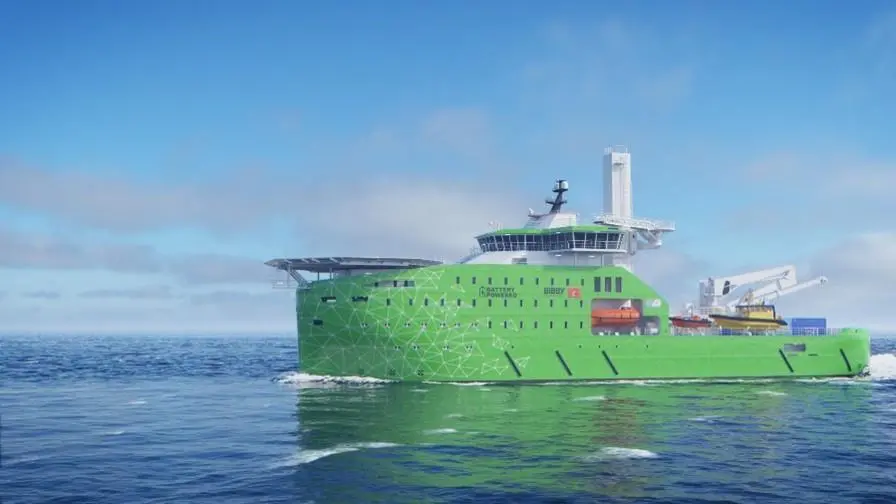
Two of the most recent developments highlight the increasing capacity of ESS and allow for new ‘first’ claims. In January this year, UK-based offshore operator Bibby Marine signed a contract with Spanish shipbuilder Armon Shipyard for what it claims as ‘the world’s first truly zero-emission CSOV’. A keel laying ceremony was held in July and the vessel planned to be delivered and operational in 2027. The DP vessel will have a pair of Wartsila 6L32 dual-fuel engines expected to run on methanol and a Corvus Energy ESS with a capacity of 24.4MWh.
The batteries when fully charged allow for a full day’s operation in seas with a significant wave height of 1.5m reducing to 15 hours in seas with 3.5m wave heights. The engines are not intended to be the main power source but are installed for use in emergencies or when safety conditions dictate. In use the vessel will recharge batteries overnight using shore power. The vessel will be fully prepared for offshore charging with a 4 – 5 hour charge time and has both stern and bow charging connections.
In May this year, Tasmanian aluminium ship specialist Incat launched Hull 096 which is built for Uruguayan ferry operator Buquebus and planned to be renamed China Zorrilla after sea trials intended for later this year. The vessel is claimed as the largest all electric vessel and features more than 40MWh of installed battery capacity supplied by Wärtsilä and operating an eight-unit water jet propulsion system. All the required power for ship operation comes from the batteries.
Multiple input options
Being a straightforward electrical energy storage option, batteries can draw power from a variety of sources. For pure battery ships with no engines or generators, the main supply is shore power. In Norway, where most electricity comes from hydropower, this ensures clean operation in line with regulations requiring most ferries to be emission free.
The short bursts of energy demanded by Norwegian short-service ferries allow a long overnight charge, topped up briefly during the day. Initially only low-speed charging was needed, but as operating profiles expand, higher-speed charging systems have been developed.
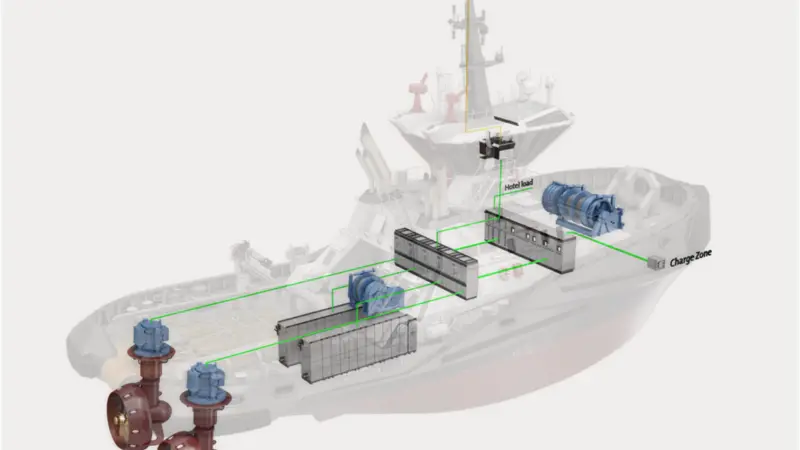
For ships with engines and generators, charging is not confined to shore. Some small craft carry a dedicated genset, but more commonly peak shaving is employed: propulsion power from the main engine is supplemented by surplus energy diverted to the battery. In diesel-electric ships this comes via the power management system, while mechanically propelled ships may use a shaft generator/motor. In multi-engine vessels, the battery system can substitute for one engine, instantly providing extra power instead of starting another unit.
Other options are also emerging. Car carriers and other ships with large deck areas can install solar panels, feeding either hotel loads or the battery pack. Wind-assist systems are not yet electricity providers, though concepts exist for solid sails carrying solar panels or small turbines.
A more radical idea is diverting surplus offshore wind power to suitably equipped ships plugged into a farm’s grid. This could allow wind farm service vessels to remain on station longer without returning to shore.
Finally, some inland vessels already employ containerised batteries, swapped out when depleted. This avoids fixed onboard storage and could be adopted for ferries, with mobile truck-based units offering flexibility where cranes are unavailable.
New uses need safety changes
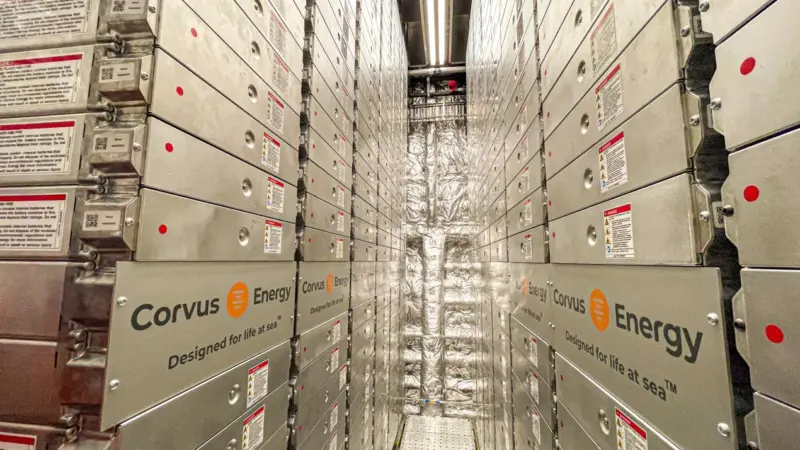
Battery technology is evolving at a rapid rate as more uses cases suggest serious consideration. The ESS on Ampere was a first generation Corvus system with just 1MWh. Since then Corvus – which claims more than 50% of the ESS market has developed a range of systems each designed with a particular type of operation in mind.
As batteries grow larger, owners looking at installing an ESS are requiring higher charge rates especially if charging is to be done using shore power rather than by way of peak shaving. This has raised concerns of safety and especially fires and explosions caused by thermal runaway as more reports of such events occurring in shore-based applications. So far there has been only two safety issues with an onboard ESS. The first was in 2019 on the Norwegian ferry Ytterøyningen which happened after some service operations on the system and the second on the excursion boat Brim – also in Norway -in 2021.
The increased number of deliveries since those two incidents with no further issues having been reported has served to settle some of the fears especially as class societies have become more aware of issues and incorporated the knowledge into their rules and guidance.
Much of the research into new generations of batteries is looking at alternatives to Lithium-ion batteries of various types. When experiencing thermal runaway, Li-ion batteries emit a mixture of gases, including flammable hydrogen and hydrocarbons, and highly toxic and corrosive gases such as hydrogen fluoride and carbon monoxide. Next-generation batteries pose additional risks, releasing gases such as silicon tetrafluoride from silicon anode batteries and hydrogen sulfide from lithium-sulfur batteries.
It is generally accepted that Lithium-ion technology is approaching its limits as regards power density, charging times and safety. However, the alternatives such as Sodium-ion and solid-state batteries are showing promise and could well become mainstream within a few years.
It is reasonable to assume that scepticism around ESS and the benefits hybrid ships can confer is dissipating. As system suppliers become established players rather than being newcomers, this will increase confidence in battery systems as customers can expect the suppliers to devise ways to reduce the cost of cell replacements, which presently suggests may be needed after a working life of around 10 years, thus protecting their investment. The cost savings from improved efficiency and avoided emission charges will also play into the equation.
Related Articles
 BATTERIES, SUPERCAPACITORS, FUEL CELLS AND OTHER ENERGY STORAGE TECHNOLOGY
 BATTERIES, SUPERCAPACITORS, FUEL CELLS AND OTHER ENERGY STORAGE TECHNOLOGY
 BATTERIES, SUPERCAPACITORS, FUEL CELLS AND OTHER ENERGY STORAGE TECHNOLOGY