LR on bridging shipping’s decarbonisation gap
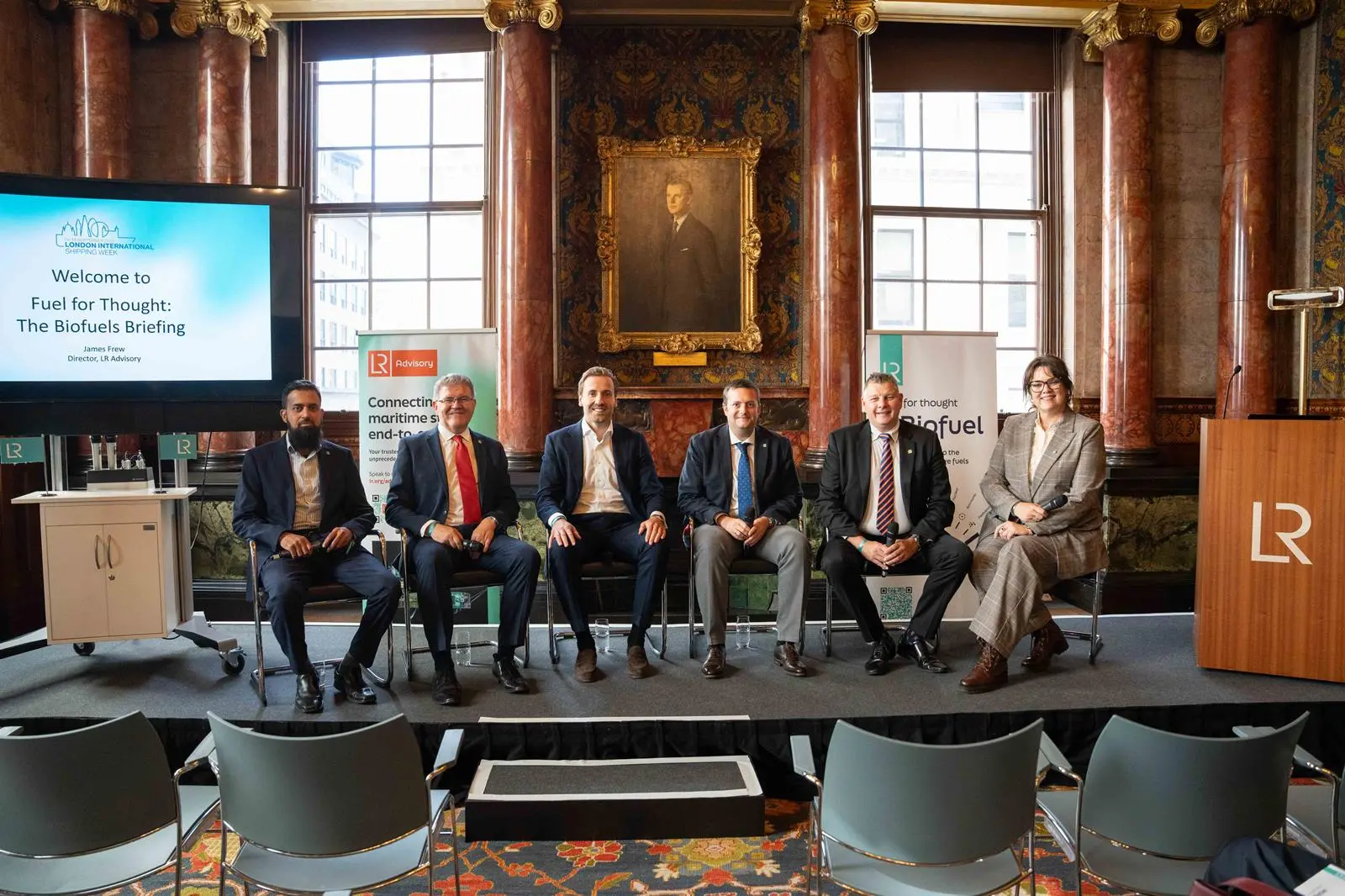
Moderated by LR’s head of external communications Lucy Dibdin, the panel featured Muhammad Usman (FOBAS Product Manager, LR Advisory), Ian Butler (Head of Energy Transition, Vitol), Ashley Jenkins (Director, John H Whitaker Tankers), Alberto Perez, (Regional Advisory Lead, LR Advisory) and Johannes Schurmann (Commercial Director, FincoEnergies). Together, they painted a picture of an industry grappling with regulation-driven demand, operational hurdles, and the uncertainties of a new fuel landscape.
Just five years ago, biofuels were the preserve of early adopters—carriers seeking to satisfy carmakers’ sustainability demands or container lines with green shipping programmes. FincoEnergies’ Johannes Schurmann has witnessed the shift first-hand.
“Back then, the first conversation was always with a sustainability manager,” he recalled. “Today, it’s about price from the outset. Regulation has turned biofuels from a voluntary market into a compliance tool.”
The introduction of FuelEU Maritime and the EU Emissions Trading System (ETS) has been transformative. Vitol’s Ian Butler described how FuelEU’s penalty structure has created a powerful incentive: “The penalty is so high that practically every other alternative is going to be cheaper. That changes the equation for anyone trading into Europe.”
Butler noted that for a trading company without fixed routes, the challenge lies in flexibility. “We don’t have a dedicated line like a container operator. We have to be reactive to where vessels call, and prices vary significantly across regions. Sometimes it’s cheaper to take biofuel in Asia, sometimes in Europe. It’s about optimising globally.”
While regulation is pushing adoption, the panel agreed that certification remains a major stumbling block. FOBAS LR’s Muhammad Usman warned that trust in sustainability claims is paramount:
“The biggest challenge is certification—ensuring the biofuel is truly sustainable and that the industry isn’t exposed to reputational or compliance risks. We’re already seeing a range of exotic feedstocks coming into the market, from cover crops to tire pyrolysis oil. Without robust standards, it’s difficult for operators to have confidence.”
Schurmann reinforced the point. Unlike fossil fuels, which are globally uniform, biofuels are fragmented. “Feedstocks will come from all corners of the world. How do we know they are sustainable, and that there’s no unintended impact on land use or food supply? That complexity is going to be a major challenge.”
For tanker operator John H Whitaker, the hurdles have been practical as well as regulatory. Director Ashley Jenkins described the company’s efforts to adapt its fleet to handle biofuels safely.
“When we started this journey six years ago, we discovered the bio component was classified as a chemical, which created extraordinary challenges,” Jenkins said. “We had oil tankers, but suddenly we were told we were carrying a chemical cargo.”
Working closely with Lloyd’s Register and the UK’s Maritime and Coastguard Agency, Whitaker converted vessels to meet new requirements. Technical modifications—from tank coatings to valves—were manageable, but the real challenge was regulatory clarity. “The MCA were helpful, but they didn’t have all the answers. Much of the heavy lifting had to be done by the shipowner and class.”
On the operational side, Whitaker also faced logistical hurdles. Based in southwest England—far from major bunker hubs like Rotterdam or Singapore—the company has had to maintain segregated storage onboard and manage blending processes in-house. “It’s more complicated than conventional fuels, but it works,” Jenkins said.
Despite the complexity, the panel agreed that biofuels offer shipping a vital bridge in its energy transition. They are compatible with today’s engines, available at scale in certain regions, and can deliver immediate carbon intensity reductions.
Butler suggested that market mechanisms will play a key role in easing the transition. Under FuelEU Maritime, for example, companies can over-comply with one vessel and use the surplus to offset fossil fuel use elsewhere. “That flexibility allows us to manage our fleet as a whole, rather than ship by ship,” he said.
Usman, meanwhile, stressed the importance of continued technical support to build confidence among operators. “We see a lot of questions about suitability—whether a particular biofuel blend will work with a ship’s systems. There’s still uncertainty, but guidance is improving.”
The road ahead
If there was a single takeaway from the discussion, it was that biofuels are not a silver bullet—but they are indispensable in the short to medium term. As Jenkins reflected:
“For nearly a century, this industry ran on heavy fuel oil. Now, we’re facing a much more complex market. The challenge is making sure our fleets, our infrastructure, and our regulations keep pace.”
For now, biofuels represent a necessary and pragmatic step towards decarbonisation. Their ultimate role—whether as a bridging fuel or a long-term fixture—will depend on how well the industry addresses the twin challenges of certification and supply with LR on hand to provide vital advice.