



Robust ro-ro for Northern Lifeline
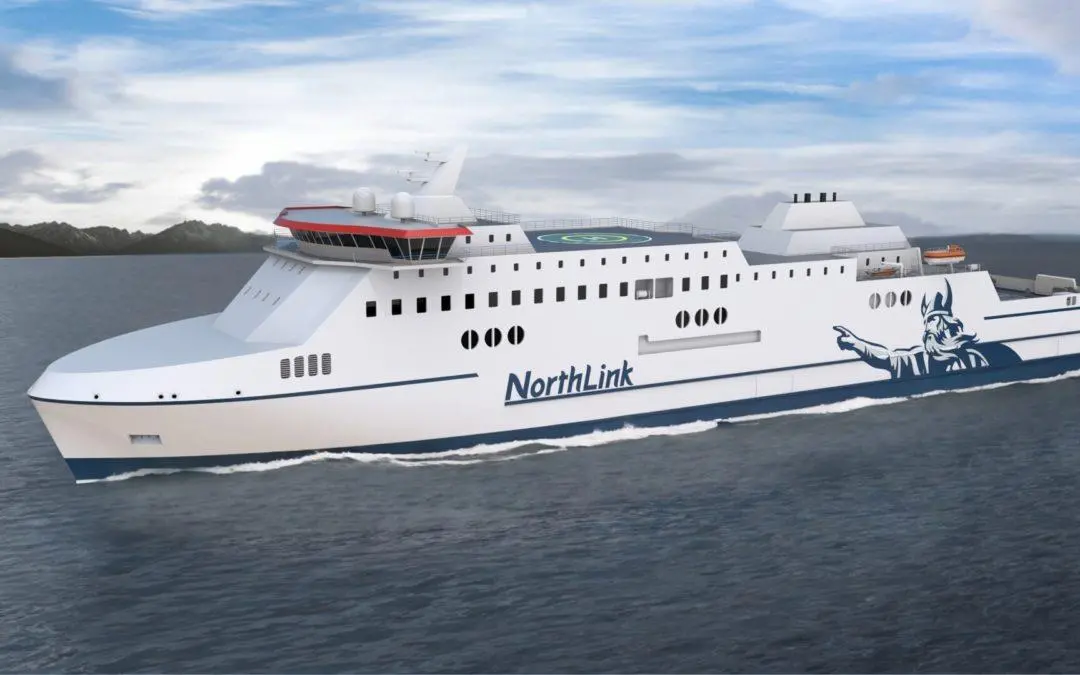
The planned newbuilds will serve the overnight connections between Aberdeen, Kirkwall and Lerwick, one of the most storm-prone, roughest ferry crossings in the British Isles, providing a lifeline between the Northern Isles and Scottish mainland.
Expected to be commissioned in 2029, and dubbed the Freight Flex type, the vessels will supersede two ro-ro freight carriers dating from 1997 and 1999, promising increased year-round resilience as well as boosting capacity by 33%. The dimensions have been maximised for Aberdeen.
Transport Scotland is overseeing the project underwritten by the Scottish Government, referencing a design concept developed by state-controlled Caledonian Maritime Assets (CMAL) and naval architects Leadship Design and Consulting. The NorthLink service to which the vessels will be dedicated is managed and run by Serco, under contract to the Scottish Government. CMAL is the owner of the ferries which maintain both the extensive CalMac network and the NorthLink traffic.
The newbuilds will account for the lion’s share of the estimated £200 million ($267m) cost of the programme, which includes technical support, shore power upgrades and other project expenditure. Besides the major uplift in freight loads to some 1,400 lane-metres, the vessels will have higher operating speeds than their forebears, and a flexible accommodation design that will allow the 12-driver capacity in freight mode to be upped to 200 passengers during peak seasons.
Following the initial stage of the competitive tender process, the four concerns selected to progress to tender stage are Cemre Marin Endustri and Tersan Shipyard, both of Turkey, Guangzhou Shipyard International (GSI) of China, and China Merchants Jinling Shipyard, the latter acting in concert with the UK arm of the Stena organisation.
The two Turkish builders have both increased their standings over recent years in the international ferry newbuild market, with Cemre currently producing a four-ship series for CMAL and the CalMac operation. For its part, GSI has emerged as a prolific supplier of short-sea ro-pax ferries to European operators, while CMJL now is synonymous with the production of Stena RoRo’s E-Flexer series deployed and ordered by multiple companies worldwide, including Stena Line itself.
Significantly, Stena RoRo has lately added a 140m version to its E-Flexer range, hitherto constructed to lengths varying from 195m to 240m.
The two newbuilds are destined to supersede the 122m ro-ros Helliar and Hildasay on the Serco NorthLink service. Completed 28 and 26 years ago, respectively, by southern Spanish shipbuilder Astilleros de Huelva, each offers a ro-ro intake of 1,055 lane-metres and just 12 passenger/driver berths. Twin Wartsila 32-series diesels give a combined output of 7,400kW for a speed of 17 knots.
The Freight Flex generation is also expected to ease pressure during the summer season and other peak periods on the 2002-built NorthLink ro-pax vessels Hjaltland and Hrossey.
The new ships will provide flexibility in power and speed settings, providing a maximum 20 knots on certain schedules and with time-sensitive freight. The propulsion configuration has yet to be determined. The fuel choice is not an easy decision due to the operational profile and the distances NorthLink vessels have to cover in a single sailing, typically involving 12-hour crossings.
It is understood that CMAL and Serco NorthLink have considered low-sulphur marine gas oil (MGO) (less than 0.1% sulphur content) with methanol-ready and potentially bio-diesel capable engines, as well as MGO/LNG dual-fuel plant. In addition, large battery packs have been examined as part of the specification, for peak-shaving and manoeuvring within ports.
Technical studies have also looked into ensuring full redundancy to ensure a speed of 14 knots in the event of either ‘side’ of the propulsion plant failing.
Serco won the first Northern Isles Ferry Services contract in 2012, and its current operating franchise ends on 30 June 2028. Traffic has grown substantially on all fronts in the interim, and one of the local economic effects is that Serco now sources over 80% of food, beverage and retail services from within a 50-mile radius of the operating ports.
Bids for the construction of two 140-metre, short-sea freight ferries have been invited by Scotland’s national transport agency from a shortlist of four shipyards. Tenders will have to be submitted to Transport Scotland by the start of December this year, with a view to a contract being awarded in February 2026.
Related Articles
 ELECTRIFICATION AND BATTERY HYBRIDS
 ELECTRIFICATION AND BATTERY HYBRIDS
 ELECTRIFICATION AND BATTERY HYBRIDS