EXCLUSIVE: Ships trial methane removal technology
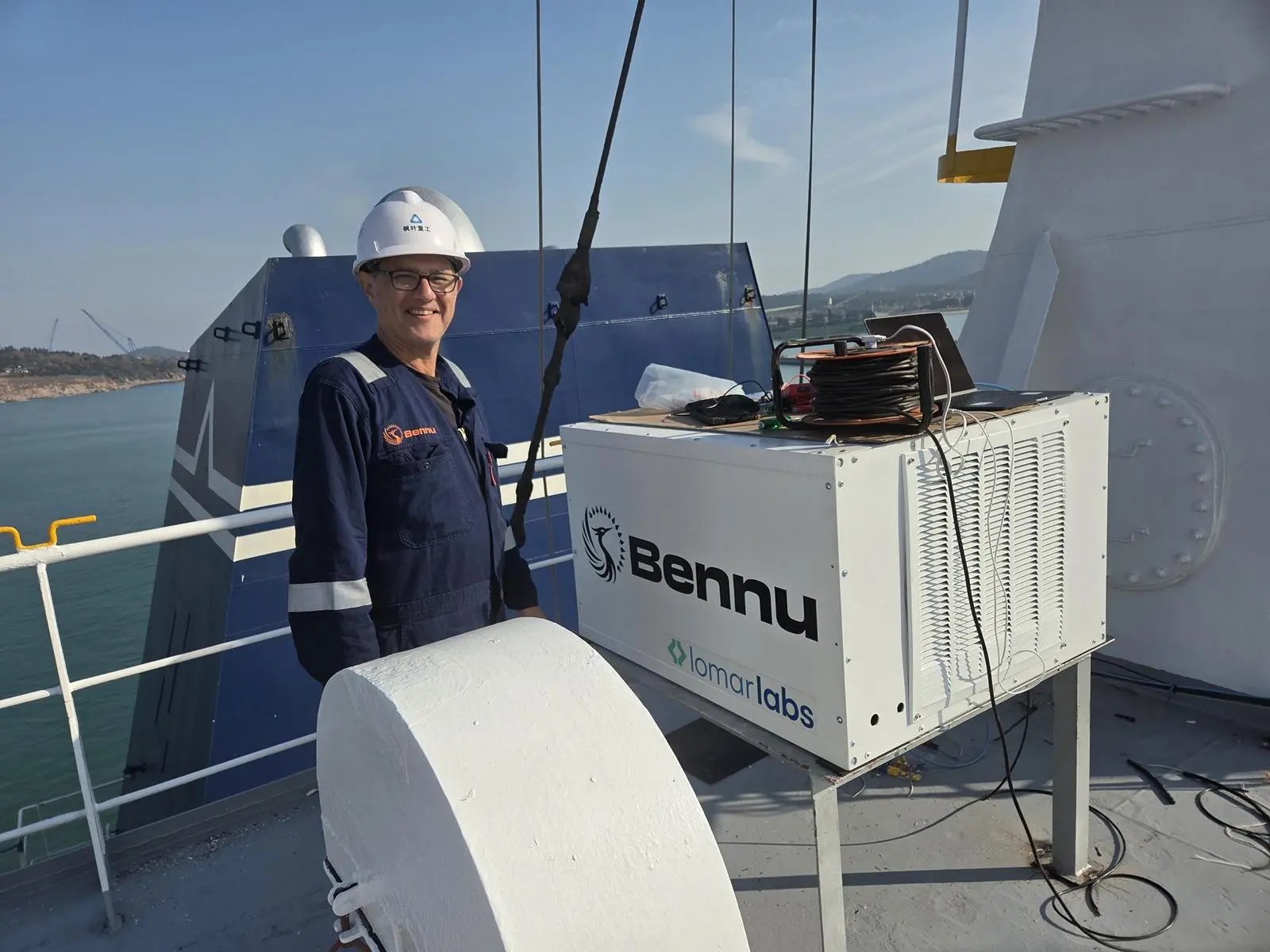
Climate technology firm Bennu Climate has partnered with maritime innovation venture catalyst lomarlabs to deploy a methane removal system aboard a Supramax bulk carrier owned by Lomar. The 12-month pilot will evaluate how effectively the compact device can eliminate fugitive methane emissions while the vessel remains in full commercial service.
The system, roughly one cubic metre in size and weighing 50 kilograms, is designed to be installed without disrupting operations. Using advanced photochemistry, it breaks down methane molecules before they can enter the atmosphere and contribute to global warming. The trial is believed to be the first time such a technology has been tested continuously at sea under real trading conditions.
Methane is widely recognised as a potent greenhouse gas, with a significantly higher short-term warming impact than carbon dioxide. While shipping accounts for a relatively small share of global methane emissions, the rise of liquefied natural gas as a marine fuel has brought increasing attention to methane slip and other fugitive emissions across the fuel supply chain.
‘Fugitive emissions’
David Henkel-Wallace, co-founder and chief executive of Bennu, told The Motorship that the pilot is focused on capturing emissions that are otherwise difficult to prevent. “This pilot with lomarlabs is designed to scavenge ‘fugitive emissions’, that is emissions that have already escaped into the atmosphere,” he explained.
“Fugitive emissions come from LNG handling where prevention isn’t feasible, so methane ends up leaking into the air which is where it causes climate problems.”
According to Henkel-Wallace, the unit is expected to remove all methane that passes through it, albeit from relatively low concentrations in ambient air. “In dispersed air, that’s not a huge amount, around 15–20 tonnes of methane a year, which is roughly equivalent to 700 tonnes of CO2,” he said.
He added that in more concentrated applications, such as floating storage and regasification units, the same technology could remove significantly larger volumes, potentially reaching tens of thousands of tonnes annually.
At this stage, performance data will be collected and analysed internally, with discussions underway involving verification bodies and classification societies to independently validate the results.
Commercial case
The commercial case for the technology is closely tied to tightening environmental regulations, particularly in Europe. From 2025, shipowners will be required to report verified methane slip under FuelEU Maritime and the EU’s Monitoring, Reporting and Verification framework. Methane emissions are also due to be incorporated into the EU Emissions Trading System from 2026, adding a direct financial incentive to reduce releases.
Henkel-Wallace said these measures could enable rapid payback for operators installing the system. “In most cases, systems subject to emissions penalties should pay back installation within the first year,” he noted, adding that vessels trading between Europe and Asia could recover costs in about 12 months through reduced compliance expenses.
LNG’s role as a transition fuel
Beyond economics, the trial also feeds into a broader debate about LNG’s role as a transition fuel. While LNG offers lower carbon dioxide and pollutant emissions compared to conventional marine fuels, concerns about methane leakage have raised questions about its long-term viability.
Henkel-Wallace argued that methane removal technologies address an immediate problem without undermining the shift to zero-emission alternatives. “Our mission is to remediate the damaging methane emissions which will be generated regardless until the transition happens,” he said. He pointed to structural changes in global energy markets, including the growing competitiveness of renewables and alternative fuels, as key drivers of that transition.
However, he acknowledged that the long lifespan of vessels means LNG-powered ships will remain in operation for decades, even as cleaner options emerge. In that context, onboard methane mitigation could serve as an interim solution, reducing climate impact while the industry gradually moves toward zero-emission propulsion.
The outcome of the pilot will be closely watched across the maritime sector, as regulators, shipowners and charterers seek practical ways to meet increasingly stringent climate targets without compromising commercial performance.