Ship arrest system trials pronounced successful
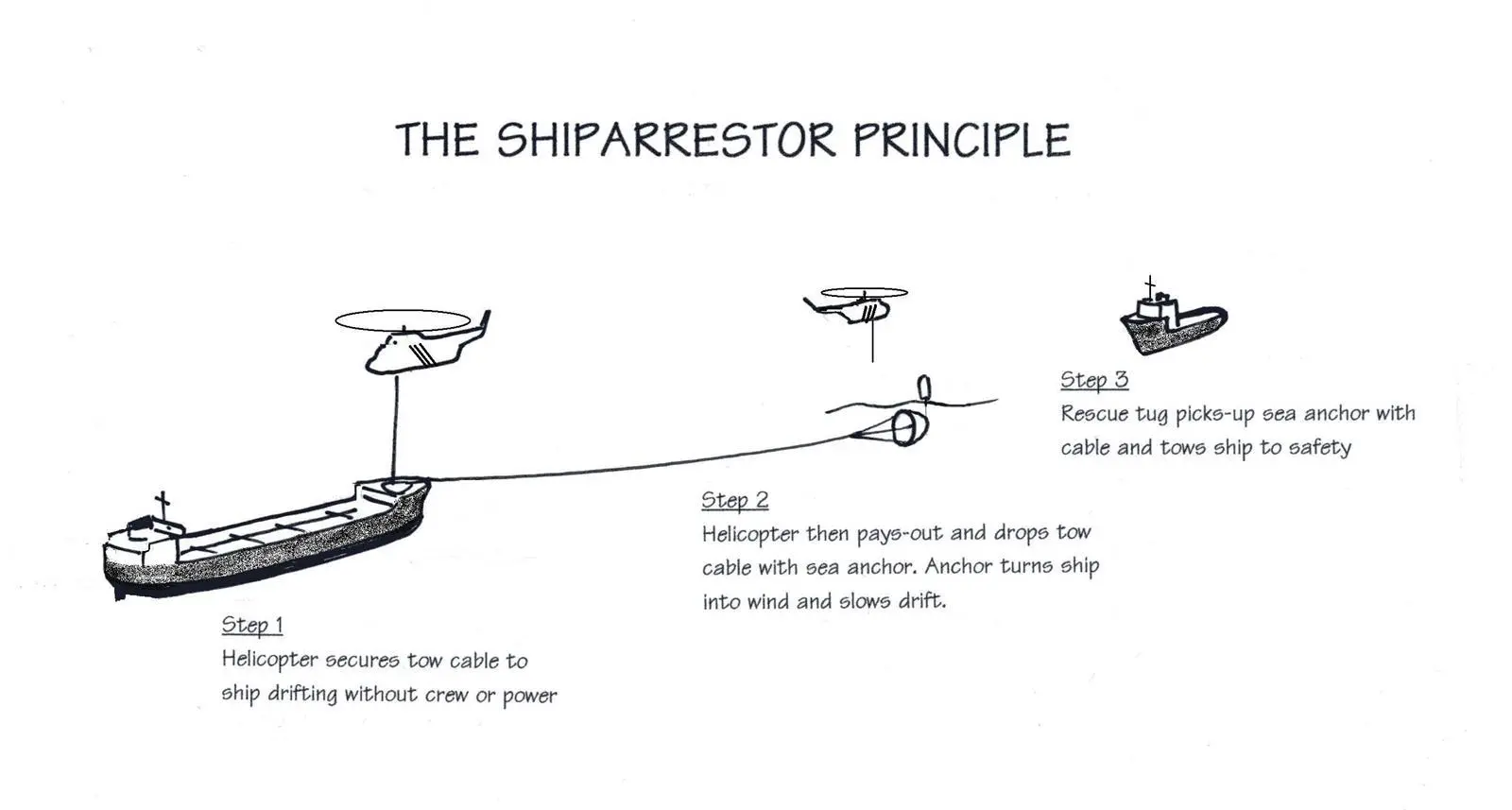
By reducing the speed of the ship’s drift, the ShipArrestor increases the time available for rescue tugs to reach the vessel before it runs aground with potentially severe environmental consequences.
The trial was undertaken by Miko Marine in association with the Norwegian Technical Institute and Norway’s Coastal Administration. It took place off the north coast of Norway using the 120,000 ton LNG tanker Arctic Princess which was made available by Hoegh LNG and Statoil.
The tests were conducted in two phases, the first being with a helicopter operated by Luftransport that successfully ‘lassoed’ the winch gear and bollards on the foredeck of the Arctic Princess. This was accomplished with a replica of the connecting ring and the lightweight chain that will be used in reality. Although it had the weight and handling characteristics of the real chain, it was decided that a mock-up should be used to avoid the chain causing damage to the ship. The helicopter pilot encountered no problems attaching the tow line to the ship and in releasing it correctly and Miko Marine is now confident that it is a viable procedure, even in poor weather.
The second phase of the trial was completed shortly afterwards. It tested the performance of the sea anchor itself, using a 30 m diameter nylon parachute anchor deployed from the Arctic Princess by a tug. It turned the tanker up into the wind in less than 20 minutes and reduced its rate of drift by 58%. Although this was thought to be a satisfactory result, the company says that it has identified some small design improvements that can be made to the sea anchor to improve performance further.
Miko has employed mathematical modelling to identify the size of sea anchors needed for ships of different tonnages. This impacts upon the sea anchor’s weight and its ability to be carried by helicopter. Similar constraints apply to the tow line which must be strong and also capable of resisting abrasion against the ship’s winch and gunwhale. This has led to the development of a lightweight chain that is half the weight of conventional chains offering the same performance.
It is also believed that the research will lead to the development of sea anchors that can be permanently carried aboard ships for emergency use. The recent loss of a jack-up platform for windfarm installation from a heavy lift vessel when its engines failed in mid-Atlantic is a demonstration of the dangers arising from excessive roll when a ship is unable to turn into the wind. Miko Marine is confident that a solution now exists for this type of hazard.
Miko Marine holds the patent for the ShipArrestor principle which is being developed with help from an EU investment grant and a consortium of eight European organisations.