Deck gear suppliers look offshore
Companies like Cargotec subsidiary MacGregor reported plenty of activity in the hatch cover and crane sectors, but, looking to a bleaker future, attention stepped up in the offshore field, this being a relatively buoyant area.
It was the offshore sector that provided the more newsworthy innovations. Several companies were looking at the need for drilling operations to move to deeper water, and the implications for this on the support vessels ad their equipment. One of the big problems is that the sheer weight of conventional steel wire ropes makes its use impracticable for use over certain depths, providing a challenge for the next generation of anchor handling vessels. Other challenges involved in working in deeper water involve safety issues, and the sheer costs involved.
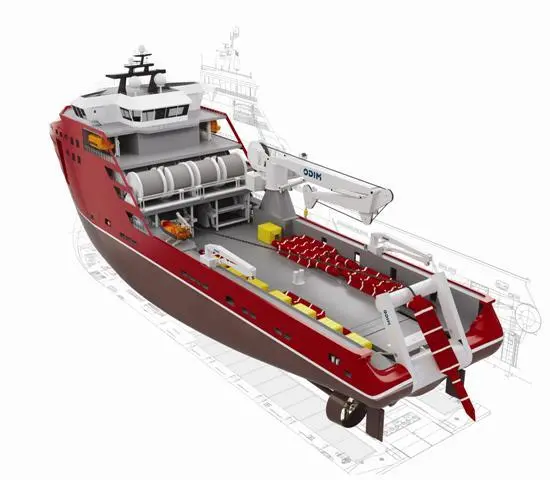
Norwegian company Odim claimed to be the first to address these issues with a new concept for deep-water operations, which it called the ‘Smart AHTS’. The winches and cable drums have been specially developed to handle very long lengths of polyester rope, which is considerably lighter than wire rope of equivalent strength, but has significantly different characteristics.
The CTCU (cable traction control unit) technology allows 35,000m of rope to be stored onboard and enables rapid deployment with the tension controlled at all times and in all sea states. Although the system can be used with conventional moorings, and DP rigs, its main application is with the pre-set moorings that are gaining popularity for deep-sea rigs. DP is highly suitable, according to Odim, for short-term operation, as little advance preparation is required for setting moorings, but the need to have thrusters constantly operating carries a heavy fuel consumption penalty, and thus a rise in emissions.
Pre-set moorings, according to Odim, have the advantage that they can be installed with a single Smart AHTS vessel rather than the more normal three. This can result in significant cost savings, making the system cost-competitive for tasks as short as 10 days. The company foresees greater use of floating drilling and production units, which lend themselves well to such mooring systems.
Other component parts in the Smart AHTS concept include the secondary winches, the Odim LARS (launch and recovery system), a versatile anchor handling frame, and custom-designed cranes.
In larger vessels, the major advances in cargo handling – as well as some other areas – in 2009 came in the LNG sector. Hamworthy Engineering successfully concluded trials of its re-liquefaction system, developed in conjunction with Kongsberg and Atlas Copco, and based on Moss technology. This particular unit has been developed for re-liquefying boil-off gas to be returned to the cargo tanks. Further re-liquefaction plants have been developed, and were tested and delivered by Hamworthy in 2009, for dual-fuel diesel-electric powered ships, and for shuttle regasification vessels, which transport and store LNG, and then vaporise it into natural gas that can be piped ashore. The company says that the major challenge in designing and building such plant for shipboard use is the limited space; onboard ship cargo capacity must be maximised.
Hamworthy further secured six shipsets of cargo equipment for Pertamina, one for a 5,000m3 LPG carrier, and five for a series of 30,000 dwt product carriers, all being built in China. The product tanker equipment includes electrically driven cargo pumps, ballast pumps, stripping pumps and engine room pumps, all controlled by a PLC system.
UK company PSM introduced a simplified digital cargo monitoring system, which allows full tank monitoring using far less cabling, thus easing installation, improving reliability and reducing costs.