The dilemma of piracy
In response to this phenomenon, shipowners and operators have begun implementing anti-piracy measures to lower the risk under guidance from the IMO but it is debatable just how effective these recommendations are against the current piracy epidemic, particularly off the Horn of Africa.
In January 2009, Somalia and other countries adopted the “Repression of Piracy and Armed Robbery against Ships” in the Western Indian Ocean and the Gulf of Aden for which the IMO secretary general, Efthimios Mitropoulos, stressed the importance of its effective implementation.
The Prime Minister of Somalia said that pirates would be prosecuted within Somalia and that the country is reviewing its national legislation and would like help from the IMO. In response, Mitropoulos said he, in conjunction with his counterparts at the UN Office on Drug and Crime (UNODC), would provide the requested aid. In addition, IMO will, through its technical cooperation programme and assistance from member states, help Somalia establish a national coast guard.
Although the coordinated action by governments in providing military support in the shape of a multi-national naval force patrolling the area has, undoubtedly, made the Gulf of Aden a safer place, piracy has not been eliminated in this area. Rather, it has merely been suppressed to some degree and, if anything, there has been an upsurge in ever more audacious attacks being conducted in the Somali Basin, deep into the Indian Ocean.
For its part, the shipping industry has adopted best management practices (BMPs) which are a living document in that they can be adjusted to evolving tactics to fight piracy.
To arm or not to arm?
To tackle the effects of piracy there are a number of options including whether ships should be armed. Here the industry position is fragmented with some ship operators already arming their vessels while others are adamant that arms should not be used.
Arming ships carries a danger of escalating the level of violence and this has led to the development of non-lethal means of protecting ships. Companies such as BCB International in the UK and Scanjet Marine AB in Sweden have developed systems which claim to be effective against pirates.
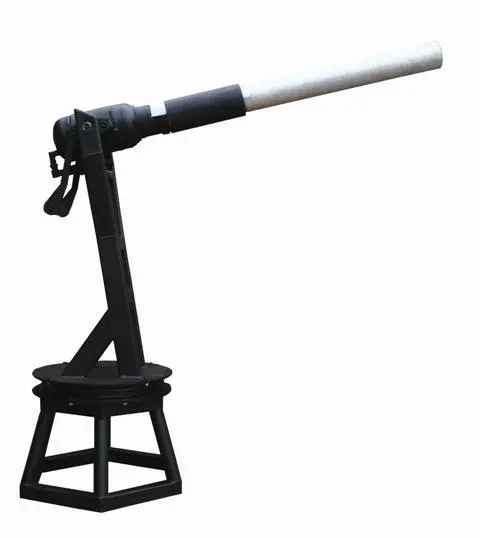
BCB is marketing its Buccaneer ship-borne shore launcher (SBSL) which resembles a breach loading swivelling canon mounted on a robust slew-ring tripod base. The system uses compressed air to fire a variety of projectiles, initially using it as a warning deterrent at longer range up to 400m, with less than lethal projectiles. Should any pirate skiff then continue to press home its attack, the power and lethality of the projectiles used can be increased to further deter any attack or to stop the attackers.
It is debatable just how effective this system can be against fast moving skiffs and pirates will inevitably concentrate the firepower of their automatic weapons and rocket propelled grenades on the SBSL to put it out of action.
The Scanjet anti-pirate water cannon system seems, on the face of it, more promising. The system is based on the company’s existing tank cleaning technology and the patented water cannon system is powered by an integrated turbine driven by the water flow. The system can be remotely and safely operated from any look out post around the vessel and, by strategically placing several water cannons around the vessel, 100% coverage can be obtained rendering boarding very difficult.
Another solution is to embark a security team to repel pirate attacks using long-range acoustic devices (LRADs) and small arms fire. By far the most effective anti-piracy solution, however, is for merchant vessels to sail in convoy under the protection of an adequate naval escort.
Conclusion
The commander of the Somali Coast Guard has said that piracy would not be curbed unless, and until, illegal fishing by foreign nations is stopped. He explained that the illegal fishing and exploitation of Somali’s marine resources were the main factors which encouraged desperate young men to head to sea to defend their livelihood. The problem is further compounded by the difficulty of trying to establish a stable government in Somalia which could well take years if not decades.
The unacceptable situation prevailing now, where the lives of seafarers are threatened on a daily basis will, unfortunately, not be resolved until those two issues are resolved.