Pre-treatment system claimed to reduce OWS filer costs
According to the company, ever since 2005, when the MEPC 60(33) regulation was replaced by MEPC 107(49), older gravity-type oily water separators (OWS) often had to be replaced by a centrifugal type or an emulsion breaking cleaning system or, alternatively, the shipowner chose to complement the existing OWS with additional filters. In addition, many new separators sold today act by using exchangeable filter cartridges.
The filter option, involving the least initial investment, has, however, shown to become a costly option for many operators. In many cases, filters need to be changed several times per month and sometimes even more often. Marinfloc says that annual filter costs of well above $50,000 per year are not uncommon.
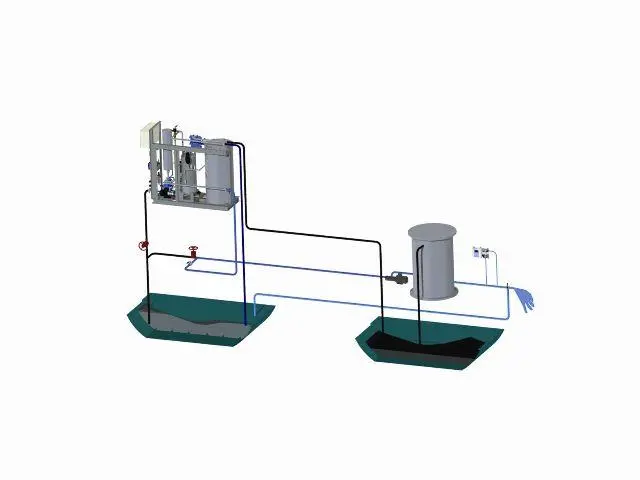
The Swedish manufacturer has addressed this problem by launching a new pre-treatment system called CD pre-T. By keeping the existing certified OWS, and connecting the CD pre-T in line with the OWS, filter changes are said to become virtually unnecessary. With the Marinfloc CD pre-T breaking the emulsion and cleaning the water down to 15ppm, the existing OWS acts primarily as a pump, discharging clean water overboard.
Since the new CD pre-T is to be installed before any existing OWS, independent of type or make, no changes or new certificates are necessary and the investment cost for the pre treatment system is easily balanced against filter costs and the effort and time it takes to change them. Marinfloc claims the payback time is less than one year for many ships with challenging bilge water.
The emulsion breaking step of the CD Pre-T uses forced flotation together with a flocculent. After this step the cleaned bilge water with less then 15 ppm of oil is led back through a three-way valve into the present OWS suction line and is pumped overboard through the existing OWS and controlled by the present oil content meter. Alternatively, the CD Pre-T discharges the cleaned bilge water into a separate tank, from which the existing OWS can take its suction.
The first two systems to be launched by Marinfloc have a capacity of 1,000 litres/h, measuring 1.5m x 0.7m, and 250 litres/h, measuring 0.8m x 1.2m. The company says that a larger 2,000 litres/h system is to be launched soon.